
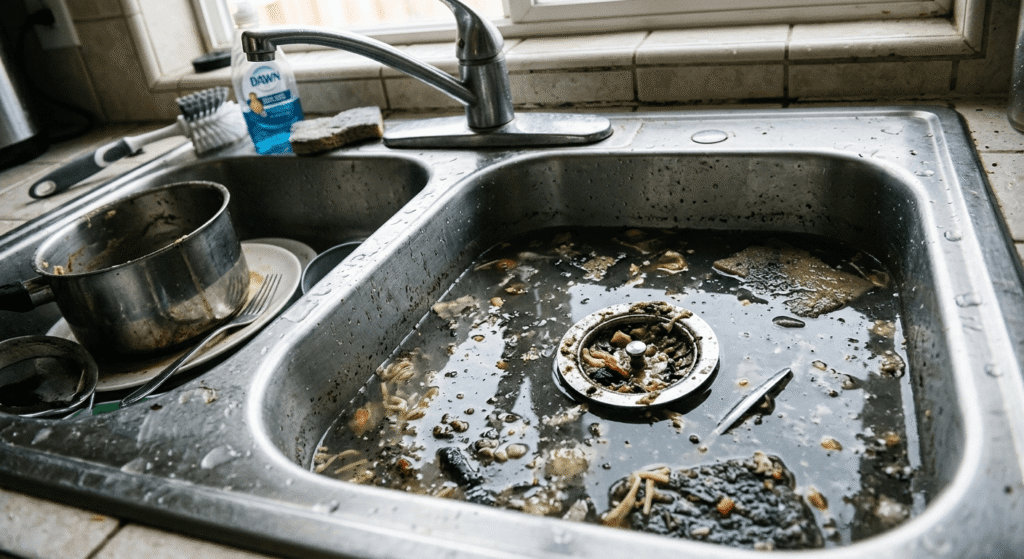
Drain problems affect nearly every home and range from a slow-draining sink to a fully blocked sewer line. Grease buildup, hair, soap scum, food waste, foreign objects, and pipe corrosion cause most household drain failures. Each cause produces distinct warning signs, including slow drainage, gurgling sounds, foul odors, water backup, and visible leaks.
Homeowners can diagnose many drain problems through simple observation and basic testing before calling a professional. A clogged sink often responds to mechanical clearing methods, while a failing pipe requires repair or replacement by a licensed plumber. Correct diagnosis determines whether a problem needs a five-minute fix or a full pipe repair.
This article explains the most common drain problems, the signs that indicate pipe damage, and the specific causes behind clogs and slow drainage. It also covers safe grease disposal, at-home diagnostic tests, step-by-step repair methods, and the point at which a professional plumber becomes necessary.
What Are the Most Common Drain Problems?
The most common drain problems are clogged drains, slow drainage, gurgling sounds, foul odors, water backup, and pipe leaks. Clogged drains form when grease, hair, soap scum, food waste, or foreign objects restrict water flow through a pipe. Slow drainage occurs when a partial blockage narrows the interior diameter of a pipe. Gurgling sounds and foul odors indicate trapped air or decomposing organic material inside the drain line. Water backup happens when a blockage forces wastewater to return through a fixture instead of flowing away from it. Pipe leaks develop from corrosion, physical damage, or loose pipe joints.
These problems occur in kitchen sinks, bathroom sinks, tubs, showers, and floor drains. Kitchen drains clog most frequently due to grease and food debris. Bathroom drains clog most frequently due to hair and soap scum. Each problem type requires a different diagnostic approach and repair method, covered in the following sections.
Signs Your Drain Pipes Are Broken or Failing
Broken or failing drain pipes produce slow drainage, gurgling sounds, foul odors, water backup, and visible leaks. These signs indicate a blockage, a structural pipe failure, or both. A single sign may point to a minor clog, while multiple signs occurring together often indicate a more serious pipe condition.
Each sign has a distinct cause and requires a specific diagnostic response, detailed in the subsections below.
Slow or Sluggish Draining
Slow or sluggish draining occurs when a partial blockage restricts water flow through a pipe. Water pools in the sink, tub, or shower basin instead of draining at a normal rate. The restriction typically results from grease buildup, hair accumulation, or mineral deposits narrowing the interior wall of the pipe.
Slow draining that affects a single fixture usually indicates a localized blockage near that fixture’s trap or branch line. Slow draining that affects multiple fixtures at the same time indicates a blockage farther down the main drain line. A gradual decline in drainage speed over several weeks signals a growing buildup rather than a sudden obstruction.
Gurgling or Bubbling Sounds
Gurgling or bubbling sounds occur when trapped air escapes through standing water in a drain or trap. The sound indicates a partial blockage that disrupts normal airflow through the venting system. Air becomes trapped behind the obstruction and forces its way back through the water, creating audible bubbles.
Gurgling that occurs when running one fixture affects the sound or drainage of a nearby fixture often points to a shared vent or drain line blockage. A toilet that gurgles when a nearby sink drains indicates a blockage in the shared branch line connecting both fixtures.
Persistent Foul Odors
Persistent foul odors come from decomposing organic material trapped inside a drain, a dry trap that no longer blocks sewer gas, or a cracked vent pipe. Food particles, grease, and soap scum decompose inside the pipe and release sulfur-based gases. A dry P-trap allows sewer gas to enter the home directly through an unused fixture.
An odor limited to one fixture usually traces back to organic buildup in that fixture’s trap or branch line. An odor present throughout the home suggests a dry trap, a venting problem, or a crack in the main sewer line.
Water Backing Up Into Sinks or Tubs
Water backing up into sinks or tubs occurs when a downstream blockage forces wastewater to reverse direction and return through a connected fixture. The backup typically appears in the lowest fixture in the plumbing system, such as a basement floor drain or a ground-floor tub. Water or waste rising in one fixture after using another fixture indicates a shared drain line obstruction.
Backup affecting only one fixture points to a blockage in that fixture’s individual trap or branch line. Backup affecting multiple fixtures, especially the lowest fixtures in the home, points to a blockage in the main sewer line.
Visible Leaks or Pipe Damage
Visible leaks or pipe damage appear as water stains, pooling water, corrosion, or physical cracks on or near a drain pipe. Metal pipes show green or white corrosion deposits at joints and fittings. Plastic pipes show cracks, warping, or separation at connection points. Leaks commonly appear under sinks, around tub and shower drains, and along exposed basement piping.
A leak combined with slow drainage or gurgling often indicates that pipe damage and a blockage exist together. Water damage to cabinetry, flooring, or ceilings below a fixture confirms an active leak that requires prompt repair.
What Causes Drains to Clog or Stop Draining
Drains clog or stop draining due to grease and oil buildup, hair and soap scum accumulation, food waste and debris, foreign objects, and pipe corrosion or age-related wear. Each cause narrows or blocks the interior of the pipe, restricting or fully stopping water flow. Kitchen drains clog primarily from grease, oil, and food waste. Bathroom drains clog primarily from hair and soap scum. Older plumbing systems develop additional blockages from internal corrosion and scale buildup.
The following subsections explain how each cause develops and which fixtures it affects most.
Grease and Oil Buildup
Grease and oil buildup clogs drains when liquid fat cools inside the pipe and solidifies against the interior wall. Grease enters the drain as a warm liquid, then hardens as it moves through cooler sections of pipe. The hardened layer traps food particles and other debris, gradually narrowing the pipe’s interior diameter until water flow slows or stops.
Grease buildup occurs almost exclusively in kitchen drains connected to sinks and garbage disposals. Repeated grease disposal over time creates a compounding blockage that standard water flow cannot clear.
Hair and Soap Scum
Hair and soap scum clog drains when loose hair strands combine with soap residue to form a dense, sticky mass inside the pipe. Soap scum consists of fatty acids from soap that bind with mineral deposits in water. Hair strands catch on this residue and on the drain stopper mechanism, accumulating into a blockage over repeated use.
This clog type occurs most frequently in bathroom sinks, tub drains, and shower drains. The blockage typically forms at or near the drain stopper, where hair collects most consistently.
Food Waste and Debris
Food waste and debris clog drains when solid particles fail to break down and pass through the pipe. Coffee grounds, rice, pasta, eggshells, and fibrous vegetable matter resist breakdown by a garbage disposal and accumulate inside the drain line. These particles combine with grease residue to form a compacted blockage.
Food-related clogs occur primarily in kitchen sinks with or without a garbage disposal. Disposal use reduces particle size but does not eliminate the risk of blockage when large volumes of debris enter the drain at once.
Foreign Objects
Foreign objects clog drains when solid items enter the pipe and become lodged at a bend, joint, or narrowing point. Common foreign objects include hygiene products, cotton swabs, dental floss, small toys, and jewelry. These items do not dissolve or break down in water and physically obstruct the pipe.
Foreign object blockages occur in bathroom sinks, tubs, showers, and toilets. The obstruction typically forms at the trap or at the first significant bend in the pipe, where the object’s shape or size prevents further movement.
Pipe Corrosion or Age-Related Wear
Pipe corrosion or age-related wear clogs drains when internal rust, scale, or mineral deposits build up on the interior pipe wall and reduce its diameter. Galvanized steel pipes corrode from the inside as the zinc coating wears away, exposing the underlying metal to rust. Older cast iron pipes accumulate scale deposits that narrow the passage over decades of use.
This cause primarily affects homes with plumbing systems older than 40 to 50 years. Corrosion-related blockages develop gradually and often combine with reduced water pressure and discolored water.
Can You Pour Oil or Grease Down the Drain?
Oil and grease should not be poured down a drain because they solidify inside the pipe and cause blockages. Liquid fat cools as it travels through the pipe, hardening against the interior wall and reducing the pipe’s usable diameter. Repeated disposal compounds this buildup and increases the likelihood of a full blockage.
The following subsections explain why oil and grease cause this damage and whether water temperature changes the outcome.
Why Oil and Grease Damage Drain Pipes
Oil and grease damage drain pipes by solidifying against the interior wall and trapping food particles, hair, and other debris. Fat remains liquid only while hot. As the liquid moves away from the heat source, it cools below its melting point and converts to a solid or semi-solid state inside the pipe.
The solidified layer creates a rough, sticky surface that catches additional debris with each subsequent use. Over weeks or months, this layered buildup narrows the pipe’s interior diameter until water can no longer pass through at a normal rate.
Does It Matter If the Water Is Hot?
Hot water does not prevent grease from solidifying inside a drain pipe. Hot water keeps fat in a liquid state only within the section of pipe still exposed to that heat. Once the water and grease travel further into the plumbing system, or once the water cools, the fat returns to a solid state at the same rate as if cold water had been used.
Grease that reaches a municipal sewer line combines with grease from other sources and contributes to fatberg formation, a large mass of solidified fat, oil, and debris that blocks sewer infrastructure. Hot water disposal delays visible clogging in a single household drain but does not eliminate the underlying buildup.
What to Do If You Already Poured Oil or Grease Down the Drain
If oil or grease has already gone down a drain, flush the pipe immediately with hot water and dish soap to help break up the fat before it fully solidifies. This response works best within a short time after the grease enters the pipe. Once the grease has cooled and hardened, additional water alone will not clear the blockage.
The following subsections outline the correct immediate response, when hot water and dish soap provide real benefit, and when to stop DIY efforts.
Immediate Steps to Take
The immediate response to pouring oil or grease down a drain includes running hot water for several minutes, adding dish soap to break down the fat, and avoiding additional grease disposal until the pipe clears. Hot water keeps the fat in a liquid state long enough to move it further through the plumbing system. Dish soap breaks the fat into smaller droplets that pass through the pipe more easily than a solid mass.
Avoid pouring additional grease down the same drain while addressing an existing spill, since added fat increases the total volume available to solidify and worsens the blockage risk.
When Hot Water and Dish Soap Actually Help
Hot water and dish soap help most within the first few minutes after grease enters the drain, before the fat has time to cool and adhere to the pipe wall. The combination emulsifies the fat, breaking it into smaller particles suspended in water rather than one solid mass. This process works reliably for small amounts of grease in a drain with no existing buildup.
Hot water and dish soap provide limited benefit against grease that has already hardened over time or against a blockage combined with hair, food debris, or foreign objects. In these cases, the fat has already bonded to the pipe wall and requires mechanical removal rather than dissolution.
When to Stop DIY Attempts and Call a Plumber
Stop DIY grease-clearing attempts and call a plumber when hot water and dish soap fail to restore normal drainage after two or three attempts, or when signs of a deeper blockage appear. These signs include water backing up into other fixtures, gurgling sounds from nearby drains, or a complete stop in water flow.
Continued DIY attempts beyond this point risk pushing the blockage further into the plumbing system, where it becomes harder to access and remove. A plumber can use mechanical or hydro-jetting equipment to clear grease buildup that home remedies cannot reach.
How to Diagnose a Drain Problem Yourself
A drain problem can be diagnosed at home through observation of drainage speed, sound, odor, and fixture-specific behavior. Running water in each fixture and noting how it drains identifies whether a blockage is localized or affects the broader plumbing system. Comparing results across multiple fixtures narrows down the likely location of the problem before calling a professional.
The following subsections describe specific tests and how to interpret results by fixture type.
Simple At-Home Tests
Simple at-home diagnostic tests include running water in each fixture individually, flushing the toilet while another fixture drains, and inspecting visible pipes for leaks or corrosion. Running water in one sink at a time and timing how quickly it drains identifies whether the slowdown is isolated to that fixture. Flushing the toilet while running water in a nearby sink reveals whether the two fixtures share a blocked branch line, indicated by gurgling or backup in either fixture.
Inspecting exposed pipes under sinks and in basements for moisture, discoloration, or corrosion identifies leaks that may not yet show visible water damage. Removing and checking a sink stopper or drain cover directly for trapped hair or debris confirms a surface-level blockage without professional equipment.
Reading the Signs by Fixture (sink vs. tub vs. floor drain)
Reading drain signs by fixture means matching the observed symptom to the fixture type most likely to reveal its cause. A slow-draining kitchen sink most often indicates grease or food debris buildup, while a slow-draining bathroom sink or tub most often indicates hair and soap scum accumulation. A floor drain that backs up or gurgles typically indicates a blockage in the main sewer line, since floor drains sit at the lowest point in the plumbing system.
A tub that drains slowly only during or after a shower points to hair caught at the drain stopper. A sink that gurgles when the dishwasher runs points to a shared branch line blockage between the two fixtures. A floor drain producing sewer odor without any water backup often indicates a dry trap rather than a blockage.
How to Fix Common Drain Problems
Common drain problems can be fixed through mechanical clearing, chemical-free drain maintenance, and targeted pipe repair, depending on the specific cause identified during diagnosis. A surface-level clog responds to a plunger or drain snake. A deeper blockage may require an auger or professional hydro-jetting. Minor pipe damage requires sealing or section replacement rather than clog-clearing methods.
The following subsections address specific fix methods for clogs, slow drainage, odors, and minor pipe damage.
Clearing a Clogged Drain
A clogged drain can be cleared using a plunger, a drain snake, or a manual auger, depending on the blockage’s depth and composition. A plunger creates pressure that dislodges a blockage near the drain opening, working best on sink and tub clogs caused by hair or soap scum. A drain snake or auger reaches further into the pipe and physically breaks apart or retrieves a blockage that a plunger cannot dislodge.
Insert the drain snake into the pipe, rotate it forward until resistance decreases, then withdraw it slowly to remove trapped debris. Run hot water through the drain after clearing to flush remaining loose material from the pipe.
Fixing a Slow-Draining Sink or Tub
A slow-draining sink or tub can be fixed by removing the stopper, clearing trapped hair and debris by hand, and flushing the drain with hot water. Most slow-draining bathroom fixtures develop a partial blockage directly at the stopper mechanism, where hair accumulates most heavily. Removing the stopper and cleaning both the stopper and the immediate drain opening resolves the majority of slow-drain cases without further tools.
If drainage remains slow after clearing the stopper, use a drain snake to reach deeper into the branch line and remove any remaining obstruction. Flushing the cleared drain with hot water afterward confirms whether normal flow has returned.
Removing Persistent Odors
Persistent drain odors can be removed by clearing organic buildup from the trap, refilling a dry trap with water, and flushing the drain line with hot water. A baking soda and vinegar mixture poured into the drain, left to sit for several minutes, and flushed with hot water breaks down mild organic residue without introducing harsh chemicals. Pouring water into an unused fixture’s drain restores the water seal in a dry P-trap, blocking sewer gas from entering the home.
If odor persists after clearing the trap and confirming the water seal, the source may be a crack in the vent pipe or a deeper blockage in the main line, both of which require professional inspection.
Repairing Minor Pipe Damage
Minor pipe damage, such as a small crack or a loose joint, can be repaired using pipe repair epoxy, rubber repair sleeves, or by tightening and resealing the affected joint. Epoxy putty applied to a small crack in a metal or plastic pipe creates a temporary watertight seal once cured. A rubber repair sleeve secured with hose clamps covers a larger crack or a section of corroded pipe without requiring full pipe replacement.
These repairs address minor, contained damage and function as short-term solutions. A pipe showing extensive corrosion, multiple cracks, or structural weakness requires section replacement rather than a surface repair.
When to Call a Professional Plumber
A professional plumber should be called when DIY methods fail to clear a blockage, when multiple fixtures back up at the same time, or when a drain problem involves visible pipe damage beyond a minor crack. Repeated blockages in the same drain despite clearing attempts often indicate a structural issue, such as a pipe with an incorrect slope or a root intrusion, that home tools cannot resolve.
A plumber has access to hydro-jetting equipment, motorized augers, and video inspection cameras that identify and clear blockages beyond the reach of household tools. Sewage backup into multiple fixtures, standing water in a basement floor drain, or a suspected break in the main sewer line each represent conditions that require immediate professional evaluation rather than continued DIY attempts.
How to Prevent Future Drain Problems
Future drain problems can be prevented through proper grease and oil disposal and routine drain maintenance habits. Preventing the buildup of grease, hair, soap scum, and food debris reduces the frequency of clogs and extends the interval between professional drain cleanings. Consistent prevention habits address the same causes identified earlier in this article before they develop into full blockages.
The following subsections outline specific prevention practices.
Proper Grease and Oil Disposal
Proper grease and oil disposal involves pouring cooled fat into a sealable container and discarding it with household trash instead of pouring it down a drain. Allowing grease to cool and solidify in a container, such as an empty can, prevents it from entering the plumbing system in liquid form. Wiping greasy pans with a paper towel before washing removes residual fat before it reaches the drain.
Many municipalities offer grease recycling programs that convert collected fat into biodiesel or other reusable products. Checking local waste management guidelines identifies whether a grease recycling drop-off point exists in the area.
Routine Maintenance Habits
Routine drain maintenance habits include using drain covers to catch hair and debris, flushing drains weekly with hot water, and scheduling periodic professional drain cleaning. A mesh drain cover installed over sink, tub, and shower drains catches hair and food particles before they enter the pipe, reducing the frequency of manual clearing. Running hot water through kitchen and bathroom drains for several minutes each week helps clear minor residue before it accumulates into a blockage.
Scheduling a professional drain cleaning every one to two years removes buildup that routine home maintenance cannot fully address, particularly in older plumbing systems prone to corrosion or scale accumulation.