
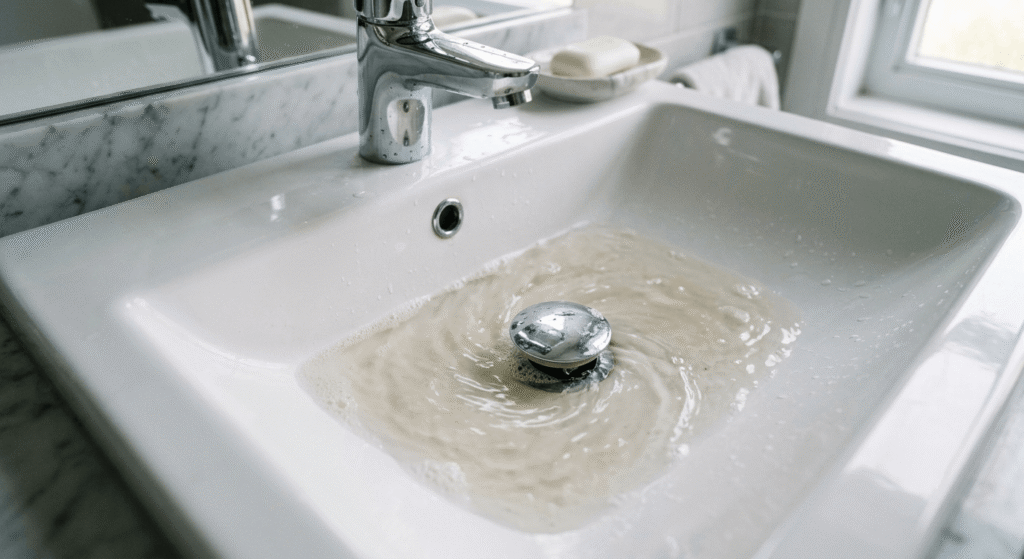
A slow drain occurs when water empties from a sink, tub, shower, or toilet at a reduced rate instead of flowing freely. The reduced flow rate signals a partial obstruction somewhere in the fixture, the trap, the branch line, or the venting system. A fully clogged drain stops water completely, while a slow drain still allows water through but at a restricted pace.
Several factors cause a slow drain, including grease and food residue in kitchen lines, hair and soap scum in bathroom lines, mineral scale inside older pipes, and blocked or undersized vents that limit airflow. Some slow drains have no visible clog at the fixture opening because the obstruction sits deeper in the pipe or forms gradually as a coating on the interior pipe wall.
Homeowners can clear most slow drains using household remedies, manual tools, or mechanical devices before contacting a professional. Baking soda and vinegar, boiling water, plunging, and drain snakes address the majority of residential clogs without specialized equipment. Chemical drain cleaners offer another option, though these products carry limitations and safety considerations that affect when they work.
This article explains the common causes of a slow-draining sink, the situations where no clog is visible, home remedies and mechanical fixes, chemical cleaner performance, fixture-specific differences between kitchen and bathroom sinks, slow drains in tubs, showers, and toilets, prevention practices, and the conditions that require a licensed plumber.
What Causes a Slow Draining Sink
A slow draining sink results from a partial blockage that restricts water flow through the drain opening, trap, or branch pipe. The blockage forms from substances that enter the drain during normal use and accumulate on the interior pipe walls or lodge in the trap.
The composition of the blockage depends on the fixture. Kitchen sinks accumulate grease, food particles, and soap residue, while bathroom sinks accumulate hair, soap scum, and toothpaste residue. Older plumbing systems also develop mineral and scale deposits from hard water, and some slow drains result from vent blockages that prevent air from equalizing pressure in the pipe rather than from a physical obstruction in the drain line itself.
Kitchen Sink Causes (grease, food debris, soap)
Kitchen sinks slow down primarily from grease, food debris, and soap residue that coat the interior of the drainpipe. Grease enters the drain as a liquid but solidifies as it cools inside the pipe, narrowing the passage available for water.
Food debris, including small particles that pass through a garbage disposal, adds to this coating and creates a rough surface that traps additional grease and debris over time. Bar soap and liquid dish soap contribute a waxy or fatty residue that combines with grease to form a dense buildup along the pipe wall. The combined layer reduces the pipe’s internal diameter and slows drainage even when no single blockage fully obstructs the line.
Bathroom Sink Causes (hair, soap scum, toothpaste residue)
Bathroom sinks slow down mainly from hair, soap scum, and toothpaste residue that collect in the drain and stopper assembly. Hair strands catch on the pop-up stopper mechanism or the trap and accumulate additional debris as water passes over them.
Soap scum forms when soap combines with minerals in water, creating a sticky film that adheres to the pipe interior and the stopper mechanism. Toothpaste residue adds a similar coating, particularly in sinks used frequently for brushing teeth and shaving. The combination of hair and scum typically restricts flow at the stopper or within the first few inches of pipe below the drain opening, which is why bathroom sink clogs often clear with stopper cleaning rather than deeper pipe access.
Mineral & Scale Buildup
Mineral and scale buildup occurs when hard water deposits calcium and magnesium compounds on the interior surface of a drainpipe, gradually narrowing the passage. Hard water contains dissolved minerals that do not fully rinse away and instead bond to metal and PVC pipe walls over repeated use.
Scale buildup develops slowly and affects the entire length of an exposed pipe section rather than forming a single blockage point. Metal pipes, including galvanized steel, are more susceptible to internal scale accumulation and corrosion than PVC piping. Homes supplied by hard water sources experience this cause more frequently, and the buildup compounds with grease, soap, or hair to reduce flow further.
Vent Blockages and Trapped Air
A blocked vent slows drainage by preventing air from entering the drainpipe as water flows out, which creates a vacuum that resists the water’s movement. Plumbing vent stacks equalize air pressure in the drain system, allowing water to flow smoothly toward the sewer or septic line.
When a vent becomes blocked by debris, leaves, or a bird or animal nest at the roof opening, trapped air forms behind the water moving through the pipe. The trapped air produces a gurgling sound at the drain and slows the flow rate even though no physical obstruction exists in the trap or branch line. Vent-related slow drains often affect multiple fixtures connected to the same vent stack rather than a single sink.
Slow Drain but No Visible Clog: What’s Going On
A slow drain with no visible clog indicates that the obstruction sits beyond the reach of the stopper or drain opening, typically deeper in the pipe, on the interior pipe wall, or within the venting system. Removing the stopper and inspecting the immediate opening will not reveal these causes because the restriction occurs further along the line.
Three conditions commonly explain a slow drain without a visible clog: a partial blockage deep in the pipe, biofilm and sludge coating the pipe interior, and venting problems that limit airflow. Each condition requires a different diagnostic approach and a different fix than a surface-level clog.
Partial Blockage Deep in the Pipe
A partial blockage deep in the pipe forms when debris travels past the trap and lodges further along the branch line or main drain, reducing the pipe’s effective diameter without fully sealing it. Water still passes through the narrowed opening, but at a slower rate than an unobstructed pipe allows.
This type of blockage commonly consists of compacted food particles, grease, or foreign objects that pass the trap during use. Because the obstruction sits beyond the visible drain opening and often beyond the trap, clearing it typically requires a drain snake or auger rather than a surface cleaning method. A partial deep blockage tends to worsen gradually, so a drain that slows over several days or weeks often points to this cause.
Biofilm and Sludge Buildup
Biofilm and sludge buildup is a slimy layer of bacteria, organic matter, and mineral particles that coats the interior wall of a drainpipe and narrows the passage available for water. Biofilm forms continuously in drains that regularly carry soap, food residue, or organic waste, since these materials feed bacterial growth.
The layer thickens gradually rather than forming a single blockage, which explains why a sink may slow down over weeks without any visible object causing the restriction. Biofilm also produces the odor commonly associated with slow bathroom and kitchen drains. Because the buildup coats the full length of the exposed pipe, cleaning methods that reach beyond the trap, such as boiling water, enzymatic cleaners, or a drain snake, address this cause more effectively than stopper cleaning alone.
Venting Problems
Venting problems cause a slow drain without a visible clog when a blocked, undersized, or improperly installed vent stack prevents air from entering the drain line as water flows out. The restricted airflow creates suction that resists water movement even though the pipe itself remains clear of debris.
Signs of a venting problem include gurgling sounds from the drain, slow drainage that affects more than one fixture on the same branch line, and drainage that improves temporarily after removing a nearby fixture’s stopper or cap, which allows air to enter through an alternate path. Venting problems typically require inspection of the roof vent stack for blockages such as leaves, debris, or nesting material, or evaluation by a plumber if the vent system was undersized or incorrectly installed during construction.
Home Remedies to Clear a Slow Drain
Home remedies clear a slow drain using common household materials that dissolve, loosen, or flush soft buildup such as grease, soap residue, and light biofilm without professional tools. These methods work best on early-stage slow drains where the obstruction has not fully hardened or compacted.
Three home remedies address most residential slow drains: the baking soda and vinegar method, the boiling water method, and the dish soap and hot water method. Each method targets a slightly different type of buildup and can be combined for a stronger effect on a persistent slow drain.
Baking Soda and Vinegar Method
The baking soda and vinegar method clears a slow drain by combining approximately one-half cup of baking soda with one-half cup of white vinegar poured directly into the drain, producing a foaming chemical reaction that loosens grease and organic residue from the pipe walls. The reaction occurs because vinegar’s acetic acid reacts with baking soda’s sodium bicarbonate, releasing carbon dioxide gas that agitates the buildup.
To perform this method, pour the baking soda into the drain first, follow with the vinegar, and cover the opening to contain the foaming reaction within the pipe. Let the mixture sit for 15 to 30 minutes, then flush the drain with hot water to carry loosened debris further down the line. This method works most effectively on light grease, soap scum, and minor organic buildup, and it does not damage PVC or metal pipes when used as directed.
Boiling Water Method
The boiling water method clears a slow drain by pouring water heated to boiling directly down the drain opening in two to three stages, using the heat to soften and dissolve grease and soap buildup along the pipe walls. Hot water liquefies solidified grease more effectively than water at room temperature, allowing it to flow out of the pipe instead of remaining coated on the interior surface.
Pour the boiling water slowly in stages, waiting several seconds between pours to allow the heat to work on the buildup rather than flushing through too quickly. This method suits metal pipes and drains with grease-related slow flow, but it is not suitable for PVC pipes, since boiling water can soften or warp PVC joints and seals. Homeowners with PVC plumbing should use hot tap water instead of boiling water to avoid pipe damage.
Dish Soap and Hot Water Method
The dish soap and hot water method clears a slow drain by combining a few tablespoons of dish soap with hot water to lubricate and break down grease coating the interior of the pipe. Dish soap is formulated to dissolve fats and oils, which makes it effective against the grease-based buildup common in kitchen sinks.
Pour the dish soap into the drain, follow with a steady stream of hot tap water, and allow the solution to flow through the line for one to two minutes. The soap reduces surface tension on grease deposits, helping the water carry loosened material further down the pipe rather than allowing it to redeposit. This method works well as a follow-up step after boiling water or baking soda and vinegar treatments, particularly for kitchen sinks with grease-related slow drainage.
Manual and Mechanical Ways to Fix a Slow Drain
Manual and mechanical methods fix a slow drain using physical tools and actions that dislodge, remove, or bypass the obstruction rather than dissolving it chemically. These methods address blockages that home remedies cannot reach or fully clear, including compacted debris, hair tangles, and obstructions beyond the trap.
Four manual and mechanical methods apply to most residential slow drains: plunging the sink, cleaning and reseating the P-trap, using a drain snake or auger, and adjusting or cleaning the pop-up stopper. Each method targets a different location within the drain system.
Plunging the Sink
Plunging the sink clears a slow drain by creating suction and pressure that dislodges the obstruction from the trap or the pipe immediately below it. A sink plunger, which has a flat bottom distinct from a toilet plunger’s extended flange, forms a seal over the drain opening to generate this pressure.
To plunge a sink, add enough water to cover the plunger’s rubber cup, seal the plunger over the drain opening, and push and pull the handle in short, forceful strokes for 15 to 20 seconds. Block the overflow opening with a wet cloth during plunging to prevent air and pressure from escaping through it. Plunging works most effectively on blockages within the trap or the first few feet of pipe, and it typically requires no disassembly of the plumbing.
Cleaning and Reseating the P-Trap
Cleaning and reseating the P-trap clears a slow drain by removing the curved section of pipe beneath the sink, clearing out accumulated debris, and reinstalling it with a secure seal. The P-trap holds a small amount of water that blocks sewer gas from entering the room, and its curved shape makes it a common location for hair, food debris, and small objects to collect.
To clean the P-trap, place a bucket beneath it to catch residual water, loosen the slip nuts at each end of the trap by hand or with pliers, and remove the trap section. Clear out any debris, rinse the trap thoroughly, and reinstall it by hand-tightening the slip nuts before finishing with a quarter turn using pliers to prevent leaks. This method directly addresses blockages that plunging or chemical methods fail to dislodge, since it provides physical access to the obstruction.
Using a Drain Snake or Auger
A drain snake or auger clears a slow drain by physically breaking apart or retrieving an obstruction located beyond the trap, deeper in the branch line than plunging or trap cleaning can reach. The tool consists of a flexible metal cable that feeds into the drain and rotates to catch or break up the blockage.
To use a drain snake, insert the cable into the drain opening or an access point such as the trap, feed it forward while rotating the handle, and continue until resistance decreases or the cable reaches the blockage. Rotating the cable against the obstruction breaks apart compacted debris or hooks onto material such as hair, which can then be pulled back out. A drain snake reaches distances of several feet to tens of feet depending on the model, making it effective for partial blockages deep in the pipe that other methods cannot address.
Adjusting or Cleaning the Pop-Up Stopper
Adjusting or cleaning the pop-up stopper clears a slow bathroom sink drain by removing accumulated hair and soap scum from the stopper mechanism or correcting its height so it seals and opens properly. The pop-up stopper sits at the drain opening and connects to a pivot rod beneath the sink that raises and lowers it.
To clean the stopper, lift and rotate it to remove it from the drain opening, or loosen the pivot rod nut beneath the sink if the stopper does not lift out directly. Remove hair and soap scum wrapped around the stopper’s base and the pivot rod, then reinstall the stopper and test its movement. If the drain remains slow after cleaning, adjusting the pivot rod’s position can correct a stopper that sits too low and restricts water flow even when clear of debris. This method resolves the majority of bathroom sink slow drains, since hair and soap scum concentrate at this location.
Chemical Drain Cleaners: When They Work and When They Fail
Chemical drain cleaners work by using reactive compounds to dissolve organic material such as hair, grease, and soap scum, but they fail when the blockage consists of solid objects, extensive mineral buildup, or an obstruction located beyond the product’s reach. Their effectiveness depends on the chemical composition of the product and the type and location of the blockage.
Two aspects define chemical cleaner performance: how the products work chemically, and the specific conditions under which they fail along with the alternatives to try instead.
How Chemical Cleaners Work
Chemical drain cleaners work by using caustic, oxidizing, or acidic compounds that break down the molecular structure of organic clog material, converting it into a substance that dissolves or flows away with water. Caustic cleaners, which contain sodium hydroxide or potassium hydroxide, generate heat and break the bonds in fats and proteins found in hair and grease.
Oxidizing cleaners use compounds such as bleach or peroxides to break down organic matter through oxidation reactions. Enzymatic cleaners use bacterial cultures that digest organic waste over a longer period, typically 8 to 24 hours, rather than reacting instantly. Each cleaner type requires sufficient contact time with the clog to be effective, and manufacturers specify this time on the product label.
Why They Sometimes Don’t (and What to Try Instead)
Chemical drain cleaners sometimes fail because they cannot dissolve non-organic obstructions such as toys, jewelry, or mineral scale, and because caustic or oxidizing formulas lose effectiveness when the blockage sits beyond the product’s reach or when standing water dilutes the concentration before it reaches the clog. A slow drain caused by a vent blockage will not improve with a chemical cleaner, since no organic material is present to dissolve.
Caustic cleaners also pose a safety risk when combined with plunging or snaking after application, since agitation can splash the corrosive chemical onto skin or eyes. When a chemical cleaner fails to improve drainage after one application, mechanical methods such as a drain snake, P-trap cleaning, or plunging provide a more reliable alternative, since they physically remove or relocate the obstruction rather than relying on chemical breakdown. Repeated chemical cleaner use on a metal pipe can also accelerate corrosion, making mechanical methods the safer choice for older plumbing.
Kitchen Sink vs. Bathroom Sink: Matching the Fix to the Fixture
Kitchen sinks and bathroom sinks require different fixes because they accumulate different types of clog material: kitchen sinks trap grease and food debris, while bathroom sinks trap hair and soap scum. Matching the fix to the fixture improves the likelihood of clearing the drain on the first attempt.
Kitchen sink slow drains respond best to methods that dissolve grease, including the dish soap and hot water method, boiling water in metal pipes, and enzymatic or caustic cleaners rated for grease breakdown. A garbage disposal connected to the kitchen sink also requires periodic clearing of trapped food particles, since these particles contribute to grease buildup further down the line.
Bathroom sink slow drains respond best to methods that remove hair and soap scum, including pop-up stopper cleaning, plunging, and drain snakes designed to catch hair. The baking soda and vinegar method also performs well on bathroom sinks, since the reaction loosens soap scum effectively. Chemical cleaners formulated for hair removal outperform grease-focused formulas in bathroom applications, while the reverse holds true for kitchen sinks. Choosing a method suited to the fixture’s typical clog material reduces the number of attempts needed to restore normal drainage.
Slow Drains in Other Fixtures: Tubs, Showers, and Toilets
Slow drains also affect tubs, showers, and toilets, though the causes and fixes differ from sink drains due to differences in fixture design, trap size, and typical debris. Tubs and showers commonly slow down from hair and soap scum similar to bathroom sinks, while toilets slow down from different mechanisms related to their flushing system and larger trap passage.
Two fixture types require distinct explanation: a slow tub or shower drain, and a toilet that drains slowly without a full clog.
Slow Tub or Shower Drain
A slow tub or shower drain most often results from hair and soap scum accumulating at the drain cover or within the trap, since these fixtures handle a higher volume of hair than sinks during bathing. The larger surface area of a tub or shower floor also allows more soap residue to reach the drain compared with a sink.
Clearing a slow tub or shower drain typically involves removing the drain cover or stopper to extract trapped hair, followed by a drain snake if the obstruction extends past the visible opening. The baking soda and vinegar method and boiling water method also apply to tub and shower drains, following the same pipe-material precautions used for sinks. Tub and shower drains connected to the same branch line as a toilet may also show slow drainage from venting problems affecting the shared line.
Toilet Draining Slowly but Not Clogged
A toilet draining slowly without a visible clog typically results from a partial obstruction in the trap or drain line, mineral buildup narrowing the trap passage, or a low water level in the tank that reduces flush pressure. Unlike sinks, a toilet’s trap has a larger diameter, so hair and soap scum rarely cause the slowdown; the more common causes involve solid waste buildup, foreign objects, or hard water scale.
A toilet auger, which is a specialized tool designed for the toilet’s curved trap, addresses partial blockages more effectively than a standard drain snake, since it protects the porcelain surface from scratching. Checking the tank’s water level and the flapper valve helps rule out a mechanical flush issue before assuming a drain blockage exists. If plunging and a toilet auger do not restore normal drainage, the blockage likely sits beyond the trap in the branch line, which typically requires a plumber’s inspection with a sewer camera.
How to Prevent a Slow Drain from Coming Back
Preventing a slow drain from returning requires reducing the amount of grease, hair, soap residue, and mineral buildup that enters the drain, combined with routine maintenance that clears minor buildup before it restricts flow. The following practices reduce the likelihood of a recurring slow drain:
- Grease disposal: Pour cooking grease and oil into a separate container instead of the kitchen sink, since grease solidifies inside pipes even in small amounts.
- Drain covers: Install a mesh drain cover on bathroom sinks, tubs, and showers to catch hair before it enters the trap.
- Routine flushing: Flush drains with hot water weekly to prevent grease and soap residue from hardening on pipe walls.
- Baking soda and vinegar maintenance: Apply the baking soda and vinegar method monthly to dissolve minor buildup before it accumulates into a blockage.
- Water softening: Install a water softener in homes with hard water to reduce mineral and scale buildup inside pipes.
- Vent inspection: Check roof vent openings periodically for debris, leaves, or nesting material that can restrict airflow.
- Garbage disposal care: Run cold water while operating a garbage disposal and avoid disposing of fibrous or starchy food waste that expands or binds together in the pipe.
When to Call a Plumber
Calling a plumber becomes necessary when home remedies, plunging, and drain snaking fail to restore normal drainage, when the slow drain affects multiple fixtures at once, or when signs point to a problem beyond the reach of homeowner tools. A licensed plumber has access to sewer cameras, hydro-jetting equipment, and diagnostic tools that identify blockages and pipe conditions not visible from the fixture.
Specific conditions that call for a plumber include a slow drain that returns repeatedly after clearing, multiple slow drains occurring simultaneously across different fixtures, gurgling sounds combined with slow drainage that suggest a venting problem, sewage odors indicating a blockage in the main line, and visible pipe corrosion or leaks near the affected fixture. A plumber should also be contacted before using repeated rounds of chemical drain cleaner, since accumulated caustic residue can complicate manual repair work and pose a safety risk to anyone who later opens the pipe.