
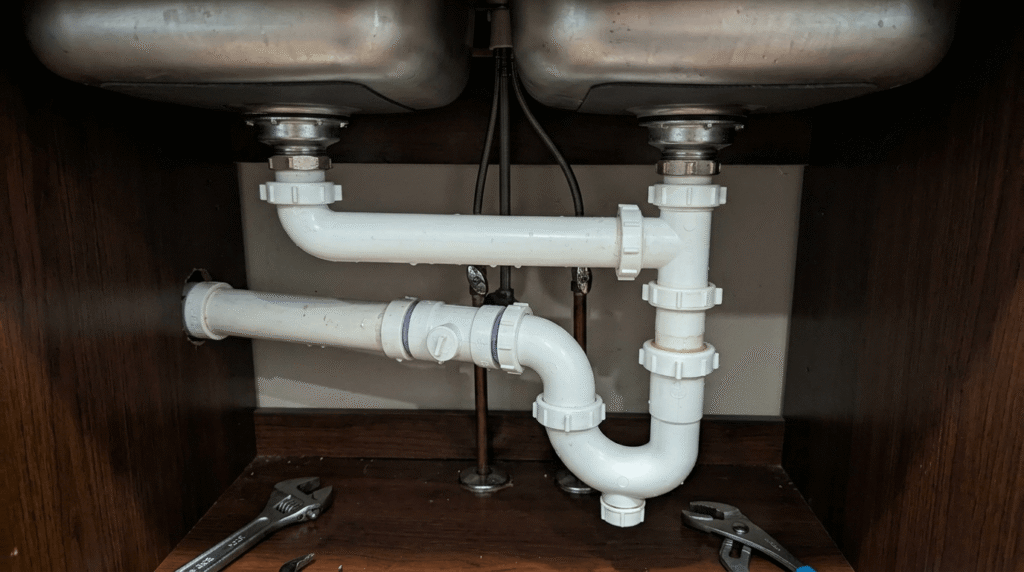
A drain pipe is a rigid or flexible conduit that carries wastewater, groundwater, or stormwater away from a structure, fixture, or landscaped area. Drain pipes operate under gravity flow in most residential and light-commercial applications, moving liquid from a higher point to a lower discharge point such as a municipal sewer, septic system, storm drain, or daylight outlet.
Drain pipe systems appear in several distinct contexts. Interior systems remove wastewater from sinks, tubs, and toilets and connect to a building’s drain-waste-vent (DWV) stack. Exterior systems manage groundwater and surface water around foundations, yards, driveways, and retaining walls. Each context uses different materials, diameters, and installation methods based on the volume of liquid, the type of liquid, and the surrounding soil or structural conditions.
Selecting the correct drain pipe requires matching the pipe material, diameter, and perforation pattern to the specific application. A foundation drain, for example, uses a different pipe than a kitchen sink waste line, and a French drain uses a different pipe than a storm sewer main. Local plumbing and building codes typically specify minimum pipe diameters, slope requirements, and approved materials for each application.
This article covers drain pipe materials, sizing, fittings, common applications, installation methods, troubleshooting, maintenance, repair, and cost, so a homeowner or contractor can identify the correct pipe for a given drainage task.
What Is a Drain Pipe?
A drain pipe is a hollow conduit, made of rigid or flexible material, that transports wastewater, groundwater, or stormwater from a source point to a discharge point using gravity or, in some systems, a pump. Drain pipes connect to fixtures, catch basins, downspouts, footing perimeters, or subsurface drainage fields and route collected liquid away from structures and finished surfaces.
Drain pipes fall into two broad categories: interior drain pipes, which remove wastewater from plumbing fixtures inside a building, and exterior drain pipes, which manage groundwater and surface runoff outside a building. Interior drain pipes connect to a building’s DWV system and require venting to maintain proper flow and prevent trap siphonage. Exterior drain pipes do not require venting and instead rely on slope, perforation, and gravel bedding to move water efficiently.
Common drain pipe materials include PVC, corrugated HDPE, cast iron, and galvanized steel. Pipe diameters range from 1.5 inches for fixture branch lines to 12 inches or larger for storm sewer mains. The defining function of a drain pipe, across every application, is the controlled removal of unwanted liquid from a specific location.
Types of Drain Pipe by Material
Drain pipe material determines a pipe’s rigidity, chemical resistance, weight, cost, and expected service life. The four primary drain pipe materials used in residential and light-commercial drainage are PVC, corrugated HDPE, cast iron, and galvanized steel, each suited to a different combination of application, budget, and soil condition.
PVC offers the lowest cost and easiest installation among common drain pipe materials. Corrugated HDPE offers flexibility for curved trench runs. Cast iron and galvanized steel provide higher structural strength but at a higher material and installation cost. A material selection depends on whether the pipe carries pressurized wastewater, gravity-fed groundwater, or surface runoff, and whether it sits underground, in a crawlspace, or inside a finished wall.
PVC Drain Pipe
PVC drain pipe is a rigid plastic pipe made from polyvinyl chloride, used for both interior waste lines and exterior gravity drainage because of its chemical resistance, smooth interior surface, and low cost. PVC drain pipe resists corrosion, tree-root intrusion when solvent-welded, and most household chemicals, which makes it the standard material for modern DWV systems and yard drainage.
PVC drain pipe comes in solid and perforated forms, with common Schedule 40 and SDR 26/35 wall thicknesses. Schedule 40 PVC withstands higher structural loads and works well under driveways or shallow burial, while thinner SDR-rated PVC suits deeper trench applications where soil provides more support. Solvent-welded joints create a permanent, watertight connection, while gasketed joints allow limited flexibility and easier future access. PVC pipe weighs less than metal alternatives, which reduces labor time during installation but requires more careful support to prevent sagging over long unsupported spans.
Corrugated (Flexible/HDPE) Drain Pipe
Corrugated drain pipe is a flexible plastic pipe, typically made from high-density polyethylene (HDPE), with a ridged exterior wall that allows it to bend around obstacles without fittings. Corrugated pipe suits French drains, yard drainage, and other exterior applications where the trench path curves or where a homeowner installs the system without solvent-welding equipment.
Corrugated HDPE pipe comes in solid and perforated versions, often sold pre-wrapped in a fabric sock that filters soil particles from entering the perforations. The corrugated wall design increases the pipe’s resistance to crushing under soil load while adding flexibility, but the ridged interior surface creates more friction than smooth-wall PVC, which can allow sediment to settle and accumulate over time. Corrugated pipe connects with snap-fit couplings rather than solvent welds, which speeds installation but produces a less rigid joint than PVC.
Metal Drain Pipe
Metal drain pipe refers to cast iron, galvanized steel, and copper pipe used in older plumbing systems and select modern applications requiring high heat resistance, sound dampening, or fire-rated construction. Cast iron remains common in multi-story buildings for its noise-reduction properties, while galvanized steel appears mainly in older residential systems that have not been re-piped.
Cast iron drain pipe resists fire and reduces water-flow noise better than plastic pipe, which makes it a code requirement in some multi-family and commercial buildings. Galvanized steel drain pipe corrodes internally over time, which narrows the pipe’s effective diameter and eventually causes reduced flow or blockage; most plumbing codes and contractors now recommend replacing galvanized steel drain lines with PVC or cast iron. Metal drain pipe costs more to purchase and install than plastic pipe because of its weight, the specialized tools required for cutting and joining, and the skilled labor needed for proper installation.
Types of Drain Pipe by Function: Solid vs. Perforated
Drain pipe divides into two functional categories: solid pipe, which contains no openings along its wall, and perforated pipe, which contains rows of holes or slots that allow water to enter from the surrounding soil. The functional category determines whether a pipe transports water to a discharge point or collects water along its length.
Solid pipe suits applications that require water to move from one fixed point to another without loss along the way, such as a downspout extension or a sewer lateral. Perforated pipe suits applications that require water collection from surrounding soil, such as a French drain or a footing drain. Many drainage systems combine both types, using perforated pipe to collect groundwater and solid pipe to carry that water to a discharge point.
Solid Drain Pipe
Solid drain pipe is a pipe with a continuous, unbroken wall that carries water from one point to another without allowing water to enter or exit along its length. Solid pipe applies to any drainage task that requires directed transport rather than collection, including sewer laterals, downspout extensions, and the discharge leg of a French drain system.
Solid pipe prevents water from escaping into surrounding soil before it reaches its intended discharge point, which protects foundations, walkways, and landscaped areas from unwanted saturation along the pipe’s route. Building and plumbing codes require solid pipe for any drain line that passes under a structure, driveway, or paved surface, since perforated pipe in those locations would release water beneath load-bearing surfaces and increase the risk of settlement.
Perforated and Slotted Drain Pipe
Perforated and slotted drain pipe is a pipe with rows of round holes or narrow slots along its wall that allow groundwater to enter the pipe from the surrounding soil. Perforated pipe collects water rather than merely transporting it, which makes it the standard choice for French drains, footing drains, and other subsurface collection systems.
Perforated pipe typically installs with the holes facing downward or at the 4 o’clock and 8 o’clock positions, allowing water to enter from below while the pipe fills gradually and directs collected water toward a downhill outlet. Slotted pipe, which uses narrow linear openings instead of round holes, allows a higher intake rate and resists clogging from fine soil particles better than round-hole perforation. Installers typically wrap perforated and slotted pipe in landscape fabric or use a pre-socked pipe to prevent silt and sand from entering and reducing the pipe’s collection capacity over time.
Drain Pipe Sizes: How to Pick the Right Diameter
Drain pipe diameter selection depends on the fixture or area being drained, the anticipated water volume, and the applicable plumbing or building code. Undersized pipe increases the risk of backup and standing water, while oversized pipe adds unnecessary material cost without improving drainage performance.
Standard drain pipe diameters range from 1.5 inches for individual fixture branches to 12 inches or larger for municipal storm sewer mains. A correct diameter balances expected flow rate against the pipe’s slope, since a steeper slope allows a smaller-diameter pipe to carry the same volume of water as a shallower slope with a larger diameter.
Standard Drain Pipe Sizes
The standard drain pipe sizes used in residential plumbing and drainage are 1.5, 2, 3, 4, 6, 8, and 12 inches in diameter, with each size assigned to a specific class of fixture or drainage volume. A 1.5-inch pipe typically serves a single bathroom sink or lavatory, while a 4-inch pipe typically serves a building’s main sewer line or a foundation footing drain.
Plumbing codes generally require a minimum 1.5-inch diameter for individual fixture drains, 2 inches for a shower or floor drain, 3 inches for a toilet branch, and 4 inches for a building’s main drain-waste line. Exterior drainage systems commonly use 4-inch pipe for French drains and footing drains, and 6-inch or larger pipe for storm drain mains and driveway culverts that handle higher runoff volumes during heavy rainfall.
Sizing by Application
Correct drain pipe sizing by application matches the pipe diameter to the specific fixture count, catchment area, or runoff volume the pipe must handle. A single downspout typically requires a 3- or 4-inch solid pipe, while a French drain collecting groundwater along a 50-foot foundation wall typically requires a 4-inch perforated pipe.
Interior fixture sizing follows the fixture-unit method specified in most plumbing codes, which assigns a numeric load value to each fixture type and sums those values to determine the minimum branch and main drain diameter. Exterior sizing follows a rainfall-intensity and catchment-area calculation, in which a larger roof, driveway, or yard area requires a proportionally larger pipe diameter to prevent overflow during peak storm events. A contractor or plumber typically confirms final sizing against the local plumbing or drainage code before installation, since minimum diameters vary by jurisdiction.
Drain Pipe Fittings and Connectors
Drain pipe fittings and connectors are the components that join pipe sections, change flow direction, branch a line, or transition between different pipe materials or diameters. Fittings allow a drainage system to route around obstacles, connect multiple collection points to a single discharge line, and adapt older piping to newer materials during a repair.
Every drain pipe system requires fittings at each direction change, branch point, and material transition. Fitting selection depends on the pipe material, since PVC fittings use solvent-weld or gasketed joints, corrugated HDPE fittings use snap-fit couplings, and cast iron fittings use hub-and-spigot or no-hub band connections.
Common Fitting Types
The common drain pipe fitting types are elbows, tees, wyes, couplings, and adapters, each performing a distinct function within a drainage system. An elbow changes the direction of flow, a tee or wye adds a branch connection, a coupling joins two pipe sections of the same diameter and material, and an adapter joins two sections of different diameter or material.
Elbows come in 22.5-, 45-, and 90-degree angles, with gentler angles preferred in drain-waste lines to reduce flow turbulence and clog risk. Wye fittings, which join a branch line at a 45-degree angle, perform better than tee fittings in solid-waste drainage because the angled entry reduces the chance of blockage at the junction. Couplings restore a continuous pipe run after a cut or repair, and adapters allow a plumber to transition from cast iron to PVC or from one diameter to another without replacing an entire pipe run.
Connecting Different Pipe Materials
Connecting different drain pipe materials requires a transition fitting or rubber coupling designed to seal two dissimilar pipe types, such as cast iron to PVC or PVC to corrugated HDPE. A mismatched connection without the correct adapter risks leaks, misalignment, or premature joint failure.
Rubber banded couplings with stainless steel clamps, commonly called no-hub couplings, join cast iron to PVC by compressing a flexible rubber sleeve around both pipe ends. Manufactured transition fittings join PVC to corrugated HDPE by stepping down the outer diameter to match each pipe’s coupling profile. A plumber selects the coupling type based on the pressure rating required, since exterior gravity drains generally need lower-pressure couplings than interior waste lines connected to a vented DWV stack.
Drain Pipe Uses and Applications
Drain pipe applications span interior plumbing, yard drainage, structural protection, and municipal infrastructure, with each application relying on a specific pipe material, diameter, and perforation pattern suited to its water source and discharge requirement. Matching the application to the correct pipe type prevents standing water, foundation damage, and premature pipe failure.
The following applications represent the most common uses for drain pipe in residential and light-commercial settings: French drains, yard and landscape drainage, driveway drains, gutter and downspout drainage, foundation and basement drainage, retaining wall drainage, storm drain and sewer systems, and septic and leach field drain pipe.
French Drains
A French drain is a gravel-filled trench containing a perforated pipe that collects and redirects groundwater away from a saturated area toward a lower discharge point. French drains prevent water from pooling near foundations, low-lying yard sections, or areas with poor natural drainage.
A French drain system typically uses 4-inch perforated corrugated HDPE or PVC pipe, wrapped in landscape fabric or a filter sock, laid at the bottom of a trench and surrounded by washed gravel. Water enters the pipe through its perforations as it percolates down through the gravel, then travels along the pipe’s slope to a daylight outlet, dry well, or storm drain connection. A properly sloped French drain requires a minimum grade of 1 percent, or roughly 1/8 inch per foot, to maintain consistent gravity flow.
Yard and Landscape Drainage
Yard and landscape drainage refers to a drain pipe system designed to remove excess surface and subsurface water from lawns, garden beds, and other landscaped areas to prevent pooling, erosion, and plant root damage. Yard drainage systems typically combine catch basins, solid discharge pipe, and sometimes a French drain to address both surface runoff and groundwater saturation.
A typical yard drainage layout places a catch basin at a low point where surface water collects, then connects that basin to solid 4-inch PVC pipe that carries the water to a daylight outlet or municipal storm connection. Landscape drainage systems require a consistent downhill slope along the entire pipe run, since low spots in the line create standing water and increase the risk of sediment buildup and eventual blockage.
Driveway Drains
A driveway drain is a channel or trench drain, connected to solid discharge pipe, that collects surface water across a driveway’s width and redirects it away from the paved surface before it can pool or flow toward a garage or foundation. Driveway drains typically use a metal or plastic grate over a linear channel that feeds into 4- or 6-inch solid PVC pipe.
Driveway drain pipe requires enough structural strength to withstand vehicle loads without collapsing, which makes Schedule 40 PVC or cast iron the preferred materials for any drain pipe run beneath or adjacent to a driving surface. The discharge pipe from a driveway drain typically routes to a storm sewer connection, a dry well, or a daylight outlet at a lower grade point on the property.
Gutter and Downspout Drainage
Gutter and downspout drainage refers to the solid drain pipe that carries water collected by a roof’s gutter system away from a building’s foundation after it exits the downspout. Downspout drain pipe prevents roof runoff from concentrating at the foundation edge, which reduces the risk of basement seepage and soil erosion.
Downspout drainage typically uses 3- or 4-inch solid PVC pipe connected to the downspout outlet through an adapter, then routed underground to a discharge point at least 6 to 10 feet from the foundation. A properly installed downspout drain maintains a continuous downhill slope and terminates at a daylight outlet, dry well, or connection to a broader yard drainage system rather than releasing water directly against the foundation wall.
Foundation and Basement Drainage
Foundation and basement drainage refers to a perforated drain pipe, commonly called a footing drain, installed alongside a building’s foundation footing to collect groundwater before it can pressurize the foundation wall or seep into a basement. Foundation drainage protects below-grade structures from hydrostatic pressure and moisture intrusion.
A footing drain typically uses 4-inch perforated PVC or corrugated HDPE pipe, laid at the base of the foundation footing and surrounded by gravel, with the perforations facing downward to collect water rising from below. The collected water travels along the pipe’s slope to a sump pump basin or a gravity discharge point away from the structure. Building codes in many jurisdictions require a footing drain on any new foundation in an area with a high water table or poor soil drainage.
Retaining Wall Drainage
Retaining wall drainage refers to a perforated drain pipe installed behind a retaining wall to relieve hydrostatic pressure caused by groundwater accumulating in the backfill soil. Retaining wall drain pipe prevents water pressure from building against the wall’s structural face, which can otherwise cause cracking, bowing, or collapse.
Retaining wall drainage typically uses 4-inch perforated PVC pipe laid along the base of the wall’s backfill zone, surrounded by free-draining gravel and separated from finer soil by landscape fabric. Weep holes through the wall face work alongside the drain pipe in some designs, providing an additional pressure-relief path. The collected water routes through the perforated pipe to a discharge point at a lower elevation along the wall’s length.
Storm Drain and Sewer Systems
Storm drain and sewer systems refer to large-diameter solid drain pipe, typically 8 to 36 inches or larger, that collects and transports stormwater runoff from streets, parking lots, and connected residential drainage systems to a treatment facility, retention pond, or natural waterway. Storm drain pipe operates on a municipal scale, distinct from the smaller residential drain pipe used for individual property drainage.
Municipal storm sewer pipe commonly uses reinforced concrete, corrugated HDPE, or PVC, selected based on load capacity, burial depth, and expected service life. Storm drain systems connect to residential yard drainage and driveway drains through a permitted tie-in point, subject to local drainage authority approval and sizing requirements that account for the combined runoff of an entire watershed or neighborhood.
Septic and Leach Field Drain Pipe
Septic and leach field drain pipe is a perforated pipe, typically 4 inches in diameter, that distributes treated effluent from a septic tank into the surrounding soil across a leach field for final filtration and absorption. Leach field pipe differs from other perforated drain pipe in that it disperses liquid outward into soil rather than collecting groundwater inward.
Leach field pipe typically uses perforated PVC or corrugated HDPE, laid in gravel-filled trenches spaced according to local septic system design standards, with perforations facing downward or to the sides to allow even effluent distribution. A leach field requires soil with adequate percolation capacity, since soil that cannot absorb effluent at the design rate causes surface pooling and system failure. Septic system design and pipe spacing typically require review and permitting by a local health or environmental agency before installation.
Corrugated vs. PVC Drain Pipe: Which Should You Use?
Corrugated and PVC drain pipe differ primarily in flexibility, interior smoothness, structural rigidity, and installation method, with each material better suited to specific drainage conditions. PVC suits applications requiring long straight runs, higher structural loads, or solvent-welded permanent joints, while corrugated pipe suits curved trench paths and lower-budget installations.
PVC’s smooth interior wall reduces friction and sediment buildup compared with corrugated pipe’s ridged interior, which improves long-term flow performance in solid pipe applications. Corrugated pipe’s flexibility allows installation around trees, utility lines, and other obstacles without additional fittings, reducing labor time on irregular trench layouts. PVC costs more per linear foot than corrugated pipe in most markets, but PVC’s rigidity and smoother bore generally extend its effective service life in high-sediment soil conditions. A property with straight, unobstructed trench runs and heavier soil loads typically favors PVC, while a property with curved paths, tree roots, or a lower installation budget typically favors corrugated pipe.
SDR 26 vs. Schedule 40 PVC
SDR 26 and Schedule 40 PVC differ in wall thickness and pressure rating, with Schedule 40 providing a thicker wall and higher structural strength than SDR 26 at the same nominal diameter. SDR 26 pipe suits deeper trench burial where surrounding soil provides structural support, while Schedule 40 suits shallow burial or locations requiring higher load resistance, such as under driveways.
Schedule 40 PVC maintains a constant wall thickness across all pipe diameters, which increases material cost and weight compared with SDR-rated pipe. SDR 26 pipe uses a wall thickness proportional to its diameter, following the “standard dimension ratio” method, which reduces material use and cost for larger-diameter pipe while maintaining an adequate pressure rating for gravity drainage. Local plumbing codes typically specify which rating applies to sewer laterals, foundation drains, and other buried applications based on burial depth and expected surface load.
How to Install a Drain Pipe
Installing a drain pipe requires determining the correct slope, joining pipe sections securely, and laying the pipe in a properly prepared trench with adequate bedding and backfill. Correct installation prevents standing water, joint leaks, and pipe settlement after backfilling.
A complete drain pipe installation follows three main stages: establishing the pipe’s slope and pitch, connecting and joining pipe sections, and laying the pipe underground with appropriate bedding material. Each stage affects the system’s long-term flow performance and resistance to clogging or damage.
Determining Pipe Slope and Pitch
Determining drain pipe slope and pitch requires calculating a consistent downhill grade, typically 1/8 to 1/4 inch of drop per foot of pipe length, to maintain adequate gravity flow without causing sediment to settle in low spots. A slope below this range risks standing water, while an excessive slope can cause liquid to outpace solid waste in interior drain lines.
Installers typically use a laser level, string line, or slope-calculating app to confirm the trench bottom maintains a continuous downhill grade from the collection point to the discharge point. A 4-inch drain pipe commonly targets a 1/8-inch-per-foot slope, while a 3-inch or smaller pipe often requires a steeper 1/4-inch-per-foot slope to maintain sufficient flow velocity. Any low point along the trench creates a location where water and sediment can accumulate, increasing the risk of future blockage.
Connecting and Joining Sections
Connecting and joining drain pipe sections requires a method matched to the pipe material, including solvent welding for PVC, snap-fit coupling for corrugated HDPE, and no-hub banded coupling for cast iron. A secure joint prevents leaks, root intrusion, and eventual separation under soil pressure or thermal expansion.
Solvent welding PVC requires cutting the pipe squarely, deburring the cut edge, applying primer and cement to both the pipe and fitting, and inserting the pipe fully into the fitting with a quarter-turn twist to distribute the cement evenly. Corrugated pipe joins through a coupling collar that snaps or clamps over the ridged ends of two pipe sections, creating a connection that allows slight flexing without leaking. Cast iron sections join with a rubber sleeve and stainless steel clamp, tightened to the torque specification listed by the coupling manufacturer to achieve a watertight seal.
Laying Underground Drain Pipe
Laying underground drain pipe requires excavating a trench to the correct depth and slope, placing a bedding layer of sand or gravel beneath the pipe, positioning the pipe, and backfilling with soil that will not shift or settle unevenly over time. Proper bedding supports the pipe uniformly and prevents point-loading that can crack rigid pipe materials.
A typical trench depth ranges from 12 to 24 inches for residential yard drainage, with deeper burial required in regions subject to frost heave. Installers place 2 to 4 inches of compacted sand or gravel bedding beneath the pipe before positioning it at the calculated slope, then add a similar layer above the pipe before completing the backfill with native soil in compacted lifts. Marking tape or a locator wire installed above the pipe helps prevent accidental damage during future excavation near the same trench line.
Common Drain Pipe Problems and How to Fix Them
Common drain pipe problems include standing water within the pipe, partial or complete blockages, and joint leaks caused by settlement, root intrusion, or improper installation. Identifying the specific cause of a drainage problem determines whether the correct fix involves cleaning, re-sloping, or pipe replacement.
Standing water and clogged pipe represent the two most frequent drain pipe issues encountered in both interior and exterior drainage systems. Each problem has distinct causes and requires a different diagnostic and repair approach.
Standing Water in a Drain Pipe
Standing water in a drain pipe results from an inadequate or reversed slope, a collapsed pipe section, or a partial blockage that prevents water from reaching the discharge point at the expected rate. Standing water increases the risk of sediment settling, mosquito breeding in exterior systems, and eventual complete blockage.
A plumber or contractor typically diagnoses standing water by running a garden hose or camera inspection through the pipe to locate the point where flow stops or slows. A low spot caused by soil settlement often requires excavating and re-bedding the affected section to restore proper slope, while a collapsed section requires cutting out and replacing the damaged pipe length with a new section joined by appropriate couplings.
Clogged or Blocked Drain Pipe
A clogged or blocked drain pipe results from an accumulation of debris, grease, tree roots, or sediment inside the pipe that restricts or stops water flow. Interior drain pipes clog most often from grease, hair, and solid waste, while exterior drain pipes clog most often from root intrusion, silt, and leaf debris.
Clearing a clogged drain pipe typically starts with a plumbing snake or auger for smaller obstructions, followed by hydro jetting for more severe blockages or root intrusion that a snake cannot fully clear. A camera inspection after clearing confirms whether the blockage has fully cleared or whether a structural issue, such as a pipe belly or crushed section, caused the debris to accumulate in the first place and will cause the clog to recur.
Cleaning and Maintaining Drain Pipe
Cleaning and maintaining drain pipe involves routine debris removal, periodic camera inspection, and preventive measures that reduce the likelihood of blockages and extend the pipe’s service life. Regular maintenance costs less than emergency repair and reduces the risk of water damage from an undetected backup.
Interior drain pipe maintenance typically includes periodic snaking of slow-draining fixtures, avoiding grease and non-flushable material disposal, and installing drain strainers to catch hair and food particles before they enter the pipe. Exterior drain pipe maintenance typically includes annual inspection of catch basins and cleanouts for debris accumulation, periodic hydro jetting to clear sediment from perforated pipe, and root-barrier installation near trees planted close to a drainage trench. A camera inspection every few years identifies developing issues, such as minor root intrusion or slight pipe settlement, before they progress into a full blockage or collapse requiring excavation.
Repairing and Replacing Drain Pipe
Repairing and replacing drain pipe involves either fixing a localized section of damaged or deteriorated pipe or removing and installing an entirely new pipe run when damage extends across a significant length or the existing material has reached the end of its service life. The choice between repair and replacement depends on the pipe’s age, material, extent of damage, and accessibility.
Localized repair methods include cutting out and replacing a damaged section with new pipe and couplings, or applying a trenchless pipe-lining method that inserts a resin-saturated liner inside the existing pipe to seal cracks and restore structural integrity without full excavation. Full replacement becomes necessary when a pipe shows widespread corrosion, multiple collapsed sections, or a material, such as aging galvanized steel, that no longer meets current code or performance expectations.
When to Repair vs. Replace
The decision to repair versus replace a drain pipe depends on the extent of damage, the pipe’s age and material, and whether the problem is isolated or recurring across multiple sections of the system. A single crack or joint failure in an otherwise sound pipe typically justifies a localized repair, while recurring blockages, multiple failure points, or an outdated material typically justifies full replacement.
A plumber typically recommends repair when a camera inspection shows damage confined to a short section and the surrounding pipe remains structurally sound. A plumber typically recommends replacement when the pipe material has exceeded its expected service life, such as galvanized steel pipe older than 40 to 50 years, or when root intrusion, bellying, or corrosion appears at multiple points along the run. Cost comparison between repeated repairs and a single replacement often factors into this decision, since frequent repairs on an aging pipe can eventually exceed the cost of full replacement.
Cost of Drain Pipe by Material and Size
The cost of drain pipe varies by material, diameter, and installation method, with material costs for residential drain pipe generally ranging from about $1 to $5 per linear foot for PVC, $1 to $4 per linear foot for corrugated HDPE, and $10 to $25 per linear foot or more for cast iron, before installation labor. Larger diameters and specialty fittings increase material cost within each category.
Installation labor typically adds a significant portion of total project cost, particularly for trenching, bedding, and backfill work on exterior drainage systems. A simple downspout extension or short yard drain repair often costs several hundred dollars in total, while a full foundation footing drain or French drain system spanning the perimeter of a house can range from several thousand to over ten thousand dollars, depending on excavation depth, soil conditions, and regional labor rates. Trenchless repair methods, such as pipe lining, typically cost more per linear foot than open-trench replacement but reduce landscaping and hardscape restoration costs, which can offset the difference on properties with extensive paving or mature landscaping above the pipe route.
How to Choose the Right Drain Pipe for Your Project
Choosing the right drain pipe for a project requires matching the pipe material and diameter to the specific application, expected water volume, burial depth, and budget. A footing drain, a downspout extension, and a driveway drain each call for a different combination of these factors, even though all three fall under the broader category of exterior drainage.
A project involving straight trench runs under load-bearing surfaces, such as a driveway, generally calls for rigid Schedule 40 PVC or cast iron. A project involving curved paths around obstacles, such as a residential yard with mature trees, generally calls for flexible corrugated HDPE. A project requiring water collection from surrounding soil, such as a French drain or footing drain, requires perforated pipe, while a project requiring directed transport to a discharge point, such as a downspout extension or sewer lateral, requires solid pipe. Confirming diameter and slope requirements against the local plumbing or drainage code before purchasing material prevents undersized or improperly sloped installations that require costly rework.
Drain Pipe vs. Interior Plumbing Waste Lines
Drain pipe used for exterior groundwater and stormwater management differs from interior plumbing waste lines in venting requirements, pressure exposure, material standards, and the type of liquid each system carries. Exterior drain pipe moves clean or lightly silted water under simple gravity flow, while interior waste lines move sewage and greywater through a vented system designed to prevent sewer gas from entering a building.
Interior plumbing waste lines connect to a building’s DWV stack, which uses vent pipes to equalize air pressure and allow wastewater to flow freely without siphoning the water seal out of fixture traps. Exterior drain pipe requires no venting, since it carries groundwater or surface runoff rather than sewage, and instead relies entirely on slope and gravity to maintain flow. Plumbing codes hold interior waste lines to stricter material, joint, and inspection standards than exterior drainage, reflecting the health and safety requirements associated with sewage transport compared with general groundwater management.