
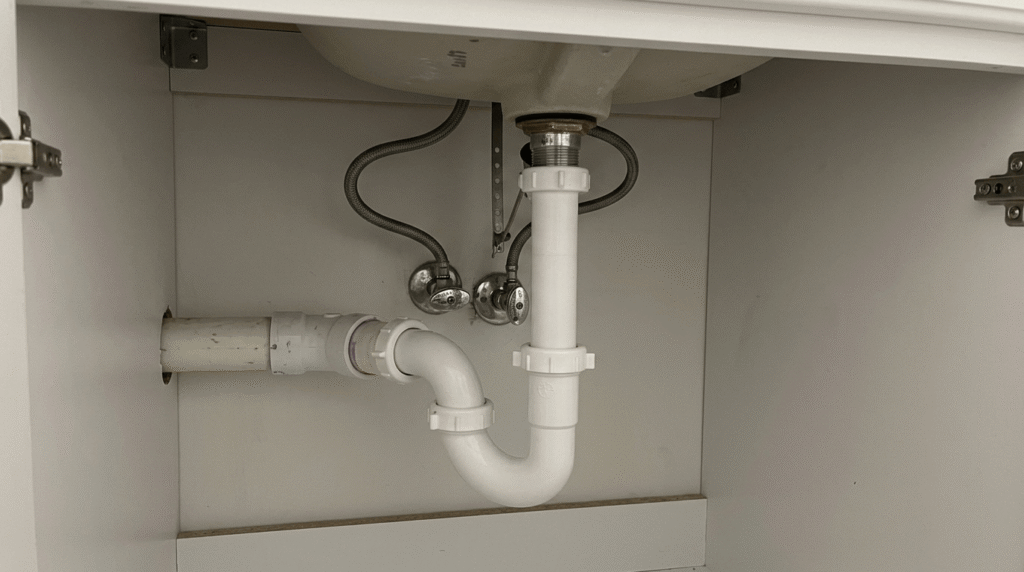
A bathroom contains several distinct drain systems, each built for a specific fixture and water volume. Sink drains manage low-volume wastewater from handwashing and grooming. Tub and shower drains handle higher water volumes and rely on a stopper or strainer to control flow during use. Floor drains remove standing water from tiled surfaces and prevent flooding in wet-room layouts.
Every bathroom drain shares three core functions: it channels wastewater away from the fixture, it blocks sewer gas from entering the room through a trap, and it connects to the home’s drain-waste-vent (DWV) system. The design of each drain changes according to the fixture it serves, the required flow rate, and the stopper or strainer mechanism installed.
Drain types also differ by size, material, and the number of moving parts. A sink drain assembly typically includes a flange, tailpiece, and P-trap. A bathtub drain includes an overflow plate and a mechanical stopper linked by a linkage or cable. A shower drain uses a strainer or linear grate positioned over a sloped pan. A floor drain uses a flat strainer set into a sloped subfloor.
This article explains the main types of bathroom drains, the stopper mechanisms used in each fixture, standard sizing, the key components of each drain assembly, and how to install, replace, or troubleshoot common drain problems.
What Is a Bathroom Drain and How Does It Work?
A bathroom drain is a fixed outlet that channels wastewater from a sink, tub, shower, or floor into a home’s plumbing system. The drain connects the fixture to a trap, a branch drain line, and the main drain-waste-vent (DWV) stack.
A bathroom drain works through gravity flow and a trap seal. Water exits the fixture through a strainer, flange, or stopper opening and travels down a tailpiece or drain body into a curved trap. The trap retains a small volume of water at all times, which blocks sewer gas from rising back into the bathroom. Past the trap, wastewater flows through a branch line to the main drain stack and out to the sewer or septic system.
Each fixture type applies this same working principle at a different scale. A sink drain moves a small, intermittent water volume through a narrow tailpiece. A tub or shower drain moves a larger volume through a wider drain body, often controlled by a stopper that a user opens or closes. A floor drain remains open at all times and relies on the room’s floor slope to direct water toward the drain opening.
Types of Bathroom Sink Drains
Bathroom sink drains are classified into two types: the fixture style they connect to and the stopper mechanism installed in the drain opening. Fixture-based classification depends on how the sink is mounted and shaped. Stopper-based classification depends on how the user opens and closes the drain.
Both classifications apply to the same physical drain assembly. A vessel sink drain, for example, may use a pop-up stopper, while a vanity sink drain may use a grid strainer instead. The sections below explain each classification separately.
Sink Drains by Fixture (Vanity, Vessel, Lavatory, Basin)
Bathroom sink drains differ by fixture type in four common forms: vanity, vessel, lavatory, and basin drains. Each form matches the mounting style and bowl shape of its corresponding sink.
A vanity sink drain connects to an undermount or drop-in sink set into a countertop, using a standard tailpiece that runs down through the cabinet to the P-trap. A vessel sink drain connects to a bowl that sits above the counter surface, requiring a longer or extended drain body to reach the countertop opening. A lavatory drain refers to any standard bathroom sink drain in wall-mounted or pedestal installations, using a shorter tailpiece where cabinet space is limited. A basin drain describes the drain opening itself within any of these sink types, regardless of mounting style.
The mounting height and cabinet depth determine which drain length and stopper type fit a given fixture. A vessel sink typically needs a taller drain assembly than a vanity or pedestal sink because the bowl sits higher above the countertop or wall connection point.
Bathroom Sink Stopper Types (Pop-Up, Push-Pull, Toe-Touch, Grid/Basket)
Bathroom sink stoppers come in four main types: pop-up, push-pull, toe-touch, and grid or basket stoppers. Each type opens and closes the drain through a different mechanism.
A pop-up stopper connects to a pivot rod beneath the sink and a lift knob on the faucet body; raising or lowering the knob raises or lowers the stopper inside the drain opening. A push-pull stopper operates without a connecting rod: the user presses down to close the drain and pulls up to open it, using a threaded post inside the drain body. A toe-touch stopper closes and opens with a single press, using a spring-loaded mechanism similar to a bathtub toe-touch stopper but sized for a sink drain. A grid or basket stopper remains a fixed, non-sealing strainer that catches debris while allowing continuous water flow; it does not stop the drain and suits sinks without a standing-water function.
Pop-up and push-pull stoppers allow the sink to hold standing water, which supports tasks such as shaving or soaking small items. Grid and basket stoppers do not hold water and instead prioritize continuous drainage and debris control.
Types of Shower Drains
Shower drains fall into two primary categories based on placement and shape: point drains and linear drains. A point drain sits at a single central or corner location on the shower floor, while a linear drain forms a narrow channel along one edge of the shower pan.
Both drain categories perform the same underlying function of removing water from a sloped shower floor, but they require different pan slopes and installation methods. A point drain needs a four-way slope toward a central opening, while a linear drain needs a single-direction slope toward one edge.
Shower Drain Styles and Placement
Shower drains use three common placement styles: center-set, corner-set, and linear edge placement. Center-set drains sit at the middle of the shower floor and require the pan to slope evenly from all four sides toward the drain. Corner-set drains sit near one corner of the shower and reduce the slope distance needed from two of the four sides. Linear edge drains run along one wall of the shower and require the floor to slope in a single direction, which simplifies large-format tile installation.
Shower placement also affects strainer or grate style. Center-set and corner-set drains typically use round or square strainer covers, while linear drains use a narrow rectangular grate that spans the channel length. The choice between these styles depends on shower size, tile format, and accessibility requirements.
How a Shower Drain Works
A shower drain works by collecting water through a sloped pan and releasing it through a strainer or grate into a trap and branch drain line. Water flows across the shower floor toward the lowest point of the slope, enters the drain body through the strainer openings, and passes into a P-trap or, in some installations, a shared trap connected to an adjacent fixture.
The strainer or grate prevents hair and debris from entering the trap while allowing continuous water flow, since most shower drains remain open at all times without a stopper. A shower drain’s clamping ring and rubber gasket create a watertight seal between the drain body and the shower pan membrane, which prevents water from leaking into the subfloor.
Types of Bathtub Drains and Stopper Mechanisms
Bathtub drains use one of six primary stopper mechanisms: lift-and-turn, toe-touch, push-pull, trip-lever, flip-it, and screw-in stoppers. Each mechanism controls the same basic function, opening and closing the drain to allow the tub to hold or release water, through a different physical action.
The mechanisms differ in how they connect to the drain body, whether they require an overflow linkage, and how a user operates them. The sections below explain each mechanism separately.
Lift-and-Turn Stoppers
A lift-and-turn stopper closes the bathtub drain when a user turns the knob to lock it in a raised position and opens the drain when the knob is turned and lifted out. The stopper connects to a stem that screws directly into the drain body, without requiring an overflow linkage in most installations.
This mechanism uses a simple twist-and-lift motion, which makes it straightforward to operate but also more prone to trapping hair around the exposed stem threads. Lift-and-turn stoppers remain compatible with most standard 1.5-inch to 1.75-inch tub drain openings.
Toe-Touch (Foot-Lock) Stoppers
A toe-touch stopper, also called a foot-lock stopper, closes the bathtub drain when a user presses down on the cap with a foot and opens the drain with a second press. The stopper operates through a spring-loaded internal mechanism housed inside the drain body.
This mechanism connects to an overflow linkage in most tub installations, allowing the stopper to remain in a fixed position over the drain while the trip-lever assembly at the overflow controls the internal mechanism. A toe-touch stopper does not require twisting or lifting, which suits users with limited hand mobility.
Push-Pull Stoppers
A push-pull stopper closes the bathtub drain when a user presses the stopper down and opens it when the stopper is pulled upward. The mechanism uses a threaded post similar to a sink push-pull stopper but sized for a bathtub drain opening.
Push-pull stoppers typically do not connect to an overflow linkage, since the stopper seals the drain directly rather than through a trip-lever mechanism. This design simplifies installation and reduces the number of moving parts compared with trip-lever or flip-it systems.
Trip-Lever (Plunger) Stoppers
A trip-lever stopper, also called a plunger-style stopper, closes the bathtub drain using a plunger housed inside the overflow tube rather than a visible stopper cap over the drain opening. A user moves a lever on the overflow plate up or down to raise or lower the plunger.
This mechanism relies on a linkage rod connecting the overflow lever to the plunger, and the drain opening itself remains uncovered or fitted with a fixed strainer. Trip-lever stoppers require periodic adjustment of the linkage rod length to maintain a proper seal.
Flip-It Stoppers
A flip-it stopper closes the bathtub drain when a user flips a small lever on top of the stopper cap and opens the drain with a second flip in the opposite direction. The stopper sits inside the drain body and uses a rubber gasket that expands or contracts based on the lever position.
Flip-it stoppers do not require an overflow linkage or threaded connection, which allows for a simplified push-fit installation into most standard tub drain openings. This mechanism has become common in retrofit and replacement kits due to its tool-free installation.
Screw-In (Twist) Stoppers
A screw-in stopper, also called a twist stopper, closes the bathtub drain when a user threads the stopper clockwise into the drain body and opens it by threading the stopper counterclockwise until it lifts free. The stopper uses threads that match the drain body’s internal fitting.
This mechanism does not rely on a spring, linkage, or gasket, which reduces the number of parts that can wear out over time. A screw-in stopper requires matching thread size to the specific drain body, since thread patterns vary between manufacturers.
Floor Drain Types in Bathrooms
Bathroom floor drains fall into three main types: point drains, linear drains, and trench drains, each set into a sloped floor to remove standing water from wet-room or curbless shower layouts. A point drain uses a small square or round opening set at the low point of a four-way floor slope. A linear drain uses a narrow rectangular opening set along one edge of the floor, matching the single-direction slope used in curbless shower designs. A trench drain uses an elongated channel with a continuous grate, typically installed across a doorway threshold or the full width of a wet room to intercept water before it spreads to adjoining areas.
Bathroom floor drains also differ by cover material and grate pattern, including stainless steel, tile-insert, and solid brass covers. A tile-insert cover allows matching floor tile to sit within the grate frame, creating a visually continuous floor surface. Floor drains connect to a P-trap or, in some jurisdictions, a trap primer that maintains the trap seal when the drain receives water infrequently.
Bathroom Drain and Stopper Sizes
Bathroom drain sizes vary by fixture type, with sink, bathtub, and shower drains each following a distinct standard opening diameter. These standard sizes ensure that replacement stoppers, strainers, and drain bodies fit existing plumbing without requiring modification to the fixture or drain line.
Drain size also affects flow rate. A larger drain opening moves more water per minute, which is why bathtub and shower drains use wider openings than sink drains.
Standard Bathroom Sink Drain Size
The standard bathroom sink drain size measures 1.25 inches (32 millimetres) in diameter. This size applies to most vanity, pedestal, and lavatory sink drain openings in residential construction.
Vessel sink drains sometimes use a 1.5-inch to 1.75-inch opening to accommodate a wider drain body, so a vessel sink installation requires confirming the manufacturer’s specified drain size before purchasing a replacement stopper or drain assembly.
Standard Bathtub Drain Size
The standard bathtub drain size measures 1.5 inches (38 millimetres) or 1.75 inches (44 millimetres) in diameter, depending on the tub manufacturer and drain body style. Most modern bathtubs use a 1.5-inch drain opening, while some older or cast-iron tubs use the 1.75-inch size.
Replacement stoppers and drain bodies are manufactured to match both sizes, so confirming the existing drain opening diameter prevents a mismatched fit during replacement.
Standard Shower Drain Size
The standard shower drain size measures 2 inches (51 millimetres) in diameter for point drains, which is wider than both sink and bathtub drain openings. This larger size accommodates the higher continuous water flow of a shower compared with a sink or a bathtub drained after filling.
Linear shower drains do not use a diameter measurement and instead follow a channel length, commonly available in lengths ranging from 24 inches to 60 inches to match different shower widths.
Bathroom Drain Anatomy: Key Parts Explained
Bathroom drain anatomy includes a set of connected parts that route water from the fixture surface into the home’s plumbing system. These parts differ by fixture type, since a sink, bathtub, and shower each use a distinct drain body and connection sequence, but every drain assembly shares the same basic function: capturing water at the surface and passing it through a trap that prevents sewer gas from entering the room.
The sections below explain the parts specific to sink, bathtub, and shower drains.
Sink Drain Parts (P-Trap, Flange, Strainer)
A sink drain assembly consists of a flange, a strainer or stopper, a tailpiece, and a P-trap. The flange sits at the top of the drain opening and seals against the sink basin using a plumber’s putty or silicone gasket. The strainer or stopper fits inside the flange and controls whether debris passes through or water is retained in the basin. The tailpiece connects the flange to the trap below the sink, carrying wastewater downward. The P-trap forms a curved section of pipe that retains a water seal, blocking sewer gas from rising into the bathroom.
These parts connect in a fixed sequence: flange, strainer or stopper, tailpiece, then P-trap, before the water reaches the branch drain line.
Bathtub Drain Parts (Overflow Plate, Trip Lever, Drain Shoe)
A bathtub drain assembly consists of an overflow plate, a trip lever or linkage (in mechanisms that use one), a drain body with a stopper, and a drain shoe. The overflow plate covers the overflow opening near the top of the tub and, in trip-lever and toe-touch mechanisms, houses the lever or plunger control. The trip lever connects to a linkage rod that runs down inside the overflow tube to operate the internal plunger or stopper mechanism. The drain body sits at the tub floor and holds the stopper mechanism, whichever type is installed. The drain shoe connects the drain body to the trap below the tub, directing wastewater into the home’s drain line.
The overflow tube and the main drain body merge into a single trap connection beneath the tub, since both openings feed into the same drain line.
Shower Drain Parts
A shower drain assembly consists of a strainer or grate, a clamping ring, a rubber gasket, and a drain body connected to a trap. The strainer or grate sits at the top of the drain and catches hair and debris while allowing water through. The clamping ring secures the shower pan membrane or liner between the drain body and the strainer, creating a watertight seal that prevents water from reaching the subfloor. The rubber gasket reinforces this seal at the membrane connection point. The drain body extends downward to connect with a P-trap and the branch drain line.
Linear shower drains use the same core parts in an elongated form, with a channel body replacing the round drain body and a rectangular grate replacing the round strainer.
How to Install or Replace a Bathroom Drain Stopper
To install or replace a bathroom drain stopper, first identify the fixture type and stopper mechanism, since bathtub and sink stoppers use different removal and installation steps. Shut off the water supply if the replacement involves any connected supply lines, though most stopper replacements only require access to the drain opening itself.
The exact steps differ between bathtub and sink stoppers, covered separately below.
Replacing a Bathtub Drain Stopper
To replace a bathtub drain stopper, remove the existing stopper according to its mechanism type, then install the new stopper by reversing the same motion. A lift-and-turn or screw-in stopper unscrews counterclockwise from the drain body. A toe-touch or flip-it stopper lifts out after being turned to the open position. A trip-lever stopper requires removing the overflow plate screws and pulling the linkage assembly out through the overflow opening.
After removing the old stopper, clean the drain body threads or opening of any hair, mineral buildup, or old plumber’s putty. Install the new stopper by threading, pressing, or reconnecting the linkage, depending on the mechanism, and test the seal by filling the tub partially and checking for water loss.
Replacing a Bathroom Sink Stopper
To replace a bathroom sink stopper, disconnect the pivot rod from beneath the sink if the existing stopper uses a pop-up mechanism, then lift the old stopper out through the drain opening. For push-pull or toe-touch stoppers, unscrew or pull the stopper directly from the drain body without accessing the pivot rod.
Install the new stopper by inserting it into the drain opening and reconnecting the pivot rod through the horizontal opening in the tailpiece, if the mechanism requires one. Adjust the pivot rod position so the stopper seals fully when closed and clears the drain opening when open.
Common Bathroom Drain Problems and How to Fix Them
Common bathroom drain problems include a stopper that will not close or stay down, a bathtub that drains slowly or fails to hold water when closed, and a missing or broken stopper that leaves the drain without a functioning seal. Each problem traces to a specific point of failure in the stopper mechanism, trap, or drain body.
The sections below address each problem and its corresponding fix.
Stopper Won’t Close or Stay Down
A stopper that will not close or stay down typically results from a misaligned linkage, a worn gasket, or hair and debris obstructing the mechanism. In lift-and-turn and screw-in stoppers, worn threads prevent the stopper from locking into the closed position. In trip-lever and toe-touch stoppers, a disconnected or corroded linkage rod prevents the internal plunger from fully closing.
To fix this problem, remove the stopper and clean any hair or mineral buildup from the threads, gasket, or plunger mechanism. If the linkage rod has disconnected or corroded, reconnect or replace the rod and adjust its length so the plunger reaches a full seal. If the gasket has degraded, replace it with a size-matched rubber gasket for the specific stopper model.
Bathtub Won’t Hold Water / Drains When Closed
A bathtub that drains when closed indicates a broken seal at the stopper, a linkage rod set to the wrong length, or a worn or missing gasket. In trip-lever systems, an improperly adjusted linkage rod can leave the plunger slightly raised even when the lever is in the closed position.
To fix this problem, first check whether the stopper mechanism reaches full closure by testing it manually. Adjust the linkage rod length in trip-lever systems until the plunger seals completely. Replace a worn gasket on toe-touch, flip-it, or push-pull stoppers, since a compressed or cracked gasket cannot maintain a watertight seal even when the mechanism operates correctly.
How to Plug a Drain Without a Stopper (Temporary Fix)
To plug a drain temporarily without a stopper, cover the drain opening with a flat, non-porous object heavy enough to stay in place, such as a small plate or a rubber sink stopper sized to fit over the opening rather than inside it. Press a damp washcloth or rag around the edges of the covering object to improve the seal.
This method holds water only for short-term use and does not replace a properly fitted stopper, since gaps around an improvised cover allow water to drain slowly even when pressed firmly into place.
How to Choose the Right Drain Stopper for Your Bathroom
Choosing the right drain stopper for a bathroom depends on the fixture type, the existing drain opening size, and whether the fixture needs to hold standing water. A sink used for shaving or soaking benefits from a pop-up or push-pull stopper, while a sink used only for handwashing functions well with a grid or basket strainer that prioritizes continuous drainage over water retention.
For a bathtub, the choice depends on the existing overflow configuration. A tub with a working overflow linkage suits a trip-lever, toe-touch, or lift-and-turn replacement that matches the current mechanism, while a tub without an overflow linkage, or one being converted to a simpler mechanism, suits a push-pull or flip-it stopper that seals directly at the drain body. Confirming the drain opening diameter, either 1.5 inches or 1.75 inches for most tubs, and the drain body’s thread pattern prevents a mismatched replacement part.
For a shower, the stopper choice is limited to strainer and grate style rather than a sealing mechanism, since most shower drains remain open. A center-set or corner-set point drain suits standard square or round tile layouts, while a linear drain suits curbless or barrier-free shower designs using large-format tile.