
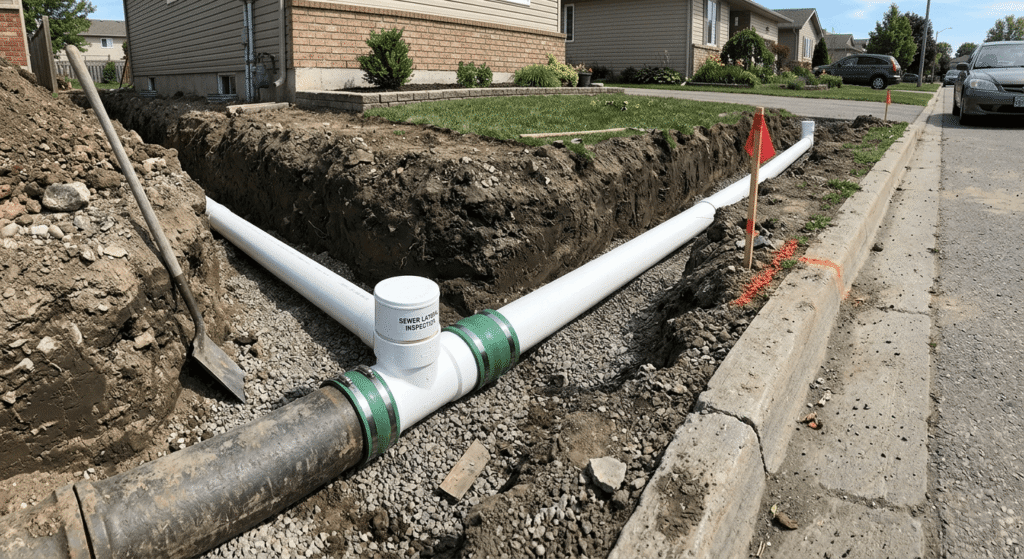
A sewer lateral is the underground pipe that carries wastewater from a home or building to the public sewer main. Every property connected to a municipal sewer system relies on this pipe, yet most owners never see it or think about it until a backup, odor, or inspection report brings it to their attention.
The lateral sits below the yard, driveway, or sidewalk, connecting a building’s internal plumbing to the city’s collection system. Its material, depth, length, and condition determine how well wastewater flows and how soon repair or replacement becomes necessary. Tree roots, pipe age, ground movement, and material degradation are the most common causes of lateral failure.
This guide explains what a sewer lateral is, how it differs from the sewer main, the materials and fittings used in its construction, the signs of failure, and the inspection process that identifies problems. It also covers the available repair and replacement methods, how to choose between them, typical costs, and the maintenance steps that extend a lateral’s service life.
Homeowners preparing for a property sale, responding to a plumbing issue, or planning preventive maintenance will find the specific information relevant to their situation under the corresponding heading below.
What Is a Sewer Lateral?
A sewer lateral is the underground pipe that connects a building’s plumbing system to the public sewer main. It carries wastewater and sewage from a home, business, or other structure away from the property and into the municipal collection system.
The lateral begins at the building’s foundation, where interior drain lines exit through the wall or slab, and extends underground to the connection point at the sewer main, typically located under or near the street. A single-family home lateral commonly ranges from 4 to 6 inches in diameter and runs 40 to 100 feet in length, depending on the distance between the house and the main.
Every fixture in a building that drains water, including toilets, sinks, showers, and washing machines, feeds into this pipe before the wastewater leaves the property. The lateral relies on gravity in most residential installations, so it must maintain a consistent downward slope toward the main to prevent standing water and blockages.
Sewer Lateral vs. Sewer Main: What’s the Difference?
A sewer lateral serves a single property and connects that property to the sewer main, while the sewer main is the larger municipal pipe that collects wastewater from multiple laterals along a street and carries it to a treatment facility. The lateral is a private connection line; the main is a public collection line.
Sewer mains typically measure 8 inches or more in diameter, larger than the 4- to 6-inch laterals that feed into them, because they carry combined wastewater from many properties. A municipality or utility district owns, operates, and maintains the main, while property owners are generally responsible for the lateral on their own land.
Where the Lateral Ends and the Main Begins
The lateral ends and the main begins at the point where the private connection pipe joins the municipal sewer line, usually marked by a wye or tee fitting installed in the main. This connection point sits beneath the street or right-of-way in most residential areas.
A cleanout or check well often marks a transition point along the lateral, separating the section closest to the house from the section that extends toward the main. Some municipalities define the property line, rather than the physical fitting at the main, as the boundary between private and public responsibility. Local ordinances determine the exact boundary, so the dividing line can vary between jurisdictions.
Who Owns and Maintains Each Section
The property owner typically owns and maintains the sewer lateral on their property, while the municipality or utility district owns and maintains the sewer main. Many jurisdictions extend the homeowner’s maintenance responsibility to the full length of the lateral, including the portion beneath the public right-of-way up to the main connection.
Some cities assume responsibility for the lateral segment located within the public right-of-way, splitting maintenance duties between the owner and the municipality at the property line. A property owner should confirm the applicable rule with their local public works department or water and sewer utility, since responsibility boundaries differ by city and county.
Sewer Lateral Materials, Fittings & Depth
Sewer laterals are constructed from cast iron, clay, Orangeburg, PVC, or ABS pipe, connected with fittings that manage direction changes and branch connections, and installed at a depth sufficient to stay below the frost line and support surface loads. Material and depth vary based on the age of the installation and local plumbing code requirements.
Older laterals installed before the 1970s commonly used cast iron or vitrified clay, materials known to corrode or crack over time. Laterals installed from the 1980s onward typically use PVC, which resists corrosion and root intrusion better than earlier materials. Installation depth generally ranges from 18 inches to several feet, depending on regional frost depth requirements and the elevation difference between the house and the main.
Common Sewer Lateral Pipe Materials
The most common sewer lateral pipe materials are cast iron, vitrified clay, Orangeburg (bituminous fiber), PVC, and ABS. Each material has distinct performance characteristics that affect a lateral’s durability and failure risk.
- Cast iron: Resists crushing but corrodes internally over 50 to 100 years, producing rough interior surfaces that trap debris.
- Vitrified clay: Resists chemical corrosion but develops cracked joints that allow tree root intrusion, particularly in pipe manufactured before 1970.
- Orangeburg (bituminous fiber): Was installed primarily between the 1940s and 1970s and deforms or collapses under soil pressure within 30 to 50 years.
- PVC (polyvinyl chloride): Resists corrosion, root intrusion, and chemical damage, with a service life exceeding 100 years under normal conditions.
- ABS (acrylonitrile butadiene styrene): Offers similar corrosion resistance to PVC and is commonly used in colder climates due to its impact resistance.
A pipe’s age and original material often indicate its remaining service life and its likelihood of requiring repair.
Sewer Lateral Fittings and Connection Points
Sewer lateral fittings include wyes, tees, elbows, couplings, and cleanouts, each serving a specific function in directing flow or providing access to the pipe. A wye fitting joins the lateral to the sewer main at an angled connection that reduces flow turbulence.
Elbows change the pipe’s direction where the lateral must curve around obstacles or transition between depths. Couplings join sections of pipe, particularly where materials change during a partial repair or where older pipe connects to newer replacement sections. Cleanouts provide vertical access points at the surface, allowing a plumber or inspector to insert a camera or clearing tool directly into the line without excavation. Connection points, including the wye at the main and the point where the lateral exits the foundation, are common locations for leaks and root intrusion due to the joints present at each fitting.
Signs Your Sewer Lateral Needs Attention
A sewer lateral needs attention when a property shows slow drains, recurring backups, sewage odors, yard sinkholes, unexplained wet spots, or visible tree root growth near the pipe’s path. These signs typically indicate a blockage, crack, or structural failure somewhere along the line.
Symptoms that affect multiple fixtures at once, rather than a single drain, point toward the lateral itself rather than an isolated interior plumbing issue. Symptoms that appear outdoors, such as soggy patches of lawn or sunken soil, indicate that wastewater is escaping the pipe underground.
Slow Drains, Backups & Odors
Slow drains, recurring backups, and sewage odors indicate a partial or full blockage in the sewer lateral, often caused by root intrusion, grease buildup, or a collapsed pipe section. When multiple drains slow down simultaneously, particularly the lowest fixtures in the house such as basement floor drains, the blockage is likely located in the lateral rather than in an individual fixture’s trap.
A backup that occurs after running the washing machine or flushing multiple toilets in succession suggests the lateral cannot handle the combined flow due to a restriction downstream. Persistent sewage odors near floor drains, cleanouts, or in the yard indicate that gas is escaping through a crack or a failed seal rather than venting properly through the plumbing system.
Yard Sinkholes, Wet Spots & Tree Root Intrusion
Yard sinkholes, unexplained wet spots, and visible tree root intrusion indicate that a sewer lateral has cracked, collapsed, or separated at a joint, allowing wastewater and surrounding soil to shift. A sinkhole forms when soil erodes into a broken pipe, leaving a void that eventually collapses under surface weight.
Wet or unusually green patches of grass, present even during dry weather, often mark the location of a leak, since escaping wastewater acts as fertilizer for surrounding vegetation. Tree roots growing toward or through a lateral typically enter at cracked joints or fittings, drawn by the moisture and nutrients inside the pipe, and can expand a small crack into a full blockage within one to two growing seasons.
Sewer Lateral Inspection: What It Involves
A sewer lateral inspection involves inserting a video camera into the pipe through a cleanout or check well to visually assess the pipe’s interior condition, identify blockages, cracks, root intrusion, and misalignment, and record the findings in a written report. Licensed plumbers, inspection companies, and some municipal utilities perform this service.
The inspection process typically takes 30 minutes to an hour for a standard residential lateral and does not require excavation unless the camera reveals a problem that needs physical repair. Municipalities in many jurisdictions require a passing lateral inspection before approving a property sale, remodel permit, or new sewer connection.
Camera Inspection Through the Cleanout or Check Well
A camera inspection is performed by feeding a waterproof video camera attached to a flexible cable through the cleanout or check well and pushing it along the length of the lateral to the sewer main connection. The camera transmits a live video feed to a monitor, allowing the technician to view the pipe’s interior in real time.
A locating transmitter built into the camera head allows the technician to mark the exact position and depth of any defect found during the inspection, using a handheld receiver at the surface. This location data becomes important if excavation or point repair is later required, since it identifies precisely where to dig.
When a Sewer Lateral Inspection Is Required (Home Sales & Permits)
A sewer lateral inspection is required in many jurisdictions before a property sale closes, before a major remodel permit is issued, or before a new water or sewer connection is approved. Local ordinances vary, and some cities mandate the inspection only for properties above a certain age or only within designated sewer service areas.
Some municipalities require the seller to complete any necessary repairs identified in the inspection before the sale can close, while others allow the repair cost to be negotiated between buyer and seller. A buyer or seller should confirm the specific requirement with the local public works department or building permit office, since compliance rules differ by city.
What an Inspection Report Reveals
An inspection report reveals the pipe’s material, diameter, condition, and the location and severity of any defects, including cracks, offset joints, root intrusion, sags (bellies), and blockages. The report typically includes a video recording or still images alongside written notes describing each defect’s location, measured in distance from the starting access point.
A report also documents the pipe’s overall slope and identifies any sections that hold standing water due to insufficient grade. Inspectors commonly rate defects by severity, distinguishing between cosmetic issues that require monitoring and structural failures that require immediate repair or replacement.
Sewer Lateral Repair Options
Sewer lateral repair options include spot repair for isolated damage, trenchless lining (CIPP) for pipes with multiple defects, and grouting for minor cracks and leaks. The appropriate method depends on the defect’s size, location, and extent along the pipe.
Repair methods restore a lateral’s function without replacing the entire pipe, making them less disruptive and generally less expensive than full replacement. A licensed plumber or trenchless contractor determines the appropriate method based on the inspection report’s findings.
Spot Repair for Localized Damage
Spot repair addresses a single localized defect, such as a cracked section or a collapsed joint, by excavating only the affected area and replacing that short section of pipe. A contractor digs a small access pit directly above the damaged section, identified using the location data from the camera inspection, then cuts out and replaces the compromised pipe.
Spot repair suits laterals with one isolated defect surrounded by otherwise sound pipe, avoiding the cost and disruption of a full-length repair. This method is not suitable for laterals with multiple defects spread along the pipe’s length, since each defect would require a separate excavation.
Trenchless Lining (CIPP) for Sewer Laterals
Trenchless lining, also known as cured-in-place pipe (CIPP), repairs a sewer lateral by inserting a resin-saturated felt tube into the existing pipe and curing it in place to form a new pipe within the old one. The process requires access only through the existing cleanout or a small excavation point, avoiding a trench along the pipe’s full length.
The resin liner cures using hot water, steam, or ultraviolet light, hardening into a smooth, jointless pipe that resists root intrusion and corrosion. CIPP lining suits laterals with multiple cracks, minor root intrusion, or general deterioration along the pipe’s length, provided the pipe has not collapsed or lost its round shape. The finished liner reduces the pipe’s interior diameter slightly, typically by less than half an inch, which does not significantly affect flow capacity in most residential applications.
Grouting for Minor Cracks and Leaks
Grouting repairs minor cracks and leaks by injecting a chemical sealant into the pipe at the defect location, sealing the gap from the inside without excavation or lining the full pipe. A contractor positions an inflatable packer at the defect site, identified through camera inspection, then injects grout through the packer to fill the crack and seal it against the surrounding soil.
Grouting suits small, isolated leaks and infiltration points rather than structural damage, since the sealant does not restore the pipe’s structural strength. This method offers a lower-cost option for minor defects but does not address root intrusion, offset joints, or significant cracking, which require lining or spot repair instead.
Sewer Lateral Replacement
Sewer lateral replacement removes the existing pipe and installs a new one, using either trenchless pipe bursting or traditional dig-and-replace excavation. Replacement becomes necessary when a lateral has collapsed, shifted significantly out of alignment, or deteriorated beyond what repair methods can address.
A licensed contractor determines the appropriate replacement method based on the pipe’s condition, the yard’s landscaping and hardscaping, and local permitting requirements. Both methods result in an entirely new pipe, differing primarily in the amount of excavation required and the total project timeline.
Trenchless Replacement (Pipe Bursting)
Pipe bursting replaces a sewer lateral by pulling a bursting head through the existing pipe, fracturing the old pipe outward while simultaneously pulling a new pipe into the space it occupied. This method requires only two access pits, one at each end of the lateral, rather than a continuous trench.
The bursting head, typically attached to a hydraulic or pneumatic pulling machine, breaks the old pipe into the surrounding soil as the new pipe, most commonly HDPE (high-density polyethylene), follows behind it. Pipe bursting suits laterals that need a full-length replacement but where surface features, such as driveways, patios, or mature landscaping, make continuous trenching impractical.
Traditional Dig-and-Replace Installation
Traditional dig-and-replace installation removes a sewer lateral by excavating a continuous trench along the pipe’s entire length, removing the old pipe, and installing a new one before backfilling the trench. This method exposes the full pipe run, allowing a contractor to adjust the slope, depth, or alignment during installation.
Dig-and-replace suits laterals with severe structural failure, significant misalignment, or damage that trenchless methods cannot address, since it allows complete control over the pipe’s placement. This method requires restoring any surface features disturbed by the trench, including landscaping, concrete, or asphalt, which adds to the project’s total cost and timeline.
Permits and Timeline for Replacement
A sewer lateral replacement requires a permit from the local building or public works department in nearly all jurisdictions, and the project typically takes one to three days to complete once work begins. The permit process itself, including plan review and inspection scheduling, can add several days to several weeks before excavation starts.
Most municipalities require a final inspection after replacement, sometimes including a follow-up camera inspection, to confirm the new pipe meets code before the trench is fully backfilled and the permit is closed. A property owner should confirm specific permit requirements and expected timelines with their local permitting office, since processing times vary by jurisdiction and season.
Repair vs. Lining vs. Full Replacement: How to Decide
The decision between repair, lining, and full replacement depends on the number and severity of defects found during inspection, the pipe’s overall structural condition, and the remaining service life of the existing material. A single isolated defect in an otherwise sound pipe favors spot repair, while multiple defects along the pipe’s length favor trenchless lining.
A pipe that has collapsed, lost its round shape, or shifted significantly out of alignment cannot be repaired or lined effectively and requires full replacement. Older pipe materials nearing the end of their expected service life, such as Orangeburg or heavily corroded cast iron, often justify replacement even when only one defect currently appears, since additional failures are likely to follow.
Budget, project timeline, and landscaping or hardscaping constraints also factor into the decision. Trenchless lining and pipe bursting generally cost less in restoration expenses and finish faster than dig-and-replace excavation, making them preferable when the pipe’s condition allows either option. A licensed plumber or trenchless contractor should base the final recommendation on the specific findings of a camera inspection report.
Cost of Sewer Lateral Repair and Replacement
Sewer lateral repair and replacement costs generally range from $1,000 for minor grouting or spot repair to $25,000 or more for a full dig-and-replace installation, depending on the method, pipe length, depth, and site accessibility. Trenchless methods typically cost less in total restoration expense than traditional excavation, despite similar or slightly higher per-foot pipe costs, because they avoid extensive landscaping and surface repair.
Total project cost depends on several combined factors: the repair or replacement method selected, the length and depth of the pipe, the ease of access to the work site, and local labor and permitting rates. Homeowners should request itemized quotes from licensed contractors, since the same defect can produce significantly different costs depending on site conditions.
Cost by Repair Method
Sewer lateral repair costs vary significantly by method: grouting for minor cracks typically costs $250 to $800 per point of repair, spot repair for a localized section typically costs $1,000 to $4,000, and trenchless CIPP lining for a full lateral typically costs $4,000 to $12,000. These ranges reflect the amount of excavation, materials, and labor each method requires.
- Grouting: Lowest cost, suited to single small leaks; does not restore structural strength.
- Spot repair: Moderate cost, limited to one or two localized defects requiring small excavation.
- CIPP lining: Higher cost than spot repair but avoids the restoration costs of full trenching, suited to pipes with multiple defects.
Cost by Pipe Length, Depth & Access
Sewer lateral replacement cost increases with pipe length, installation depth, and difficulty of access, with trenchless pipe bursting typically costing $80 to $250 per linear foot and traditional dig-and-replace typically costing $100 to $300 per linear foot including surface restoration. A longer lateral, deeper trench, or pipe located beneath a driveway, patio, or mature tree increases both labor time and equipment requirements.
Depth adds cost because deeper trenches require additional shoring, dewatering, and excavation volume to reach the pipe safely. Restricted access, such as a lateral running beneath a finished driveway or through a narrow side yard, often pushes a project toward trenchless methods specifically to avoid the added restoration cost of removing and replacing hardscaping.
Sanitary Sewer Service Lead / Riser Cost
A sanitary sewer service lead, also called a riser, connects the property’s lateral to the sewer main and typically costs $2,000 to $6,000 to install or replace when the connection itself requires work rather than the full lateral. This cost applies specifically to the connection fitting and short pipe segment at the main, separate from the cost of repairing or replacing the lateral’s full length.
Municipalities in some jurisdictions require a licensed contractor bonded with the city to perform work on the service lead, since this section connects directly to public infrastructure. Permit fees for lead or riser work are frequently assessed separately from lateral repair permits, adding to the total project cost.
Sewer Lateral Cleanout and Ongoing Maintenance
A sewer lateral cleanout is a capped vertical pipe that provides direct access to the lateral for inspection and clearing, and ongoing maintenance primarily involves preventing root intrusion and grease or debris buildup inside the pipe. Regular maintenance reduces the likelihood of backups and extends the pipe’s service life between major repairs.
A property owner who locates and maintains their cleanout, avoids flushing damaging materials, and schedules periodic root treatment reduces the risk of an emergency backup. Municipalities and plumbers generally recommend camera inspection every two to five years for older laterals, particularly those made from clay or cast iron.
Locating and Using Your Cleanout
A sewer lateral cleanout is typically located near the foundation where the lateral exits the house, along the pipe’s path in the yard, or near the property line, marked by a capped pipe fitting flush with or slightly above ground level. The cap is usually round, threaded, and made of PVC or cast iron, often labeled “sewer” or “cleanout.”
To use a cleanout, a plumber removes the cap with a wrench and inserts a camera, auger, or hydro-jetting hose directly into the lateral without opening interior plumbing fixtures. Locating the cleanout before a plumbing emergency occurs allows faster access for a plumber and avoids unnecessary excavation to find it under time pressure.
Preventing Root Intrusion and Buildup
Root intrusion and buildup are prevented by scheduling periodic root treatment or hydro-jetting, avoiding grease and non-flushable materials in drains, and planting trees away from the lateral’s path. Chemical root treatments, applied through the cleanout, kill roots inside the pipe without harming the surrounding tree, and are typically applied annually or every other year in laterals with a history of root problems.
Hydro-jetting clears grease, scale, and debris buildup from the pipe’s interior walls using high-pressure water, restoring flow capacity without chemicals. Property owners should avoid planting trees with aggressive root systems, such as willows or poplars, within 10 feet of a known lateral path, since root growth toward the pipe’s moisture is a primary cause of cracked joints and blockages.
Sewer Lateral vs. Septic Lateral Lines
A sewer lateral connects a property to a municipal sewer main, while a septic lateral line, also called a leach field or drain field line, distributes treated effluent from a septic tank into the surrounding soil. The two systems serve different purposes and operate independently of a public treatment facility.
A sewer lateral carries raw wastewater directly to a treatment plant operated by a municipality or utility district, while a septic lateral line carries partially treated effluent from an on-site septic tank into perforated pipes buried in gravel trenches, where soil microorganisms complete the treatment process. A property connects to one system or the other, not both, since municipal sewer service and septic systems serve as alternative wastewater disposal methods for properties without access to the other option.