
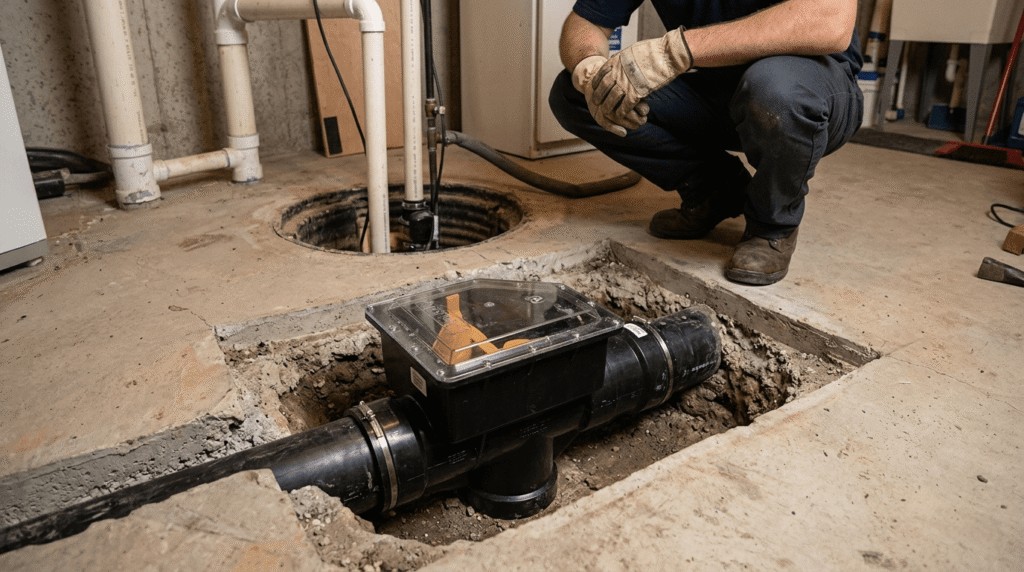
A backwater valve is a plumbing device installed on a building’s main sewer line to stop wastewater from flowing back into the property. The valve allows sewage and wastewater to exit the building in one direction and closes automatically when pressure from the municipal sewer line pushes water back toward the house.
Sewer backups occur when a municipal line becomes overloaded during heavy rainfall, snowmelt, or a blockage downstream of the property. Without a one-way valve on the line, that pressure forces wastewater back through the building’s drains, most often into a basement floor drain or a low-lying fixture. A backwater valve interrupts this reverse flow before it reaches the interior of the building.
Backwater valves differ from backflow preventers and check valves in construction, application, and the type of fluid they control. Homeowners, contractors, and insurers use the term “backwater valve” specifically for sewer-line devices, while “backflow preventer” more commonly refers to devices protecting a potable water supply. Building codes in many municipalities require a backwater valve on any drain located below the street-level sewer connection.
This article explains how backwater valves work, the types and sizes available, where they are installed, how installation and repair costs compare, and how to select and maintain a valve for a residential or septic sewer system.
What Is a Backwater Valve?
A backwater valve is a mechanical device installed in a sewer line that permits wastewater to flow away from a building and blocks reverse flow into it. The valve body contains a moving gate, flapper, or ball mechanism housed inside a section of pipe connected directly to the main sewer line.
The device functions as a one-way check point for sewage. Under normal conditions, the internal mechanism remains open, and wastewater passes through unobstructed. When sewage or floodwater in the municipal line rises and pushes back toward the building, the mechanism closes and seals the pipe. A backwater valve sits below grade, typically in a basement floor or an exterior access chamber, and connects to an inspection cover for servicing.
How Does a Backwater Valve Work?
A backwater valve works by using a gravity- or float-operated gate that closes when wastewater attempts to flow in the reverse direction. The gate remains open during normal drainage so household wastewater can exit through the sewer lateral without restriction.
Inside the valve housing, a hinged flapper or sliding gate rests in the open position under normal flow conditions. Two small floats, one on each side of the mechanism, respond to rising water levels. When sewage backs up from the municipal line, the floats lift, and the resulting buoyancy forces the flapper upward or the gate downward until it seals against the pipe wall. The seal blocks the reverse flow and holds until the water level in the main line drops. Once normal flow resumes, the mechanism reopens by gravity, and drainage from the building continues.
Backwater Valve vs. Backflow Preventer vs. Check Valve
A backwater valve protects a building’s sewer drainage line, a backflow preventer protects the potable water supply, and a check valve is a general one-way flow device used across multiple plumbing and mechanical systems. All three prevent reverse flow, but each protects a different type of pipe and fluid.
A backwater valve installs on the sanitary sewer lateral and blocks sewage from re-entering a building during a municipal line surcharge. A backflow preventer installs on a drinking-water line and stops contaminated water from siphoning back into the clean water supply, a function required for irrigation systems, fire sprinklers, and connections to non-potable sources. A check valve is a broader category of one-way valve used in water supply lines, sump pump discharge lines, HVAC systems, and industrial piping; a backwater valve is a specialized type of check valve built for large-diameter sewer pipe and solids-carrying wastewater. Local plumbing codes typically regulate backwater valves and backflow preventers under separate sections because they serve different public-health functions.
Types of Backwater Valves
Backwater valves are classified by mechanism, default gate position, and pipe diameter. These classifications determine how a valve responds to backflow, how much maintenance it requires, and which sewer lines it fits.
Flapper (Gate) Backwater Valves
A flapper backwater valve, also called a gate backwater valve, uses a hinged plate that swings closed against a seat when reverse flow occurs. The flapper hangs from a pivot point at the top of the valve housing and rests open under gravity during normal drainage.
Reverse flow pressure and rising water levels push the flapper upward until it seats flush against the valve opening, sealing the line. Flapper valves are the most common residential backwater valve type because their mechanical simplicity allows straightforward inspection and cleaning through an access cover. The flapper mechanism can trap solids such as wipes, grease, or debris along its seating edge, which prevents a complete seal and requires periodic clearing.
Normally Open vs. Normally Closed Valves
A normally open backwater valve remains open during standard drainage and closes only when backflow is detected, while a normally closed valve stays sealed and opens only when the building actively drains wastewater. Most residential installations use normally open valves because they allow continuous gravity drainage without manual operation.
Normally open valves rely on floats or a hinged gate that responds passively to reverse pressure, making them suitable for basements, floor drains, and general sewer laterals. Normally closed valves require an active trigger, such as a motorized or spring-loaded actuator, to open during a drainage event; plumbers use this configuration in commercial or industrial systems where continuous sewer access is not required and stricter backflow control is necessary.
Common Sizes (3″ and 4″)
Residential backwater valves are commonly manufactured in 3-inch and 4-inch diameters to match standard sewer lateral pipe sizes. A 4-inch valve fits the primary building sewer line, while a 3-inch valve fits secondary branch lines, such as those serving a single floor drain or fixture group.
Pipe material and local plumbing code determine which diameter a property requires. Cast-iron and PVC sewer laterals in single-family homes typically use 4-inch pipe, so a 4-inch backwater valve installs directly in line without a reducer fitting. A 3-inch valve applies where a branch line serves an isolated fixture, such as a basement laundry tub or a secondary floor drain, and does not carry the full building sewer load. Installing a valve with a mismatched diameter reduces flow capacity and increases the risk of clogging.
Why Sewer Backups Happen and How a Backwater Valve Prevents Them
Sewer backups happen when a municipal sewer line reaches capacity and pushes wastewater back through connected building laterals faster than it can drain away. A backwater valve prevents this outcome by closing the lateral line before the reverse flow reaches the building’s interior fixtures.
Heavy rainfall and snowmelt are the most common triggers, because combined sewer systems carry both stormwater and sanitary waste in the same pipe network. When inflow exceeds the pipe’s capacity, water backs up through the lowest connected points in a building, typically basement floor drains, laundry tubs, or lower-level toilets. Blockages downstream, tree root intrusion, and aging municipal infrastructure produce the same effect independent of weather. A backwater valve interrupts this chain by sealing the building’s sewer connection the moment reverse pressure appears, isolating the property’s plumbing from the surcharged municipal line until normal flow resumes.
Where Backwater Valves Are Installed
Backwater valves are installed at the lowest point of a building’s sewer connection, typically below the basement floor slab, in a dedicated access chamber, or on a branch line serving a specific fixture. Installation location depends on which drains require protection and where the building sewer exits the foundation.
Basement Installation
A basement backwater valve installs in the main sewer line beneath the basement floor, positioned between the foundation wall and the point where secondary drains connect to the lateral. Contractors excavate a section of the concrete slab to access the pipe and install the valve with an above-floor or flush-mounted inspection cover.
This installation protects every fixture connected downstream of the valve, including floor drains, basement bathrooms, and laundry connections, because it sits on the primary line before it exits the building. Placing the valve on the main line, rather than on an individual branch, provides building-wide backflow protection from a single device.
Floor Drain Installation
A floor drain backwater valve installs directly on the branch line serving an individual floor drain rather than on the main building sewer. This configuration protects a single drain opening without requiring excavation of the entire basement slab.
Contractors use floor drain installation when a basement has only one vulnerable opening, such as a mechanical room drain, and the full-lateral installation is not required by local code or budget. Because the valve protects only the connected branch, any other low-level fixture on a separate line remains unprotected unless it has its own device.
Sump Pump Backflow Protection
A sump pump discharge line uses a dedicated check valve, distinct from the building’s sewer backwater valve, to stop pumped water from flowing back into the sump pit after each cycle. This device installs directly on the discharge pipe above the pump.
Sump systems that drain to the municipal storm or sanitary sewer benefit from a backwater valve on the discharge connection in addition to the pump’s built-in check valve, because municipal surcharge can otherwise force sewage back through the discharge line and into the sump pit. Combining both devices protects the sump system from two separate failure points: pump cycling and municipal backflow.
How to Install a Backwater Valve
To install a backwater valve, a licensed plumber locates the main sewer line, excavates access to the pipe, cuts in the valve body, and connects it to an accessible inspection cover.
The plumber first identifies the sewer lateral’s path using existing drawings or a camera inspection, then breaks and removes a section of the basement floor slab or exterior ground surface directly above the pipe. After exposing the sewer line, the plumber cuts out a section matching the valve’s length and installs the backwater valve using solvent-welded or mechanical couplings appropriate to the pipe material. The valve is oriented with the flow arrow matching the direction of drainage, and the access cover is positioned flush with the finished floor or grade for future inspection. Once installed, the plumber tests the mechanism by running water through the line and confirms the flapper or gate opens and seats correctly before pouring new concrete or backfilling the excavation. Many municipalities require a permit and inspection before the installation is covered, since the valve affects the building’s sewer connection to public infrastructure.
Cost of Backwater Valve Installation
Backwater valve installation costs between $500 and $5,000, depending on whether the valve is installed during new construction or retrofitted into an existing home. New construction installation, completed before the foundation slab is poured, costs less because no excavation or slab repair is required.
Retrofitting an existing home requires breaking and repairing the basement floor, which raises the total project cost well above the price of the valve itself. Projects involving deep excavation, difficult pipe access, or additional plumbing repairs can exceed $10,000 in complex cases. The following sections break down the cost by valve type, labor, and the factors that increase total project price.
Valve Cost by Type and Size
A backwater valve, without installation, typically costs between $250 and $1,200 depending on its mechanism, material, and diameter. Standard 4-inch flapper valves fall at the lower end of this range, while larger-diameter or normally closed commercial-grade valves cost more.
PVC flapper valves for residential 3-inch and 4-inch laterals generally cost less than cast-iron or stainless-steel valve bodies rated for commercial use. Valve price also reflects the presence of an integrated inspection cover, dual-flapper redundancy, or a motorized closing mechanism, each of which adds to the base cost of a simple gravity-operated model.
Labor and Excavation Cost
Labor and excavation account for the largest share of a retrofit backwater valve installation, commonly adding $1,500 to $4,000 or more to the project beyond the cost of the valve itself. This cost reflects slab demolition, pipe access, valve installation, and concrete or ground restoration.
Excavation depth, slab thickness, and pipe accessibility determine how many labor hours a project requires. A basement installation with a shallow, easily reached sewer line costs less than a project requiring extensive concrete removal or work around existing utilities. Restoring the excavated area, including new concrete pouring and finishing, is typically billed as a separate line item within the total labor cost.
Cost Factors That Increase the Price
Several site-specific factors increase backwater valve installation cost beyond the base price of the valve and standard labor. These include excavation depth, pipe material compatibility, permit requirements, and the need for additional plumbing repairs discovered during installation.
Deeper sewer lines require more extensive excavation and longer labor hours. Older cast-iron or clay pipe may require adapter fittings or partial pipe replacement to accept a new valve, adding material and labor cost. Permit fees, required inspections, and any municipal rebate or subsidy program also affect the final price a homeowner pays. Unexpected discoveries during excavation, such as a collapsed section of pipe or root intrusion, can add repair costs beyond the original installation estimate.
Common Backwater Valve Problems and Maintenance
Backwater valves develop problems primarily from debris accumulation, mechanical wear, and inaccessible inspection covers. Routine maintenance addresses these issues before they compromise the valve’s ability to seal against backflow.
Homeowners should inspect the valve mechanism at least once a year and after any major backup event, removing debris from the flapper or gate seat and confirming that floats move freely. A valve that fails to seat completely no longer provides backflow protection even though it remains physically installed.
Flapper Failure and Clogging
Flapper failure occurs when debris, grease, or solid waste lodges along the sealing edge and prevents the flapper from closing completely against its seat. A clogged flapper allows sewage to pass through during a backflow event instead of blocking it.
Wipes, feminine hygiene products, and grease buildup are the most frequent causes of flapper obstruction, because these materials do not break down and collect at the hinge or seat line. Regular flushing of only water-soluble waste and periodic manual cleaning through the inspection cover reduce the frequency of flapper failure. A flapper with worn hinges or a warped seal may also fail to close fully and requires replacement rather than cleaning.
Inspection Cover Access
An inspection cover provides direct access to the backwater valve mechanism for cleaning, testing, and repair without re-excavating the sewer line. The cover must remain unobstructed and reachable at all times to allow routine maintenance.
Furniture, flooring, storage shelving, or finished walls placed over an inspection cover block access during an emergency and violate most local plumbing codes, which require the cover to stay visible and reachable. Homeowners should confirm the cover’s location before finishing a basement and install a removable access panel if the cover falls within a finished area.
How to Choose the Right Backwater Valve
Choosing the right backwater valve depends on the sewer line diameter, the number of fixtures requiring protection, local code requirements, and the accessibility of the installation site. Matching these factors to a specific valve type prevents undersized protection or unnecessary cost.
A 4-inch normally open flapper valve installed on the main sewer lateral protects a typical single-family basement with multiple low-level fixtures, while a 3-inch valve on a branch line suits a single isolated drain. Properties in municipalities with combined sewer systems or a documented history of backups benefit from a valve with a dual-flapper or redundant sealing design for added reliability. Local plumbing code often specifies minimum requirements for valve type, access cover placement, and permitted installation location, and these requirements take precedence over general product preference. Homeowners should also confirm that the selected valve’s material is compatible with the existing sewer pipe, since mismatched materials require additional adapter fittings during installation.
Backwater Valves for Septic Systems
A backwater valve on a septic system installs on the building’s sewer line between the house and the septic tank to prevent effluent from flowing back into the building during a tank surcharge or drain field failure. This application protects the home even though no municipal sewer connection is involved.
Septic systems can back up when the drain field becomes saturated, the tank reaches capacity, or a blockage forms in the line between the house and the tank. A backwater valve positioned on the house side of this connection closes under the same reverse-pressure conditions as a municipal sewer valve, sealing the building’s drains before effluent reaches basement fixtures. Because septic lines carry solids at a different rate than municipal sewer connections, the valve requires the same periodic inspection and debris clearing as a municipal installation to remain effective.