
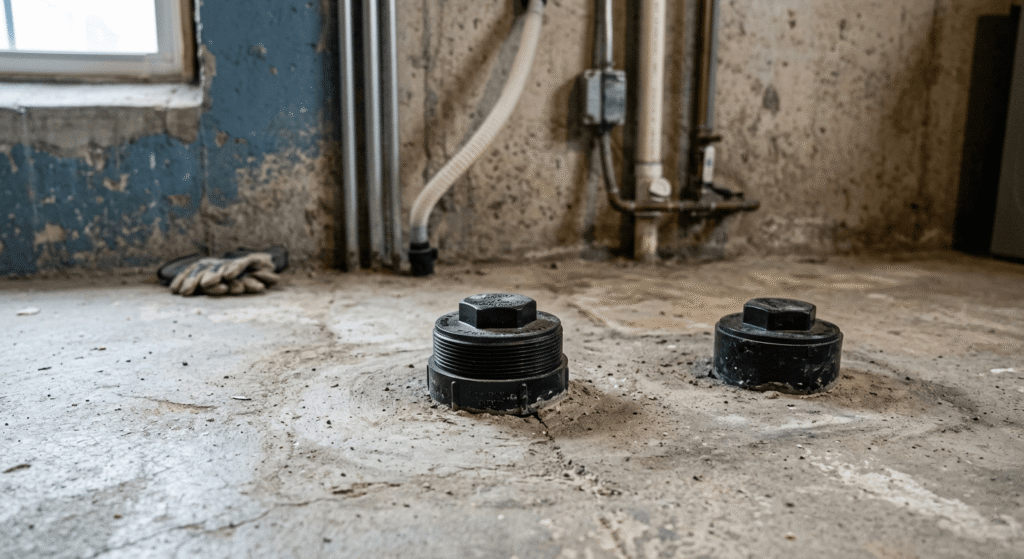
A drain cleanout is an access point built into a home’s plumbing system that allows a plumber or homeowner to reach the main drain line without cutting into walls or floors. The fitting connects directly to the sewer or septic line and terminates at a capped opening, usually a short pipe stub with a threaded plug.
Most homes built after the mid-20th century include at least one cleanout near the foundation, and many include additional cleanouts at specific fixtures or along the yard line leading to the municipal sewer or septic tank. Plumbing codes in the United States require cleanouts at defined intervals and direction changes so that clogs can be cleared without disturbing the surrounding structure.
This article explains what a drain cleanout is, how it looks, and how it fits into a home’s plumbing system. It also covers the main types of cleanouts, the plugs and covers used to seal them, how to locate a cleanout, code requirements, cleaning procedures, common problems, and typical repair costs.
Understanding these components helps a homeowner identify the correct access point during a clog, communicate accurately with a plumber, and recognize when a cleanout requires repair or replacement.
What Is a Drain Cleanout?
A drain cleanout is a capped pipe fitting that provides direct access to a home’s drain or sewer line for clearing blockages. The fitting connects to the main drainage system at a point where a plumbing snake, auger, or hydro-jetting hose can be inserted to remove debris, grease, roots, or other obstructions.
A cleanout consists of a short pipe section, typically made from PVC, ABS, or cast iron, fitted with a removable plug or cap. The plug seals the opening under normal conditions and prevents sewer gas from escaping into the home or yard. Plumbing codes require cleanouts at the point where a building drain leaves the structure, at changes of direction exceeding a specified angle, and at maximum horizontal run intervals. This placement allows a technician to clear a clog from the nearest accessible point rather than removing a toilet or cutting into a wall.
What Does a Drain Cleanout Look Like?
A drain cleanout looks like a short vertical or angled pipe stub, capped with a round plastic or metal plug, that protrudes slightly above ground level or sits flush against an interior wall or floor. Outdoor cleanouts commonly appear as a white or black PVC pipe, two to four inches in diameter, rising a few inches out of the soil near the foundation or property line.
The visible portion typically ends in a threaded cap with raised ridges or a square-drive fitting that accepts a wrench. Indoor cleanouts often appear as a flat, round cover set into a basement floor, utility room wall, or the base of a vertical stack. Older homes may have cast-iron cleanouts with a countersunk plug that requires a specialized wrench to remove. A cleanout’s exposed cap is the only visible portion; the pipe fitting itself sits below the surface or inside the wall cavity, connected directly to the drain line.
How a Cleanout Fits Into Your Home’s Plumbing System
A cleanout fits into a home’s plumbing system as a branch access point connected to the main drain line, positioned between the fixtures inside the house and the municipal sewer or septic connection. Wastewater from sinks, toilets, tubs, and appliances flows through individual fixture drains into branch lines, which merge into the building’s main drain.
The main drain carries combined wastewater to the sewer lateral or septic tank line outside the home. Cleanouts sit along this path at the base of vertical stacks, at the point where the drain exits the foundation, and at intervals along the lateral line to the property boundary. Because a cleanout connects directly to the main line rather than a single fixture, it gives access to blockages that affect multiple drains at once, such as a clog in the primary line rather than an isolated fixture trap.
Types of Drain Cleanouts
Drain cleanouts are classified by four criteria: location, connected system, property type, and the fixture they serve. Each classification identifies a different aspect of the cleanout’s placement or function within the plumbing system, and a single home typically contains cleanouts from more than one category.
By Location: Indoor vs. Outdoor Cleanouts
An indoor cleanout is installed inside the home, commonly in a basement, crawl space, garage, or utility closet, while an outdoor cleanout is installed in the yard between the house and the municipal sewer connection or septic tank.
Indoor cleanouts sit at the base of a vertical stack or near the point where the main drain exits the foundation wall, giving direct access to interior plumbing without excavation. Outdoor cleanouts appear as a capped pipe rising slightly above grade, positioned along the sewer lateral, and provide access to the section of pipe between the house and the street or septic system. A home may include both types, since indoor cleanouts address clogs originating within the house and outdoor cleanouts address clogs or root intrusion in the section of pipe buried underground.
By System: Sanitary Sewer, Septic, and Storm Drain Cleanouts
Cleanouts are also classified by the drainage system they serve: sanitary sewer cleanouts access wastewater lines connected to the municipal sewer, septic cleanouts access the line running from the house to a septic tank, and storm drain cleanouts access lines that carry rainwater and surface runoff away from the property.
A sanitary sewer cleanout connects to the pipe carrying wastewater from household fixtures to the public sewer main. A septic cleanout serves the same function for homes with an onsite septic system, connecting the house drain to the septic tank inlet. A storm drain cleanout connects to a separate piping network that channels rainwater from gutters, downspouts, or yard drains away from the foundation, and it does not carry sewage. Each system requires its own cleanout because the three pipe networks remain physically separate to prevent cross-contamination and to comply with local plumbing codes.
By Property: Residential vs. Commercial Cleanouts
A residential cleanout serves a single-family or multi-unit dwelling and typically uses two- to four-inch pipe, while a commercial cleanout serves a business or multi-tenant building and often uses larger-diameter pipe to accommodate higher wastewater volume.
Residential cleanouts are sized to match standard household drain lines and are usually limited to one or two access points per property, aside from fixture-specific cleanouts. Commercial cleanouts frequently include additional access points to serve separate tenant systems, grease traps, or higher-capacity drain runs, and local code may require more frequent cleanout placement based on projected flow volume. Commercial properties also more commonly use cast-iron or heavy-duty PVC fittings rated for higher structural loads, particularly when a cleanout is installed beneath a parking area or loading dock.
Fixture Cleanouts (Kitchen, Bathroom, Toilet)
A fixture cleanout is a small access point installed near an individual sink, tub, or toilet drain, allowing a clog in that specific fixture’s trap or branch line to be cleared without accessing the main drain.
Kitchen fixture cleanouts are commonly located under the sink, near the trap, and address grease or food debris blockages close to their source. Bathroom fixture cleanouts serve sink and tub drains and are typically built into the trap assembly or a nearby wall access panel. Toilet cleanouts, when present, connect near the base of the toilet drain and allow access to the closet bend without removing the toilet. Fixture cleanouts address localized clogs; a blockage that affects multiple fixtures at once typically requires access through the main line cleanout instead.
Cleanout Plugs and Covers Explained
A cleanout plug is the removable fitting that seals the opening of the cleanout pipe, and a cleanout cover is the visible cap or plate that protects the plug and the surrounding installation from weather, foot traffic, or accidental damage.
The plug creates an airtight and watertight seal that prevents sewer gas from escaping and keeps groundwater or debris from entering the drain line. Covers serve a secondary, protective role and are used most often on floor-mounted or ground-level cleanouts where the fitting could otherwise be exposed to impact or moisture. Not every cleanout uses a separate cover; many rely on the plug alone, with the cover added in locations with heavier foot traffic or decorative flooring.
Types of Cleanout Plugs
The two main cleanout plug types are threaded plugs and countersunk plugs, distinguished by how they attach to the cleanout fitting and how they are removed.
A threaded plug screws directly into a matching threaded fitting and is removed with a wrench or pliers applied to raised ridges or a square-drive head. Threaded plugs are the standard choice for PVC and ABS cleanouts and are available in various diameters to match two-, three-, and four-inch pipe. A countersunk plug, more common in older cast-iron installations, sits flush within a recessed fitting and requires a specialized cleanout wrench or ratchet to grip and turn. Countersunk plugs resist accidental removal but can corrode over time, making them more difficult to remove without proper tools.
Types of Cleanout Covers and Caps
Cleanout covers and caps fall into three common types: flush-mounted floor covers, raised yard box covers, and decorative interior covers, each designed for a different installation location.
A flush-mounted floor cover sits level with a basement or garage floor and protects an indoor cleanout from foot traffic while remaining accessible without excavation. A raised yard box cover encloses an outdoor cleanout at grade level, typically using a plastic or metal box with a lid that can be lifted for access while keeping the pipe protected from lawn equipment and weather. A decorative interior cover conceals a cleanout located in a finished space, such as a hallway or closet, using a hinged or removable plate that matches surrounding flooring or wall material. All three cover types protect the underlying plug and pipe rather than replacing the seal the plug provides.
How to Find Your Drain Cleanout
A drain cleanout can typically be found by checking the basement, crawl space, or garage floor near the foundation wall, and by inspecting the yard along a straight line between the house and the street or septic tank.
Inside the home, look for a capped pipe fitting, usually two to four inches in diameter, protruding from the floor or a low section of wall near where the main drain exits the building. In homes without a basement, check utility closets, garages, or the exterior foundation wall closest to the kitchen or bathroom plumbing. Outdoors, cleanouts often sit a few feet from the foundation, along the path connecting the house to the sewer lateral or septic tank, and may appear as a capped pipe stub rising from the grass or a covered access box. A home’s original plumbing permit or inspection report, when available, frequently indicates the exact cleanout location.
What to Do If Your House Has No Cleanout
If a home has no accessible cleanout, a licensed plumber can install one at the foundation exit point or along the sewer lateral to provide future access for clearing clogs and performing camera inspections. Older homes, particularly those built before mid-20th-century plumbing codes required cleanouts, sometimes lack this access point entirely. Without a cleanout, clearing a blockage may require removing a toilet, cutting into the drain line, or accessing the line through a roof vent stack, all of which increase labor time and cost. Installing a cleanout resolves this limitation permanently and brings the plumbing system closer to current code requirements.
Cleanout Size and Code Requirements
Cleanout size and placement are governed by local plumbing codes, which generally require a cleanout diameter equal to the connected pipe for lines up to four inches, along with specific placement rules based on pipe length and direction changes.
Under the International Plumbing Code (IPC) and Uniform Plumbing Code (UPC), cleanouts are typically required at the point where the building drain exits the foundation, at each change of direction greater than 45 degrees, and at intervals not exceeding 100 feet on horizontal drain runs. Vertical stacks generally require a cleanout at the base. Local jurisdictions may adjust these requirements, so code compliance should be confirmed with the applicable local plumbing authority before installation or modification. Meeting these requirements ensures that any section of the main drain can be reached for maintenance without excessive excavation or demolition.
How to Clean Out a Drain Using the Cleanout
To clean out a drain using the cleanout, shut off any water sources feeding the affected line, remove the cleanout plug slowly to relieve pressure, and insert a plumbing snake or auger into the opening to break up or retrieve the blockage.
Place a bucket or towels beneath the cleanout before removing the plug, since standing wastewater can drain out once the seal is broken. Feed the snake cable into the pipe in the direction of the blockage, applying steady pressure while rotating the cable to catch or break apart debris. For root intrusion or heavier blockages, a hydro-jetting attachment can clear the line using pressurized water instead of a mechanical cable. After clearing the obstruction, run water through the system to confirm proper drainage, then reseal the cleanout with the original plug, applying plumber’s tape or pipe joint compound to restore a watertight seal.
Common Drain Cleanout Problems
Common drain cleanout problems include a stuck or corroded plug, a cracked or damaged cleanout pipe, sewer gas odor from a failed seal, and repeated clogging near the cleanout access point.
A stuck or corroded plug, most frequent in older cast-iron fittings, can resist removal and may require penetrating oil or a specialized wrench to loosen without damaging the fitting. A cracked or damaged pipe, often caused by ground shifting, freezing temperatures, or physical impact, can allow groundwater infiltration or wastewater leakage near the cleanout location. Sewer gas odor at or near a cleanout typically indicates a deteriorated seal, a missing plug, or a dried-out trap, and it requires prompt repair because sewer gas contains methane and hydrogen sulfide. Repeated clogging near a specific cleanout can indicate a low spot in the pipe (a “belly”), root intrusion, or a partial blockage further down the line that a single cleaning does not fully resolve.
Sewer Cleanout vs. Septic Cleanout: What’s the Difference?
A sewer cleanout connects a home’s drain line to the municipal sewer main, while a septic cleanout connects the same type of drain line to an onsite septic tank, and the two differ primarily in their downstream destination and the maintenance considerations that follow from it.
Both cleanout types use similar pipe materials, diameters, and plug or cap fittings, and both provide access for snaking or jetting a clogged line. The sewer cleanout’s downstream section connects to a municipal system maintained by a local utility, so blockages beyond the property line typically fall under the utility’s responsibility. The septic cleanout’s downstream section connects to a privately owned septic tank, so a clog, backup, or odor issue may originate from a full or failing tank rather than the pipe itself, requiring tank inspection or pumping in addition to standard drain cleaning. Homeowners with a septic system should also confirm that any cleanout maintenance does not disturb the tank’s inlet baffle, which regulates flow into the tank.
Cost to Install or Repair a Sewer Cleanout
Installing a new sewer cleanout typically costs between $150 and $800, while repairing or replacing an existing cleanout generally costs between $100 and $500, with the exact price depending on pipe depth, accessibility, and local labor rates.
A straightforward installation at an accessible foundation point, requiring minimal excavation, falls toward the lower end of the range. Installations requiring deeper excavation, concrete or asphalt removal, or placement farther from the foundation increase labor and material costs. Repair costs vary based on the extent of damage: replacing a worn plug or cover costs less than repairing a cracked pipe section or correcting a fitting damaged by root intrusion. Regional labor rates, permit requirements, and whether the work is performed as part of a larger sewer line repair also affect the final price, so a licensed local plumber should provide a site-specific estimate before work begins.