
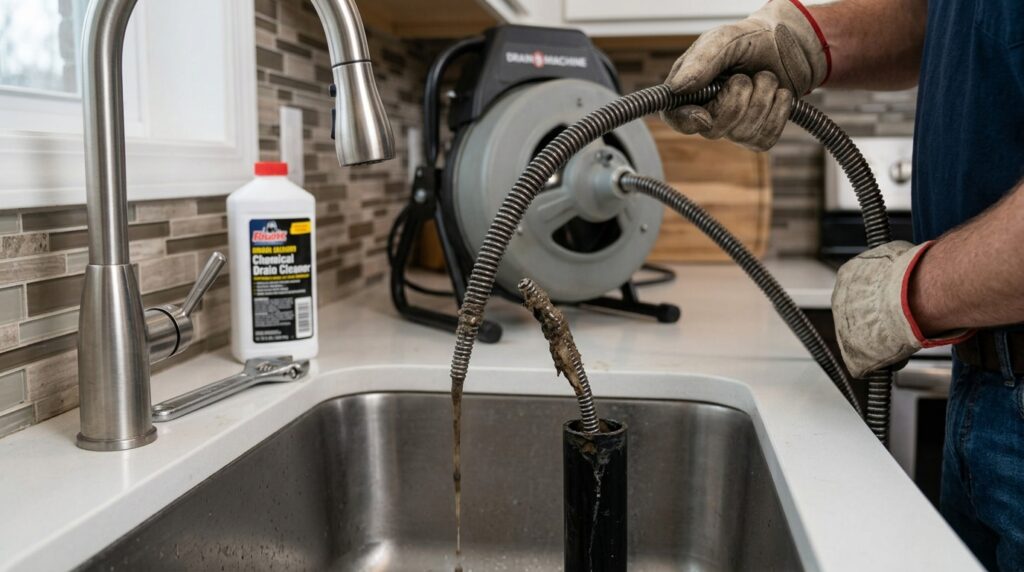
Drain snaking costs $100 to $275 for most sink, tub, shower, toilet, and laundry drains and $150 to $500 for a main sewer line, based on 2025–2026 figures from HomeGuide. National averages from Angi ($246) and HomeAdvisor ($237) fall inside the same fixture-drain range.
Snaking clears a clog by feeding a coiled steel cable, called a drain snake or drain auger, through the pipe. The rotating head of the cable breaks apart the blockage or hooks it so the plumber can pull it out. Plumbers use hand-cranked snakes for sink and tub drains and motorized machines for longer or larger lines.
The final invoice depends on the drain being cleared, the depth and type of the clog, how easily the plumber reaches the pipe, the time of the visit, and whether the company charges a flat rate or an hourly rate. Published price ranges differ between sources because each guide uses different data, regions, and service definitions.
This guide covers the average snaking cost, the price by drain type, main sewer line costs, the factors that change the final price, alternatives to snaking, DIY savings, and the steps that prevent surprise charges. All prices are in U.S. dollars and represent published ranges, not guaranteed quotes.
Average Cost for a Plumber to Snake a Drain
A plumber charges $100 to $275 on average to snake a typical household drain, and national cost guides place the average per visit between $237 and $250. Angi reports an average of $246 within a $147 to $352 range, and HomeAdvisor reports $237 within a $145 to $350 range.
Complex clogs cost more than the typical range. Forbes Home reports that intense clogs can reach $800, and HomeAdvisor identifies $350 or more as the price of a complex clog. Simple clogs in an accessible fixture drain sit at the low end of the range, near $100 to $150.
Flat-Rate vs. Hourly Pricing
Plumbers charge for snaking either as a flat rate per drain or as an hourly rate. Flat-rate snaking averages about $250 according to Forbes Home, and hourly labor ranges from $45 to $200 per hour according to HomeAdvisor, with emergency rates higher.
A flat rate fixes the price before work begins, which suits a single fixture drain with a predictable clog. An hourly rate suits jobs where the clog depth is unknown, several drains need clearing, or the plumber must disassemble plumbing to reach the blockage. Confirm in advance whether a flat rate includes the trip charge, the length of cable, and a second attempt if the first pass fails.
Drain Snaking Cost by Drain Type
Snaking costs $100 to $275 for fixture drains, and the price depends on the fixture. HomeGuide lists $100 to $220 for a kitchen sink, $100 to $250 for a bathtub, and $100 to $275 for a toilet, sink, tub, shower, or laundry drain as a group.
Price differences between fixtures reflect pipe access, the type of debris, and the tool required. Kitchen drains collect grease and food waste, bathroom drains collect hair and soap, and toilets require a specialized auger.
Kitchen Sink Drain
Snaking a kitchen sink drain costs $100 to $220 according to HomeGuide, and Thousand Oaks Plumbing gives a similar range of $125 to $225. The price rises when the clog sits deep in the line or when the plumber must remove part of the plumbing, such as the P-trap, to reach it.
Grease, food residue, and soap buildup cause most kitchen clogs. A sink connected to a garbage disposal adds a diagnostic step, because the plumber first confirms the disposal is not the source of the blockage. If the sink stays clogged after snaking, HomeGuide lists garbage disposal replacement at $200 to $550.
Bathroom Sink Drain
Snaking a bathroom sink drain costs $125 to $225 according to Forbes Home, which groups kitchen and bathroom sinks under one range with an average of $175. Bathroom sink clogs are shallow and accessible, so they fall near the low end of fixture pricing.
Hair, toothpaste, and soap scum collect in the trap and the pipe directly below the basin. A hand snake clears these blockages without a motorized machine, and the job rarely requires more than one visit.
Bathtub and Shower Drain
Snaking a bathtub or shower drain costs $100 to $250. HomeGuide lists $100 to $250 for a tub, Forbes Home lists $165 to $250, and Plumbing Diagnostics lists $150 to $250 for a shower or tub.
Hair is the most common cause of tub and shower clogs, and the blockage often sits beyond the visible drain opening. A tub can cost more than a sink because the plumber may need to remove the overflow plate or the drain stopper before feeding the cable into the pipe.
Toilet (Toilet Auger vs. Drain Snake)
Clearing a toilet costs $100 to $275 according to HomeGuide, and Forbes Home reports an average near $225, with simple clogs starting at $150 and complex clogs reaching $300. The price depends on whether a toilet auger can clear the blockage or whether the plumber must remove the toilet.
A toilet auger (closet auger) is a short, rigid tool with a protective sleeve that passes through the curved trap of the toilet without scratching the porcelain. A drain snake is a longer cable used when the blockage sits past the toilet trap, inside the drain line. If several fixtures back up at the same time, the clog is likely in a branch line or the main line, which moves the job into main-line pricing. When a toilet must be pulled, HomeGuide lists a cracked flange or wax ring replacement at $10 to $25 for parts.
Main Sewer Line Snaking Cost
Snaking a main sewer line costs $150 to $500 for most homes. HomeGuide lists $200 to $500, Angi lists $100 to $400, and Thousand Oaks Plumbing lists $150 to $500 or more. HomeGuide places the full range of sewer line cleaning at $200 to $1,400 when both snaking and hydro jetting are counted.
The main sewer line is the single large pipe that carries wastewater from every fixture in the house to the municipal sewer or septic system. A blockage in this line produces backups in several fixtures at once, and HomeGuide states that a professional plumber should always clear main line clogs.
Why Main Line Cleaning Costs More Than Fixture Drains
Main line cleaning costs more than fixture drain cleaning because the pipe is larger, longer, and more difficult to reach, and the work requires a motorized machine. HomeGuide reports that a machine-powered snake reaches 50 to 75 feet for residential blockages and costs $250 to $1,000 to buy, so plumbers price the equipment into the service.
Access adds further labor. HomeGuide notes that older homes without a cleanout require the plumber to enter the line through a toilet, a sink drain, or a roof vent. Tree roots, the most common cause of deep main line blockages, require a cutting attachment on the cable. A main line failure also carries a higher consequence than a sink clog, because a full blockage can send sewage back into the home.
Cost by Method: Snaking vs. Hydro Jetting
Snaking a main sewer line costs $200 to $500 according to HomeGuide, and hydro jetting costs more. HomeGuide lists $600 to $1,400 for severe or stubborn clogs, Angi gives an average of $475 within a $350 to $600 range for a full visit, and Yelp gives $200 to $550. The spread between sources reflects differences in line length, clog severity, and regional pricing.
Snaking cuts a channel through the blockage, and hydro jetting uses high-pressure water to scour the pipe walls and remove grease, scale, and roots. HomeGuide states that jetting can keep a line clear for 2 to 3 years, which lowers long-term cost for recurring clogs. Snaking suits minor to moderate clogs near the cleanout. Hydro jetting cannot repair a broken pipe, and a plumber typically inspects an older line with a camera first to confirm that the pipe can withstand the water pressure.
When a Camera Inspection Is Worth the Extra Cost
A camera inspection is worth the extra cost when a main line clogs again shortly after snaking, when the pipe is old, or when hydro jetting or a major repair is planned. The camera shows whether the cause is roots, a crack, an offset joint, or buildup, which determines the correct repair.
Published prices vary widely. HomeGuide lists $125 to $750, and Angi lists $271 to $1,725 with a 2026 national average of $995. Line length, camera type, and access drive the difference, and a home without a cleanout may need the toilet pulled to insert the camera. An inspection only diagnoses the pipe and does not include cleaning or repair. A first-time clog in a single fixture drain does not justify the added cost.
What Changes the Final Price of Snaking a Drain
Four factors change the final price of snaking a drain: clog severity and depth, access to the drain or cleanout, service-call and after-hours fees, and the plumber and region. The drain type and the choice between flat-rate and hourly pricing, covered above, set the starting price that these factors adjust.
Clog Severity and Depth
Deeper and denser clogs raise the price because they take longer to clear and may require a motorized machine instead of a hand snake. Typical fixture clogs fall within $100 to $275, while complex clogs run from $350 to $800 according to HomeAdvisor and Forbes Home.
Grease compaction, foreign objects, and tree roots increase the difficulty of a clog. Snaking can also reveal a damaged pipe, root intrusion, or sewer line buildup, and any repair that follows is an added charge.
Access to the Drain or Cleanout
Hard-to-reach pipes increase labor time and cost. A drain with a visible trap or an exterior cleanout allows direct entry for the cable, while a drain that requires removing a toilet, disassembling pipework, or entering through a roof vent adds time.
Access also affects which tool the plumber uses. A line with a cleanout accepts a motorized machine with a longer reach, and a line without one limits the plumber to the fixture openings, which can reduce how far the cable travels.
Service Call, After-Hours and Emergency Fees
Plumbers add fees for calls at night, on weekends, and on holidays, and HomeAdvisor reports that emergency rates can run much higher than standard rates. The surcharge reflects the urgency and the off-hours labor, not the difficulty of the clog.
Many companies also charge a separate service-call fee to dispatch a technician. Fee amounts vary by company, so ask whether the fee is separate from the snaking charge and whether it is credited toward the final bill.
Plumber and Region (Local vs. National Brand)
Plumber and region change the price because labor rates follow the local cost of living and business expenses. HomeAdvisor reports hourly plumber rates from $45 to $200, and the position within that range depends on the market.
National brands often quote higher prices than the general fixture range. HomeGuide lists Roto-Rooter snaking at $225 to $500 on average, compared with $100 to $275 for the typical fixture drain. Local plumbers set their own rates, so quotes from both types of provider give a more accurate comparison than a single national average.
Snaking vs. Other Drain Cleaning Methods: Cost and When Each Fits
Snaking is the lowest-cost professional drain-clearing method for a single, localized clog, at $100 to $275 for a fixture drain. Hydro jetting costs $350 to $900 for a residential drain according to VIP Drain Services, and a camera inspection adds $125 to $1,725 depending on the source and the line.
Each method fits a different problem. Plunging and hand snaking fit simple fixture clogs within reach. Motorized snaking fits a deeper blockage in a branch or main line. Hydro jetting fits grease, scale, root growth, and clogs that return, because it cleans the full pipe interior. A camera inspection fits unknown or recurring problems, because it identifies the cause before any cleaning begins. Yelp notes that plunging or snaking a severe blockage can push the clog deeper into the line, which makes a method change necessary. When the camera shows a cracked or collapsed pipe, cleaning does not solve the problem, and HomeGuide lists sewer line replacement at $50 to $250 per linear foot.
DIY Drain Snaking vs. Hiring a Plumber: Cost Comparison
DIY drain snaking costs $10 to $70 for a hand snake, compared with $100 to $300 for a plumber, according to Johnny Rooter Plumbing. Angi reports that clearing a minor clog yourself saves an average of more than $100.
DIY snaking suits shallow, accessible clogs in a sink, tub, or shower where hair or soap is the likely cause. A homeowner who buys a motorized machine pays $250 to $1,000 according to HomeGuide, which exceeds the cost of a single professional visit and is justified only for repeated use. HomeGuide recommends a professional for any main line clog.
Incorrect snaking carries its own cost. Monkey Wrench Plumbing warns that repeated snaking can damage pipes, and a failed DIY attempt still ends with a plumber’s fee, sometimes at a higher price if the clog has been pushed deeper. The lower upfront price makes DIY the cheaper option only when the clog is simple and the tool matches the drain.
How to Get a Fair Price and Avoid Surprise Charges
To get a fair price, request a written, itemized quote before work begins and compare it with the typical ranges of $100 to $275 for a fixture drain and $150 to $500 for a main line. A quote above those ranges needs a stated reason, such as a deep clog, difficult access, or after-hours service.
Confirm what the quote includes: the service-call fee, the number of drains, the cable length, any camera inspection, and a guarantee if the clog returns. Ask the plumber to state in writing that additional work, such as pipe repair or hydro jetting, requires approval before it starts. Quotes from at least two licensed local plumbers give a reliable comparison for the same job.
What Heavily Discounted “69/99″ Specials Usually Include
Heavily discounted “69/99” specials commonly cover a limited-scope service, such as one accessible fixture drain, standard business hours, and a short length of cable. These prices sit below the $100 low end of typical fixture-drain ranges, so the offer is an entry price and not the expected final bill.
Check the conditions before booking. Ask whether the special applies to the drain type you have, whether it covers a main line, whether service-call fees are extra, and what price applies if the clog is deeper than the included cable length. A special that excludes your drain or converts to hourly billing on arrival can end above the standard price.
Signs the Clog Needs More Than Snaking
A clog needs more than snaking when it returns within weeks or months, when several fixtures back up at once, or when a camera shows pipe damage. Home Rangers states that snaking opens a channel through buildup, so the clog often returns, while a recurring problem points to roots, cracks, offsets, or heavy buildup in the line.
Other signs include slow drains throughout the house, sewage odor, and a snake that cannot pass a certain point. A camera inspection confirms the cause. HomeGuide lists sewer backup repairs at $500 to $2,000 or more and sewer line replacement at $50 to $250 per linear foot, so identifying a failing line early limits the damage and the total cost.
Drain Snaking Prices in Your City
Drain snaking prices in a given city follow the national range of $100 to $300 for fixture drains and $150 to $500 for main lines, adjusted by local labor rates and market conditions. Hourly plumber rates of $45 to $200 reflect the spread between lower-cost and higher-cost markets.
The most accurate price for a specific city comes from licensed local plumbers. Provide the drain type, the number of fixtures affected, the access point, and the preferred time of service when requesting quotes, because these details determine whether the quote lands near the low or high end of the range. Compare at least two written quotes and use the national ranges in this guide as the benchmark for a fair price.