
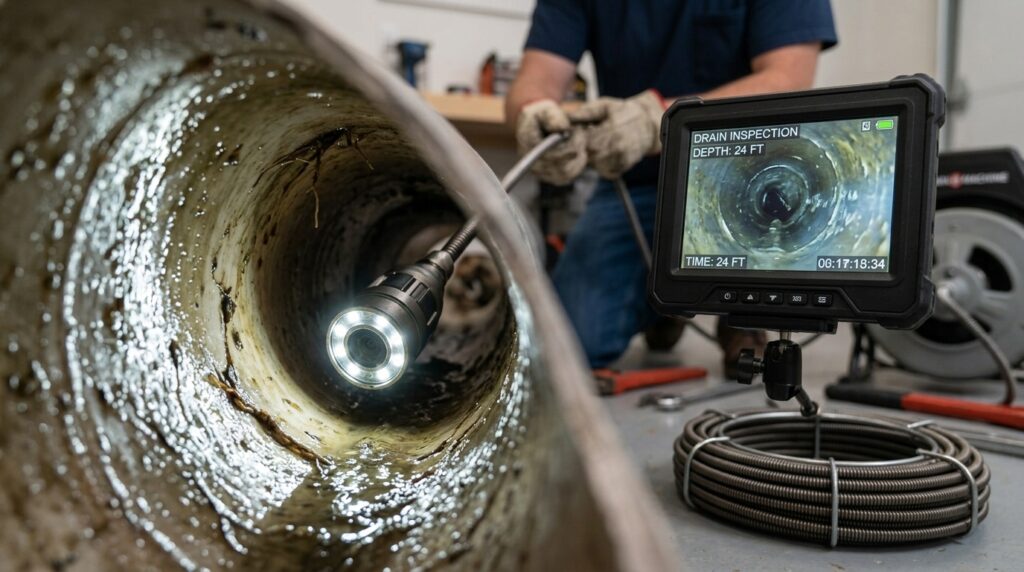
A drain camera inspection costs between $100 and $500 for most residential jobs in the United States. The final price depends on the inspection type, the length and layout of the pipe, access to the line, and how the provider charges. Specialized scopes, such as a pre-purchase sewer scope with a written report, sit at the upper end of that range or above it.
A drain camera inspection sends a waterproof camera on a flexible cable or push rod through a drain or sewer line. The camera transmits live video to a monitor, and the technician records the footage. The footage shows pipe material, joints, slope, blockages, root intrusion, cracks, offsets, and collapsed sections without excavation. Plumbers, drain-cleaning companies, and some home inspectors perform the service.
Homeowners order camera inspections for three main reasons: to find the cause of slow drains or sewer backups, to check the sewer line before buying a house, and to verify a line after cleaning or repair. Each reason produces a different scope of work, which explains much of the price variation between quotes.
This article explains typical prices by inspection type, why published price ranges disagree, what the fee includes, which factors raise or lower the cost, how prices differ by situation, which extra charges appear on the final bill, who performs the work, when a DIY scope is adequate, and how to get a fair quote. All dollar figures are U.S. dollars and represent general market ranges. Local prices vary, so confirm the final figure with a written quote.
How Much Does a Drain or Sewer Camera Inspection Cost?
A drain or sewer camera inspection costs $100 to $500 for most homes, with a national midpoint near $250 to $350 for a standard inspection of one line. Inspections that include line locating, a written report, or access work can reach $600 to $1,000.
The price reflects labour time, equipment use, and report preparation rather than the camera alone. A short inspection of a single accessible drain takes 30 to 60 minutes, while a full-home inspection of several lines takes two hours or more. Providers price the visit to cover technician time, travel, equipment wear, and documentation.
Typical Price by Type of Inspection (basic, pre-purchase, with locating, full-home)
Typical prices are $100 to $300 for a basic inspection, $150 to $500 for a pre-purchase sewer scope, $250 to $600 for an inspection with line locating, and $400 to $1,000 for a full-home inspection of all drain and sewer lines.
A basic inspection examines one drain or the main sewer line from a single access point and ends with a verbal summary or short video. A pre-purchase inspection covers the full run from the house cleanout to the municipal connection or septic tank and usually produces a written report with recorded footage. An inspection with locating adds a transmitter in the camera head, which lets the technician mark the surface position and depth of a defect; the locating step typically adds $100 to $250 to the base price. A full-home inspection scopes the main line plus branch lines such as kitchen, bathroom, and laundry drains, so cost rises with the number of lines inspected.
Why Published Price Ranges Disagree (information gain)
Published price ranges disagree because sources measure different services, use different regions, and report different statistics, such as a low-to-high range, an average, or a median.
A guide that lists $100 to $250 usually describes a basic scope of one accessible drain. A guide that lists $300 to $800 usually describes a sewer-line scope with locating and a report. Averages also shift with the data source: a figure based on online quote requests differs from one based on completed invoices, and a figure from a high-cost metropolitan area differs from a national figure. Some published ranges include same-day or emergency service, while others exclude trip fees and cleaning. Compare any published range against the inspection type, the line length, and the included deliverables before treating it as a benchmark for your own quote.
What Your Inspection Fee Actually Covers
An inspection fee covers the technician’s time on site, use of the camera and monitor, the visual assessment of the pipe, and a recording or report of the findings. The exact deliverables depend on the provider and the inspection type.
A standard fee includes travel to the property, setup at the access point, and the camera run through the line. The technician identifies the pipe material, notes visible defects, and estimates the distance to each problem. Many providers record the footage and send it by email, on a USB drive, or through a cloud link. Pre-purchase inspections usually add a written report with timestamps, photographs, and a condition summary.
The fee does not usually cover cleaning, hydro-jetting, locating beyond the stated scope, excavation, or repairs. If the line contains grease, roots, or debris that blocks the camera, the technician may stop the inspection and quote a cleaning before continuing. Ask whether the quote is for inspection only or for inspection with cleaning, and ask for the deliverables in writing.
What Affects the Price of a Camera Inspection
Five factors affect the price of a camera inspection: line length and number of branches, access point and cleanout availability, pipe material and condition, camera type with recording and reporting, and the provider’s location and pricing method. Each factor changes the time, equipment, or risk attached to the job.
Line Length and Number of Branches
Longer lines and more branches raise the price because each added foot and each added branch increases inspection time. A typical residential sewer lateral runs 30 to 100 feet, and most camera cables reach 100 to 200 feet.
A single straight line costs less than a line with several branches, bends, or connected fixtures. Lines longer than the cable reach require a longer-range camera or a second access point. Some providers include a set footage in the base fee, such as 100 feet, and charge per additional foot or per additional line.
Access Point and Cleanout Availability
An existing cleanout lowers the price because it lets the technician insert the camera directly into the line. Without a cleanout, the technician must use another entry point, which adds time and cost.
Alternative entry points include a roof vent, a removed toilet, a floor drain, or a cut-in access. Pulling a toilet and resetting it typically adds $100 to $300 to the bill. Installing a new cleanout, which gives permanent access for future inspections, typically costs $200 to $600 depending on depth, pipe material, and surface restoration. A missing or buried cleanout is common in older houses.
Pipe Material and Condition
Pipe material and condition affect the price through the difficulty of passing the camera and the time needed to document defects. Cast iron, clay, Orangeburg, PVC, and ABS pipe each present different conditions.
Cast iron develops rough interior scale that can snag the camera head. Clay pipe has joints that allow root intrusion. Orangeburg, a bonded-fibre pipe, deforms and collapses with age. PVC and ABS have smooth walls and are the easiest to scope. A pipe with heavy buildup, belly sections holding water, or partial collapse slows the camera and may require cleaning first, which adds to the total.
Camera Type, Recording, and Reporting
Camera type, recording, and reporting affect the price because advanced equipment and documentation require more investment and time. Basic push cameras cost less to operate than self-leveling or locating cameras.
Standard inspection cameras display live video and may record to a screen. Self-leveling cameras keep the image upright in bends, and cameras with a built-in sonde transmit a signal for locating. Providers that supply timestamped video, still photographs, and a written condition report charge more than providers that give a verbal summary. A written report matters most for home purchases, insurance claims, and repair negotiations.
Location and How the Provider Charges (flat, hourly, trip fees)
Location and pricing method affect the final price because labour rates differ by region and providers use flat, hourly, or trip-fee structures. Metropolitan areas and high-cost states generally charge more than rural areas.
A flat fee sets one price for a defined scope, such as one sewer line up to 100 feet. An hourly rate typically runs $100 to $250 per hour and suits uncertain scopes. A trip fee, often $50 to $150, covers travel and may be waived or credited if the customer books the work. Emergency, evening, and weekend calls usually carry a premium. Ask which structure the quote uses and what triggers additional charges.
Camera Inspection Cost by Situation
Camera inspection cost varies by situation because each situation requires a different scope, report, and level of urgency. Pre-purchase scopes typically cost $150 to $500, diagnostic scopes after backups cost $100 to $400, and follow-up scopes after repair cost $100 to $300 or less when bundled with the work.
Pre-Purchase Sewer Scope for Home Buyers (standalone vs bundled with a home inspection)
A standalone pre-purchase sewer scope costs $150 to $500, while a scope bundled with a home inspection typically costs $100 to $250 as an add-on.
A standalone scope from a plumber or specialist usually includes a full run of the sewer lateral, recorded footage, and a written report. A bundled scope from a home inspector often costs less because the visit is shared, but the depth of analysis varies with the inspector’s training and equipment. Buyers who suspect problems, such as an older house, mature trees near the line, or a home with cast iron or clay pipe, often choose a plumber’s scope for the more detailed assessment. Order the scope during the inspection contingency period so the findings can support repair requests or price negotiation.
Inspecting After Slow Drains or Backups
An inspection after slow drains or backups typically costs $100 to $400 and identifies the cause of the blockage or damage. Prices rise when the line needs cleaning before the camera can pass.
Plumbers often combine the camera run with a drain cleaning or snaking, so the total can reach $300 to $700 for the combined service. The footage confirms whether the cause is grease, roots, a collapsed section, a bellied pipe, or a foreign object. Recurring backups in a single fixture usually point to a branch line, while backups in several fixtures point to the main line. Emergency or after-hours service adds a premium.
Follow-Up Inspection After Cleaning or Repair
A follow-up inspection after cleaning or repair typically costs $100 to $300 and verifies that the line is clear or that the repair is sound. Many contractors include a final camera run in the repair price.
Post-cleaning footage confirms that roots, grease, or scale were removed and shows the remaining pipe condition. Post-repair footage confirms the alignment of replaced sections, the integrity of liners, and the absence of leaks at joints. Request the before-and-after footage in writing as proof of the work, especially for warranty claims or resale documentation.
Add-Ons and Extra Charges That Raise the Final Bill
Add-ons and extra charges that raise the final bill include line locating, drain cleaning or hydro-jetting, cleanout installation, toilet removal, written reports, emergency service, and trip fees. Each item is separate from the base inspection fee unless the quote states otherwise.
Typical add-on amounts are:
- Line locating: $100 to $250 to mark the surface position and depth of a defect.
- Drain cleaning or snaking: $100 to $350 to clear a blockage before scoping.
- Hydro-jetting: $250 to $800 for high-pressure cleaning of grease, scale, and roots.
- Cleanout installation: $200 to $600 to add permanent access.
- Toilet pull and reset: $100 to $300 to use the toilet flange as an entry point.
- Written report: $25 to $150 when not included in the base fee.
- Emergency or after-hours service: A premium of 25% to 100% over standard rates.
- Trip fee: $50 to $150 when not waived.
Request an itemized quote before work begins. Unlisted add-ons are the most common source of a final bill that exceeds the original estimate.
Who Does the Inspection: Plumbers, Chains, and Home Inspectors
Plumbers, national or regional chains, and home inspectors perform camera inspections, and they differ in scope, price, equipment, and reporting. The right provider depends on whether the inspection is for diagnosis, a home purchase, or repair verification.
Plumbers and drain-cleaning specialists can inspect, diagnose, clean, and repair in one visit. Their camera runs are usually more detailed for troubleshooting, and the inspection fee may be credited toward repair work. Chains and franchise services offer standardized pricing, advertised promotions, and scheduling systems, but prices and technician experience vary by location. Home inspectors typically offer sewer scopes as an add-on to a general inspection, which reduces the combined cost and simplifies scheduling; however, they diagnose and report but do not repair.
Check that the provider holds a state or local license where required, carries liability insurance, and records the full run of the line. A provider who sells repairs has a financial interest in the findings, so buyers who want an independent assessment may choose a provider who inspects without repairing.
DIY Camera Inspection vs Hiring a Professional
A DIY camera inspection costs $30 to $300 for an endoscope or a basic drain camera, while a professional inspection costs $100 to $500 and provides better equipment, training, and documentation. DIY suits short, accessible drains, and professional service suits sewer lines and decision-critical inspections.
Consumer cameras usually have short cables of 16 to 50 feet, no locating transmitter, lower image quality, and limited ability to pass through bends or debris. They can check a sink trap, a short branch, or a visible blockage. They cannot reliably assess a 60 to 100-foot sewer lateral. Rental options exist for larger equipment, but interpreting the footage requires experience. Misreading a normal joint as damage, or missing a defect, can lead to unnecessary repairs or missed problems.
Choose a professional inspection for home purchases, recurring backups, suspected root intrusion or collapse, insurance claims, and any inspection that needs a report as documentation. Use a DIY camera only for low-stakes checks of short, accessible lines.
Is a Camera Inspection Worth the Cost and How Often Do You Need One?
A camera inspection is worth the cost when it prevents a repair or purchase decision based on guesswork, since a $150 to $500 scope can reveal problems that cost thousands to fix. Most homes need an inspection only at a purchase, after repeated drain problems, or after repairs.
The value comes from comparison with repair costs. Sewer line repair or replacement commonly ranges from $3,000 to $15,000 or more, depending on method, length, and depth, so identifying a failing line before closing changes the negotiation. For homeowners, a camera inspection replaces exploratory excavation, which costs more and disturbs the landscape.
Inspection frequency depends on the home and the line. A reasonable schedule is:
- At purchase: Scope the sewer lateral before closing.
- After repeated problems: Scope after two or more backups or persistent slow drains.
- After repairs or cleaning: Scope to confirm the result.
- On older or high-risk lines: Scope every 2 to 5 years for homes with clay, cast iron, or Orangeburg pipe, large trees near the line, or a history of root problems.
Homes with modern PVC lines and no symptoms rarely need routine inspections.
How to Get a Fair Quote and Avoid Overpaying
To get a fair quote, request itemized written quotes from at least three licensed providers for the same scope, and compare the price, deliverables, and conditions. A fair quote states the inspection type, the line length covered, the report format, and the add-on charges.
Use these steps:
- Define the scope: State whether the job is a diagnostic scope, a pre-purchase scope, or a follow-up scope.
- Request itemized quotes: Ask each provider to list the base fee, trip fee, locating, cleaning, and report charges.
- Compare deliverables: Confirm whether the price includes recorded video, photographs, and a written report.
- Verify credentials: Confirm licensing, insurance, and experience with the pipe material in the home.
- Ask about credits: Ask whether the inspection fee is credited toward cleaning or repair work.
- Confirm cancellation and stop terms: Ask what happens if the camera cannot pass an obstruction.
Prices far below the local range often exclude the report or locating, and prices far above it may include unneeded add-ons. Decline pressure to authorize repairs on the spot, and request the footage so a second provider can review it.
What Happens After the Inspection and What Repairs Cost
After the inspection, the technician reviews the footage, explains the findings, and recommends cleaning, monitoring, repair, or replacement. The next step depends on the type and severity of the defect found.
Typical repair costs in the United States are:
- Drain cleaning or snaking: $100 to $600 for a typical blockage.
- Hydro-jetting: $250 to $800 for grease, scale, and root buildup.
- Spot repair of a damaged section: $1,500 to $5,000, depending on depth and access.
- Trenchless pipe lining: $80 to $250 per linear foot, or roughly $4,000 to $12,000 for a typical lateral.
- Pipe bursting: $60 to $200 per linear foot, or roughly $3,000 to $10,000 for a typical lateral.
- Open-trench replacement: $50 to $250 per linear foot, or $3,000 to $15,000 or more, with added landscaping and surface restoration.
Minor findings, such as light root growth or small offsets, may need monitoring or periodic cleaning rather than repair. Major findings, such as a collapse, severe belly, or broken pipe, usually require repair. Obtain at least two repair quotes, keep the inspection footage for reference, and confirm the repair method against the pipe condition the footage shows. Home buyers can use the report to request a repair, a seller credit, or a price reduction before closing.