
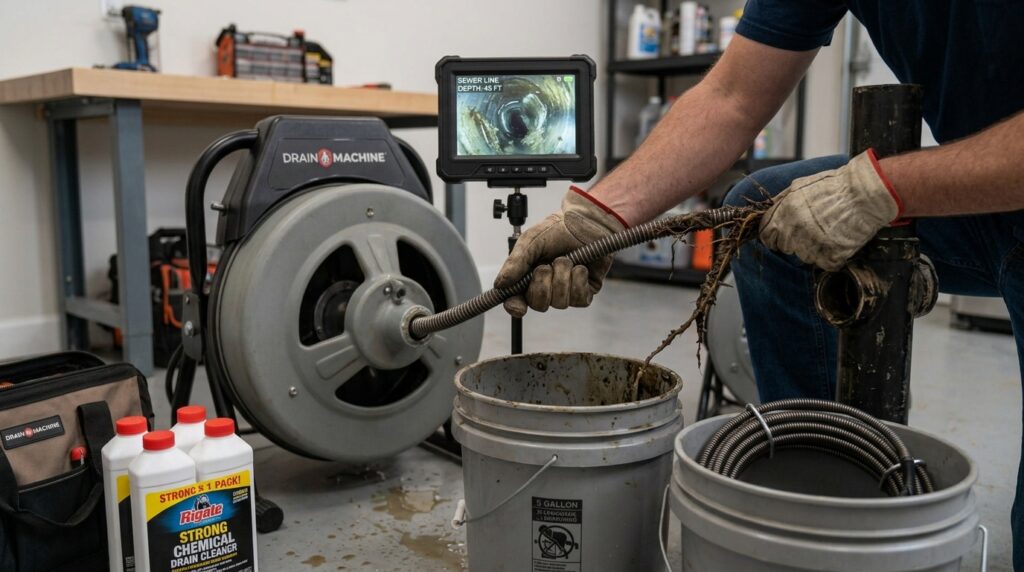
Main sewer line cleaning costs most US homeowners between $187 and $572 per job. HomeAdvisor reports an average of $376, and Angi reports $380. The final price depends on the cleaning method, the cause and severity of the clog, access to the line, pipe material, labor rates, and location.
The main sewer line is the buried pipe that carries wastewater from a home’s drains to the municipal sewer or a septic tank. Cleaning removes grease, hair, paper, scale deposits, or tree roots that restrict flow. A main line job costs more than clearing one sink or tub because it involves longer pipe, more equipment, and more labor time.
The prices on this page are in US dollars and come from 2025 and 2026 cost data published by Angi, HomeAdvisor, HomeGuide, and Homewyse. Each source collects data differently, so the figures are presented as ranges. A local plumber’s written quote is the only price that applies to a specific property.
A cleaning quote can include more than the cleaning itself. Camera inspection, cleanout installation, and repairs can raise the total when the pipe is damaged or hard to reach.
How Much Does It Cost to Clean a Main Sewer Line?
Cleaning a main sewer line costs $187 to $572 for most US homeowners, with a national average of about $380, according to Angi’s 2026 data. HomeAdvisor reports a similar range of $187 to $569 and an average of $376.
The full spread is wider than the typical range. Angi reports prices from $99 for snaking a small clog to $1,600 for a video inspection combined with hydro jetting of a major clog. Home Rangers states that a main sewer blockage can run $800 or more. Homewyse, which builds estimates from unit costs instead of customer surveys, put the national average for cleaning a sewer line at $336 to $410 in September 2026.
Main Sewer Line vs Single-Fixture Drain Cleaning Cost
Main sewer line cleaning costs more than single-fixture drain cleaning. Angi reports $350 to $600 for a main line against $100 to $250 for snaking a fixture drain.
C&C Air data, cited by Paul Bunyan Plumbing, puts main line cleaning at 82% to 264% above a single-fixture call, depending on blockage severity and method. The difference comes from equipment, time, and line length. Home Rangers reports that main line work typically takes one to two hours, while a fixture clog is usually cleared in under an hour. The national average for all drain cleaning is about $246, with most jobs between $147 and $352.
Why Published Price Ranges Disagree
Published price ranges disagree because sources measure different services, use different methods, and draw on different samples. Angi surveys customers about completed projects, while Homewyse calculates estimates from labor and material unit costs.
The gaps are visible in specific services. Angi reports snaking at $100 to $250, while HomeGuide reports $200 to $500 for minor clogs cleared with a snake or auger. Angi lists hydro jetting at $350 to $600, while HomeGuide lists $600 to $1,400 for severe clogs.
Scope also changes the number. Some quotes include the service call and camera inspection, and others price them separately. Regional labor rates add a further difference. A published range is a starting benchmark, not a quote.
Is the Clog in Your Main Sewer Line? Signs That Determine Which Price Applies
A clog is in the main sewer line when several fixtures drain slowly or back up at once, drains or toilets gurgle, water collects at the lowest drain, or sewage odor spreads through the home. These symptoms place the job in the main line price range instead of the single-fixture range.
A slow drain at one sink or tub points to a branch line. Slow drainage at multiple fixtures points to the main line. A fully blocked main line pushes wastewater into the lowest fixtures in the home, which Home Rangers classifies as a same-day call for an emergency plumber.
Responsibility for the clog also determines who is billed. Angi states that the city is responsible for clogs in the municipal sewer main, and the homeowner pays for the line that connects the home to it. Angi recommends inspecting any main line older than 40 years. A soggy or unusually green patch in the yard can indicate a leak in the line, which is a repair issue and not a cleaning issue.
Main Sewer Line Cleaning Cost by Method
Cleaning method is the first price variable. Angi reports $100 to $250 for snaking, $350 to $600 for hydro jetting, and $100 to $1,000 for tree root removal. A plumber selects the method according to what blocks the line and the condition of the pipe.
Snaking is the lowest-cost method, and hydro jetting costs more but clears the pipe more thoroughly. Root removal has the widest range because the amount of root growth varies by property.
Snaking, Rodding or Augering
Snaking, also called rodding or augering, costs $100 to $250 according to Angi. HomeGuide reports $200 to $500 for minor main line clogs cleared with a snake or auger.
The method feeds a rotating cable through the line to break through or retrieve a blockage. It suits localized clogs such as grease or paper. Angi notes that snaking can leave residue or smaller debris in the pipe, so the line can clog again sooner than after a more thorough method. Angi reports that a simple snake performed at an hourly rate averages around $250, and that main line clog jobs take from 30 minutes to a few hours.
Hydro Jetting
Hydro jetting costs $350 to $600 according to Angi, and $600 to $1,400 for severe or stubborn clogs according to HomeGuide. The higher end of the range applies to heavier blockages and longer lines.
Hydro jetting sends a high-pressure stream of water through a hose to scour the pipe wall. Angi states that it clears the pipe more extensively than snaking. HomeAdvisor describes it as gentler on pipes than snaking or rodding, although it also warns that cleaning a damaged pipe can cause further damage. For that reason, plumbers often inspect the line with a camera before jetting an older pipe. Western Rooter & Plumbing reports that periodic jetting of lines near trees usually costs less over 5 to 10 years than waiting for roots to force an emergency excavation.
Root Cutting and Descaling
Root cutting and descaling cost $100 to $1,000 for tree root removal according to Angi. Roots require more labor than grease, hair, or scale deposits.
Root cutting uses a blade or cutting attachment on a cable or jetting nozzle to remove roots that have entered the line, typically at joints. Roots regrow, so recurring service is common on properties with trees near the line. Descaling removes mineral scale deposits from the interior pipe wall, which Angi lists among the materials that restrict main lines. The price rises with the length of line affected and the density of the growth.
What Affects the Price of Cleaning a Main Sewer Line
Five factors determine the price of cleaning a main sewer line: clog cause and severity, access and cleanout availability, pipe material, age and length, labor model with timing and emergency calls, and regional rates. These factors combine, which explains why Angi reports a range from $99 to $1,600 for the same type of service.
Clog Cause and Severity
Clog cause and severity set the price because tree roots and hardened blockages require more labor and heavier equipment than grease, hair, or paper. Angi reports $100 to $600 for minor debris removal and $100 to $1,000 for tree root removal.
A clog located deep in a long line also takes more time to reach and clear. Chemical drain cleaners can reduce clogs made of hair or grease, but Angi notes that they cannot clear tree root blockages.
Access and Cleanout Availability
Access and cleanout availability change the price because a line with an exterior cleanout is cleared faster than a line reached through toilets, drains, or roof vents. HomeGuide reports that homes with easy-to-reach cleanouts typically pay less.
A cleanout is a capped pipe, often white, located in a yard, basement, or garage. Older homes without one require plumbers to work through fixtures or roof vents. Angi adds that breaking through a concrete slab or working in a crawl space increases labor hours and the final price.
Pipe Material, Age and Length
Pipe material, age, and length affect the price because older clay, cast iron, and bituminized fiber pipes need more careful handling than PVC, and longer lines take more time. Angi states that older pipe is more prone to breaking, which limits how aggressively a plumber can clean it.
PVC pipe is the least expensive to work on. Cast iron and copper sit at the higher end of Angi’s price range. Western Rooter & Plumbing advises budgeting at the higher end for homes with clay or cast iron pipe, and notes that such homes often lead to a discussion of partial replacement. Line length also increases both cleaning time and inspection cost.
Labor Model, Timing and Emergency Calls
The labor model, timing, and emergency calls affect the price through hourly versus flat-rate billing, service fees, and urgency. Angi reports hourly rates of $45 to $200 for inspecting and cleaning a main sewer line, while some plumbers charge a flat rate for the job.
A service or dispatch fee is common. A Seattle-area plumbing company reports fees of $60 to $100, and HomeGuide reports that many plumbing companies credit the service call fee toward the final bill when the customer hires them for the cleaning. Emergency timing pushes prices toward the top of the range, according to Western Rooter & Plumbing. Scheduling cleaning before a full blockage avoids that premium.
Regional Rates
Regional rates change the price because local labor markets set plumber hourly rates. Angi reports a range of $45 to $200 per hour for main sewer line work depending on location.
Local examples show the spread. Western Rooter & Plumbing reports $150 to $500 for standard sewer cleanout service in Los Angeles and San Bernardino counties. A Seattle-area plumbing company reports $200 to $600 as a typical cleaning range in many markets. Urban markets also raise related costs. A new cleanout installation costs $1,400 to $3,500 nationally and $2,000 to $5,000 or more in New York City, according to Empire Sewer and Water.
Add-On Costs Quoted With Main Line Cleaning
Two add-on costs commonly appear with main line cleaning: camera inspection, which Angi prices at $200 to $1,300, and cleanout installation, which costs $650 to $2,000 for a one-way unit and $1,400 to $3,500 for a two-way unit. Neither is required for every job.
HomeGuide reports that some companies include a camera inspection in a flat-rate cleaning package, while others bill it separately. A cleanout is a one-time installation cost, and it lowers the cost of later cleanings.
Camera Inspection
A camera inspection of a main sewer line costs $200 to $1,300 according to Angi. Paul Bunyan Plumbing, citing Angi and HomeGuide data, reports $250 to $600 or more for main line inspections and $125 to $400 for basic drain inspections.
A plumber inserts a camera to locate the blockage, identify its cause, and assess pipe condition. HomeGuide states that plumbers may recommend one for complex or recurring clogs. Main line inspections cost more than basic drain inspections because of the equipment and line length involved. Home Rangers notes that a camera can also confirm the line is clear after cleaning.
Installing a Cleanout
Installing a cleanout costs $650 to $2,000 for a one-way unit and $1,400 to $3,500 for a two-way unit, according to Angi. The average for a two-way cleanout is $2,700, and HomeGuide reports $2,000 to $5,000.
A one-way cleanout gives access in a single direction. A two-way cleanout gives access toward both the house and the city sewer, which lets a plumber clear a clog on either side. Pricing also runs $50 to $250 per linear foot, so longer connecting pipe costs more. Excavation under a concrete driveway can add $500 to $2,000, according to a Seattle-area plumber. Angi identifies installation as a way to cut long-term maintenance costs because it makes every later cleaning faster.
When Cleaning Isn’t Enough: Repair and Replacement Costs
When cleaning does not restore flow because the pipe is cracked, collapsed, or invaded by roots, repair costs $1,000 to $4,000 and full replacement costs $3,000 to $25,000, according to Angi. Trenchless repair costs $60 to $250 per foot.
HomeGuide reports $50 to $250 per linear foot for complete replacement, which makes line length the main cost variable. Angi adds that permits for trench-based repair or replacement range from $400 to $1,600 depending on location. A sewer backup that damages the home adds a separate cost, which HomeGuide puts at $500 to $2,000 or more depending on the extent of the damage.
Cleaning a damaged pipe can worsen the damage, according to HomeAdvisor, so plumbers may repair minor cracks before cleaning. A camera inspection that shows broken or offset pipe, or clogs that return soon after cleaning, indicates that repair is the cost to plan for.
How to Get an Accurate Quote and Avoid Overpaying
To get an accurate quote, describe the symptoms and where they occur, confirm the cleaning method and price basis, and compare written estimates from licensed, insured plumbers. Angi advises telling the plumber which signs of a clog are present and where, and asking about preparation steps and expected timeline.
A price quoted before diagnosis is an estimate, and it can change once the plumber finds the clog’s cause. Asking whether the price is flat or hourly, and what could change it, prevents a larger final bill. Angi also recommends looking beyond price to licensing, insurance, reviews, and transparent pricing.
What a Quote Should Include
A main sewer line cleaning quote should include the diagnostic visit, the cleaning method, camera inspection, the labor basis, service fee treatment, permit costs where required, and the conditions that change the price. Angi lists the home visit and initial diagnosis, camera inspection, and rodding or hydro jet cleaning as typical components.
The quote should state whether the service call fee is credited toward the final bill, since HomeGuide reports that many companies waive or credit it. It should also state whether the camera inspection is bundled or billed separately. A written estimate with these items allows an accurate comparison between companies.
Professional Cleaning vs DIY
Professional cleaning is the recommended approach for a main sewer line clog, because the pipe is underground and clearing it requires imaging technology and removal tools that homeowners seldom own. Angi states that homeowners are prohibited from DIY sewer line repair in many locations and can face fines and liability if something goes wrong.
DIY avoids labor charges but excludes camera diagnosis, permits, and code-compliant work. Angi’s guidance for homeowners while waiting for a professional is to turn off the main water shut-off, uncap the cleanout to relieve pressure, keep the work area accessible, and disinfect any sewage-contaminated areas using protective gear. Chemical cleaners do not clear root blockages.
Who Pays: Homeowner, City or Insurance
The homeowner pays for clogs in the private line that connects the house to the sewer, and the city pays for clogs in the municipal sewer main. Angi states this division and notes that the main line is the homeowner’s responsibility in cost guides.
Insurance coverage is limited. Angi reports that standard homeowners insurance often excludes sewer line damage, so a backup rider or a standalone sewer line policy may be needed. Sewer line insurance costs $8 to $15 per month, or $40 to $200 per year, with coverage up to $20,000. Reviewing the policy before a backup occurs establishes what a claim would cover.
Ways to Lower the Cost
The most effective ways to lower main sewer line cleaning costs are installing a cleanout, scheduling cleaning before a full blockage, and comparing itemized quotes. Angi identifies a cleanout as the main way to reduce sewer line maintenance costs, and an emergency call costs more than a scheduled one.
Smaller measures also reduce cost. Asking for the service fee to be credited toward the job and confirming whether a camera inspection is already included avoids duplicate charges. Kitchen sink and tub drain traps cost $5 to $15 each, according to Angi, and they catch hair and food debris before it reaches the main line.
Keeping Costs Down Long Term: Maintenance and Cleaning Frequency
Cleaning a main sewer line every 18 to 22 months keeps costs down, according to Angi and HomeAdvisor. A Seattle-area plumbing company recommends 18 to 24 months. At Angi’s $380 average, that interval equals about $207 to $253 per year, compared with $500 to $2,000 or more that HomeGuide reports for sewer backup repairs.
Properties with trees near the line need a shorter interval. Western Rooter & Plumbing reports that scheduled hydro jetting on such properties usually costs less over 5 to 10 years than emergency excavation after root blockage.
Routine habits lower the frequency of clogs. Angi lists flushing only human waste and toilet paper as a core maintenance step. It also recommends an annual plumbing inspection, priced at $100 to $1,380, to catch wear and early clogs, and an inspection of any main line older than 40 years. Combined with an installed cleanout, these steps keep each cleaning in the lower part of the price range.