
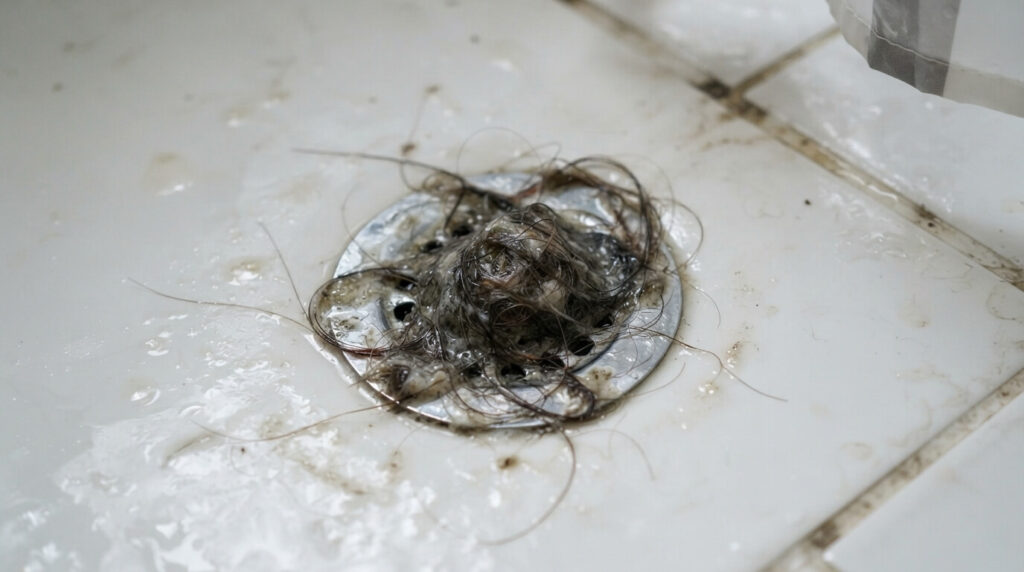
Sodium hydroxide (lye) is the main household chemical that dissolves hair in a drain. Hair is made of keratin, a tough protein, and strongly alkaline cleaners break down its structure. Bleach, hydrogen peroxide, and baking soda with vinegar weaken or loosen hair but do not reliably dissolve a clog.
Hair clogs form because hair does not degrade in pipe conditions and binds with soap residue and grease. The trapped mass narrows the pipe and slows water flow until drainage stops. Shower drains, bathtub drains, and bathroom sinks collect the most hair, so these locations see the most clogs.
Two approaches remove a hair clog: chemical dissolving and manual removal. Chemical products work on hair that cannot be reached. Manual tools such as drain snakes, plastic hair-removal strips, and plungers pull out or push through the clog without chemical reactions. Each approach has different costs, speeds, and risks for pipes.
This article covers what causes hair clogs, which substances dissolve hair, how commercial products compare, and how to clear each drain location. It also explains the hazards of chemical cleaners, how to prevent repeat clogs, how to choose a method by clog severity, and how hair affects septic systems and toilets.
What Causes Hair to Clog a Drain
Hair clogs a drain because hair resists breakdown, catches on pipe surfaces, and binds with soap residue, body oils, and grease. Shed hair enters the drain in every shower and wash, and the trapped mass builds until it restricts water flow.
Hair collects at rough joints, pipe bends, pop-up stoppers, and the P-trap, where water flow slows. A strand that snags on any of these points catches more hair, and the mass thickens with each use.
Why hair doesn’t break down on its own
Hair does not break down on its own because it consists mainly of keratin, a fibrous protein with strong internal chemical bonds. Water, household detergent, and ordinary pipe conditions cannot break these bonds, so hair stays intact for long periods.
Keratin contains cystine, an amino acid that forms disulfide bonds between protein chains. These bonds give hair its strength and chemical resistance. A protective outer layer of overlapping cuticle scales also limits how much liquid reaches the inner structure. Decomposition of keratin requires strong alkalis, strong reducing agents, or specialized enzymes, none of which occur in standing drain water.
How grease, soap scum and hair combine into clogs
Grease, soap scum, and hair combine into clogs when sticky residues coat hair strands and bind them into a dense mass. Hair provides the fibrous structure, and the residues act as the adhesive that holds the mass to the pipe wall.
Soap scum forms when soap reacts with minerals in hard water and leaves an insoluble film. Body oils, conditioner, and kitchen grease add a waxy layer to this film. Each new strand of hair sticks to the coated surface, and each new layer of residue thickens the clog. A clog containing both hair and residue resists plain water flow more than hair alone, and it requires a treatment that addresses both components.
What Dissolves Hair in a Drain
Sodium hydroxide dissolves hair in a drain, and it is the active ingredient in many commercial drain cleaners. Strong alkalis hydrolyze keratin and break the hair into soluble fragments. Bleach, hydrogen peroxide, baking soda with vinegar, and enzyme cleaners act more weakly or more slowly.
Three mechanisms affect hair: alkaline hydrolysis, oxidation, and enzymatic digestion. Alkaline hydrolysis breaks keratin bonds and is the most effective. Oxidation weakens the hair and removes its pigment but leaves most of the strand intact. Enzymatic digestion breaks down protein slowly and suits maintenance more than urgent clogs. The sections below assess each substance on this basis.
Does bleach dissolve hair?
Bleach does not dissolve hair in a drain. Household bleach contains sodium hypochlorite, an oxidizer that lightens hair by destroying pigment and damaging the outer cuticle. A dense hair clog remains largely intact after bleach contact.
Bleach may weaken strands and help disinfect the pipe surface, but it does not remove a solid mass. Bleach also creates hazardous gases when combined with ammonia or acidic products, and many commercial drain cleaners contain other reactive ingredients. Bleach should never be poured into a drain containing residue from another cleaner.
Does baking soda and vinegar dissolve hair?
Baking soda and vinegar do not dissolve hair. The two react to produce carbon dioxide, water, and sodium acetate, and the fizzing action can loosen light soap residue near the drain opening. Neither substance is strong enough to break keratin.
The reaction has limited reach in a full pipe because the gas escapes upward through the drain opening. Baking soda and vinegar may improve a slow drain with minor residue buildup. They are unlikely to clear a compact hair clog that has already restricted flow.
Does hydrogen peroxide dissolve hair?
Hydrogen peroxide does not dissolve hair in a drain. Hydrogen peroxide is an oxidizer that bleaches hair pigment and releases oxygen as it decomposes, and it does not break keratin into soluble fragments.
The bubbling action gives the impression of a cleaning reaction, but the effect on a dense hair mass is minimal. Hydrogen peroxide is milder than chlorine bleach and does not release chlorine gas, though it should not be mixed with other drain products. A hair clog treated with hydrogen peroxide usually requires a physical removal method afterward.
Does lye (sodium hydroxide) dissolve hair?
Lye (sodium hydroxide) dissolves hair. Sodium hydroxide is a strong alkali that hydrolyzes keratin and breaks the protein into soluble fragments. Hair exposed to it long enough loses its structure and washes down the pipe.
Dissolving speed depends on concentration, contact time, and temperature. A cleaner must reach the clog and remain in contact with it, which is difficult when standing water dilutes the product. Sodium hydroxide is caustic and causes severe burns on skin and eye contact. It also releases heat when mixed with water, so product instructions on quantity, contact time, and protective equipment must be followed exactly.
Do enzyme and bacterial cleaners work on hair?
Enzyme and bacterial cleaners work on hair slowly and incompletely. Protease enzymes break down protein, but keratin resists most of them, so these cleaners suit regular maintenance more than the removal of an established clog.
Enzyme and bacterial products digest soft organic residue such as soap scum, skin cells, and oils, which reduces the material that holds hair together. They operate over hours and are commonly applied overnight. Their advantages are low corrosiveness and safety for most pipe materials. Their limitation is speed, because a fully blocked drain needs faster action.
Commercial Drain Cleaners for Hair Clogs
Commercial drain cleaners clear hair clogs through sodium hydroxide, oxidizers, acids, or enzymes, and the active ingredient determines how well a product works on hair. Sodium hydroxide products dissolve hair most effectively, while enzyme products work slowly and gently. Product labels list the active ingredient, contact time, and approved pipe types.
Drano, Liquid-Plumr and similar gel or liquid cleaners: how they work on hair
Drano, Liquid-Plumr, and similar gel or liquid cleaners work on hair by combining alkaline and oxidizing ingredients that break down the clog. Sodium hydroxide hydrolyzes keratin, and sodium hypochlorite in some formulas oxidizes organic residue.
Gel formulas are thicker than liquids and sink through standing water, which keeps the active ingredients in contact with the clog. The cleaner needs to remain in the pipe for the time stated on the label before flushing with water. Formulas differ by brand and product line, so the ingredient list on each container identifies the active chemistry.
Hair-specific products (Liquid-Plumr Hair Clog Eliminator, HairAway)
Hair-specific products such as Liquid-Plumr Hair Clog Eliminator and HairAway are marketed for hair clogs in bathroom drains. They are formulated to break down or loosen hair and the residue binding it, and they vary in their active chemistry.
Some hair-focused products rely on alkaline ingredients, and others use different formulations. The label identifies the active ingredient, the approved drain locations, and the required contact time. A hair-specific product suits a shower or bathroom sink clog. It does not replace physical removal when a clog has caused a complete blockage.
How to compare products (active ingredient, wait time, pipe compatibility)
Compare drain cleaners by active ingredient, wait time, and pipe compatibility. These three criteria determine how well a product dissolves hair, how long the drain stays unusable, and whether the product is safe for the plumbing.
The following criteria apply to every product:
- Active ingredient: Sodium hydroxide dissolves hair, oxidizers act mainly on residue, and enzymes digest soft organic matter slowly.
- Wait time: Labels state the contact time before flushing, and enzyme products need the longest time.
- Pipe compatibility: Labels state whether the product suits PVC, metal, or both, and whether it suits septic systems.
- Drain condition: Some products require standing water to be removed first, and others work through it.
Safety instructions belong in the comparison as well. Protective gloves, eye protection, and ventilation are standard label requirements for caustic products.
How to Unclog a Hair-Clogged Drain by Location
Unclog a hair-clogged drain by removing the drain cover, pulling out visible hair, clearing deeper hair with a tool, and flushing the pipe with hot tap water. The steps differ by location because shower drains, bathtub drains, and bathroom sinks have different designs and trap points.
Shower drain
To unclog a shower drain, remove the drain cover, pull out the visible hair with gloved fingers or a plastic hair-removal strip, and flush the drain with hot tap water. Most shower clogs sit within reach of the drain opening.
Drain covers attach with a screw or lift off by hand, and a screwdriver removes a screwed cover. A drain snake or plastic barbed strip reaches hair beyond the visible opening, and inserting it, turning it, and withdrawing it brings the hair out. A hair-specific cleaner is the next step when the clog remains after manual removal. Clean the removed cover before reinstalling it.
Bathtub drain
To unclog a bathtub drain, remove the stopper, clean the hair from the stopper and its linkage, and push a snake or plastic hair-removal strip into the drain to extract the remaining clog. Bathtub clogs often collect on the stopper mechanism.
Tub stoppers come in several types, including lift-and-turn, toe-touch, push-pull, and trip-lever designs. Each type releases differently, so the stopper mechanism determines the removal method. A plunger can dislodge the clog when the overflow opening is blocked with a wet cloth, because the seal allows pressure to reach the drain. Hair that remains after these steps may sit deeper in the trap.
Bathroom sink
To unclog a bathroom sink, remove the pop-up stopper, pull out the hair wrapped around it, and clear the drain with a snake or plastic hair-removal strip. The stopper and the pivot rod beneath the sink are the most common collection points.
Loosen the pivot rod nut under the sink to lift out the stopper. Place a bucket beneath the P-trap, unscrew the trap connections, and empty the trap when hair continues to block the drain. Reassemble the trap with the washers seated properly to prevent leaks. Run water after reassembly to confirm the flow and check the joints for leaks.
How to Remove Hair Manually Without Chemicals
Remove hair manually by pulling it out with a hair-removal tool or drain snake, pushing it through with a plunger, or flushing it with hot tap water. Manual methods act directly on the clog, avoid chemical hazards, and suit most hair clogs near the drain opening.
Hair removal tools and drain snakes
Hair removal tools and drain snakes remove hair by reaching into the drain and pulling the clog out. A plastic barbed strip, such as the Drano Snake Plus Tool, hooks hair on its barbs, and a metal drain auger breaks up or retrieves deeper clogs.
The user inserts the tool, rotates or works it against the clog, and withdraws it with the hair attached. Plastic strips are inexpensive and suit shower and sink drains. A hand-cranked auger reaches further into the pipe and suits clogs past the trap. Gloves protect the hands, and the extracted hair belongs in the trash and not in the toilet.
Using a plunger and hot water
Using a plunger and hot water clears a hair clog by forcing pressure through the pipe and softening residue that binds the hair. A cup plunger creates a seal over the drain, and repeated pumping moves the clog.
Cover the overflow opening in a sink or bathtub to maintain pressure. Hot tap water softens soap scum and grease that hold hair together, but boiling water can crack porcelain fixtures and soften PVC joints, so hot tap water is the safer choice. This method works best on partial clogs and loosely packed hair. A dense mass near the trap often needs a snake or a strip first.
DIY drain cleaner mixtures and their limits
DIY drain cleaner mixtures such as baking soda with vinegar, salt with baking soda, and dish soap with hot water loosen residue but do not dissolve hair. Their effect is limited to soap scum and light buildup.
Baking soda and vinegar produce gas that agitates residue near the opening. Dish soap lubricates the pipe surface and helps hot water carry loosened material through. None of these mixtures breaks keratin, so a compact hair clog remains after treatment. These mixtures suit slow drains and routine upkeep. They also avoid the hazards of caustic products, which makes them a low-risk first step.
Risks and Limits of Dissolving Hair Chemically
Dissolving hair chemically carries risks to people, pipes, and the plumbing system, and chemical cleaners do not always clear a clog. Caustic ingredients burn skin and eyes, some products release hazardous gases when mixed, and some pipe materials react to heat or corrosion.
Chemicals act only where they make contact. A cleaner diluted by standing water or blocked by a dense clog may leave the obstruction in place. A repeated failed treatment leaves caustic liquid standing in the drain, which raises the risk for anyone who then works on it manually.
Chemical mixing hazards
Chemical mixing hazards arise when a drain cleaner reacts with another cleaner, and the reaction releases toxic gas or heat. Bleach mixed with ammonia produces chloramine vapors, and bleach mixed with acidic products releases chlorine gas.
Residue from a previous treatment stays in the pipe, so a new product added later can react with it. Different drain cleaners should not be combined, and a second product should not be added to a drain after a failed treatment. Ventilate the room during use, wear gloves and eye protection, and read the label warnings. A person exposed to fumes should move to fresh air and contact poison control or emergency services when symptoms occur.
Effects on pipes (PVC, metal, old plumbing)
Chemical cleaners affect pipes differently by material, and the risk rises with heat, repeated use, and pipe age. Sodium hydroxide reactions release heat that can soften PVC, while acidic cleaners can corrode metal pipes.
Standing cleaner in a fully blocked pipe concentrates the heat and corrosive action at one point. Older plumbing, including aged metal pipes and brittle joints, has a higher risk of damage because of pre-existing wear. Product labels state the pipe materials they suit, and products that do not list the pipe type in use should be avoided. Mechanical removal carries lower risk for old or fragile plumbing.
When a clog needs a plumber
A clog needs a plumber when chemical and manual methods fail, when several drains back up together, or when water stands in a fixture after treatment. These signs indicate that the obstruction is deeper than a local hair clog.
Additional signs include gurgling sounds from multiple fixtures, sewage odors, and water backing up into a tub or shower when another fixture drains. These signs point to a blockage in the main drain line. A plumber has powered augers and drain cameras that locate and clear deep obstructions. Professional help is also advisable when caustic cleaner is standing in a blocked drain, because manual work around it is hazardous.
How to Prevent Hair From Clogging Drains Again
Prevent hair from clogging drains by catching hair before it enters the pipe and by maintaining the drain on a regular schedule. A drain catcher stops most shed hair, and routine cleaning removes the residue that binds what passes through.
Choosing a drain catcher or hair-catching drain
Choose a drain catcher that fits the drain opening, has fine enough openings to trap hair, and can be emptied easily. Common designs include mesh screens, silicone hair catchers, raised dome strainers, and stopper-style covers for bathtubs.
Match the catcher to the fixture type. Shower drains suit flat silicone or mesh covers, bathtub drains suit strainers that replace or fit over the stopper, and bathroom sinks suit strainer baskets or stopper-type hair catchers. Dense mesh catches more hair but collects residue faster and needs more frequent cleaning. Emptying the catcher after each shower or several times a week keeps water flowing through it.
Routine maintenance habits
Routine maintenance habits that prevent hair clogs include emptying the drain catcher, cleaning the stopper, flushing the drain with hot tap water, and using an enzyme cleaner periodically. These habits remove hair and residue before they accumulate.
Brush hair before showering to reduce the amount that sheds in the water. Clean the visible drain area and stopper on a regular schedule, and flush the drain with hot tap water after use to carry soap residue through. An enzyme or bacterial maintenance cleaner digests the soft residue that binds hair, and it is gentler on pipes than caustic products. A slow drain is an early sign of a developing clog and warrants immediate attention.
How to Choose the Best Method for Your Clog
Choose the best method by matching the clog severity and drain type to the least hazardous method that can reach the clog. Start with manual removal for hair near the drain opening, and use chemical dissolving only when manual methods cannot reach the hair.
Method by clog severity and drain type
Method choice depends on clog severity and drain type. A slow drain suits a hair-removal tool or hot water flush, a partial clog suits a plunger or snake, and a full blockage with deep hair suits a hair-specific or sodium hydroxide cleaner following label instructions. A clog that resists every method needs a plumber.
The following guidance applies to each severity level:
- Slow drain: Pull hair from the stopper or drain opening, flush with hot tap water, and apply an enzyme cleaner for maintenance.
- Partial clog: Use a plastic strip, drain snake, or plunger before considering a chemical product.
- Full blockage: Try a snake first, and use a hair-specific or sodium hydroxide cleaner only when the label matches the pipe type and the drain is safe to treat.
- Persistent or multi-drain clog: Contact a plumber.
Drain type adds a second factor. Shower and bathroom sink drains have short runs and respond well to manual tools, and bathtub drains may need the stopper assembly cleaned first. Old or metal pipes and septic systems further limit chemical options.
Hair and Septic Systems
Hair does not decompose in a septic system, so it accumulates in the tank and can reach the drain field and clog it. Septic systems rely on bacteria to break down waste, and keratin resists this digestion.
Hair that reaches the tank collects in the scum and sludge layers, which increases how often the tank needs pumping. Hair that passes into the outlet can contribute to clogging in the drain field. Drain catchers reduce the amount of hair entering the system. Heavy use of caustic drain cleaners and bleach can disrupt septic bacteria, so products labeled as septic-safe, enzyme cleaners, and manual removal are the safer choices for septic plumbing.
Can Hair Clog a Toilet?
Hair can clog a toilet, although small amounts usually pass through. Hair does not break down in water, so it collects in the toilet trap and drain, especially when it binds with toilet paper, wipes, or other waste.
The risk rises with large amounts of hair, such as hair from a brush, and with hair combined with wipes or other items that do not disperse. Clumps of hair can lodge at the trap bend and catch further material. Dispose of hair in the trash and not in the toilet. A toilet plunger or a toilet auger clears most hair-related toilet clogs, and chemical cleaners made for sinks and tubs are not suitable for toilets.