
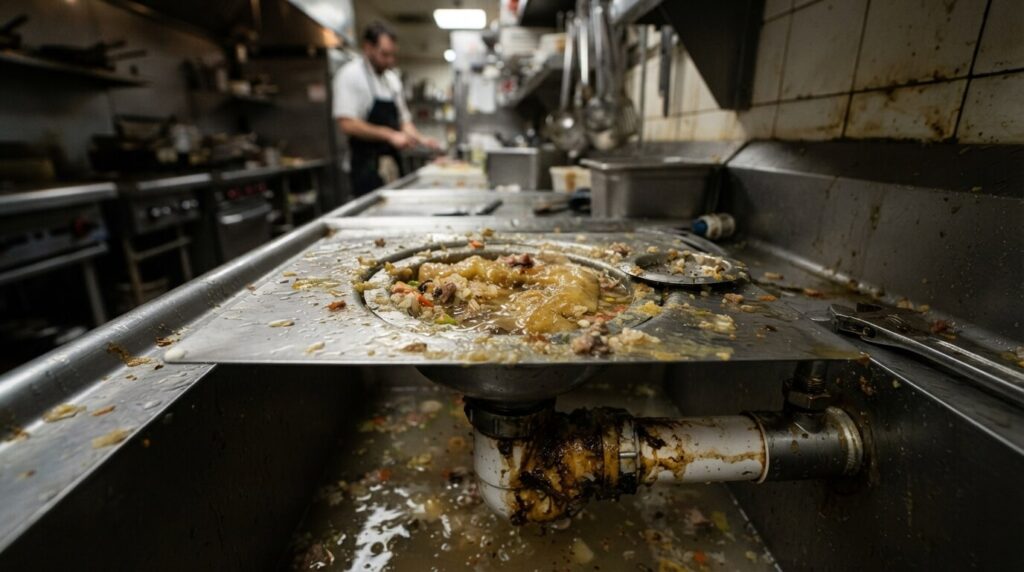
A grease clog forms when cooking fats, oils, and grease cool inside a drain pipe and harden into a sticky layer that narrows the pipe. The blockage grows as food particles, hair, and soap residue attach to the hardened layer. Kitchen sink drains are the most common location because cooking residue enters them daily.
Clearing a grease clog requires a method that matches the clog’s depth and hardness. Hot water and dish soap loosen surface grease, a plunger dislodges shallow blockages, manual cleaning of the P-trap removes the most accessible buildup, and a drain snake reaches grease deeper in the line. Drain cleaners and professional services address clogs that these steps do not clear.
This guide explains what causes a grease clog, how to recognize one, and how to unclog a kitchen sink step by step. It also evaluates home remedies and drain cleaners, identifies when a clog requires professional drain cleaning, lists common mistakes, and describes how to prevent grease from clogging the drain again.
Each method carries a condition or limitation, such as pipe material, clog location, or chemical safety. The final section of this guide connects the clog’s symptoms to the method most likely to clear it.
What Causes a Grease Clog in a Drain Pipe
A grease clog in a drain pipe is caused by fats, oils, and grease that enter the drain as liquid, cool against the pipe wall, and solidify into a layer that traps other waste. The layer thickens with each use of the sink until it restricts or blocks the flow of water.
Cooking fats such as bacon drippings, butter, lard, and cooking oil carry through the drain in a warm, liquid state. Fats and oils also arrive in dairy residue, sauces, meat juices, and greasy dishwater. Once the fat leaves the warm water flow and contacts cooler pipe walls, it stops moving with the water and begins to adhere.
How Liquid Grease Cools and Hardens Inside Pipes
Liquid grease hardens inside pipes because drain pipes are cooler than the grease that enters them. The fat loses heat to the pipe wall and surrounding air, drops below its solidification point, and sticks to the pipe’s interior surface.
Saturated animal fats such as lard, tallow, and bacon fat solidify at or near room temperature, so they harden quickly in a pipe. Liquid vegetable oils solidify less readily, but they still coat pipe walls and thicken as they mix with residue. Running hot water while pouring grease does not prevent hardening, because the water cools as it travels through the pipe and the grease hardens farther down the line.
Fats can also react chemically with minerals in the water and on the pipe surface. Free fatty acids released from fats can combine with calcium to form a waxy, soap-like solid that adheres firmly and resists water flow. This solid is harder to remove than plain cooled fat.
Why Hair, Soap, and Food Debris Make Grease Clogs Worse
Hair, soap, and food debris make grease clogs worse because the sticky grease layer captures solid material that would otherwise pass through the pipe. Each captured particle narrows the pipe further and gives the next particle more surface to attach to.
Food debris such as coffee grounds, rice, pasta, and vegetable peels adds bulk to the grease layer. Hair forms a fibrous mesh that holds grease and debris together and increases the clog’s strength. Soap residue, especially from bar soap, contains fats and minerals that bond with the grease and form a denser, more solid blockage than grease alone. Combined clogs are harder to loosen with hot water, because the solid material does not melt.
Signs Your Kitchen Sink Is Clogged With Grease
A kitchen sink clogged with grease shows slow drainage, standing water, gurgling sounds, and foul odors from the drain. These signs appear gradually as the grease layer narrows the pipe, and they intensify until the sink stops draining completely.
Grease clogs differ from other blockages in how they develop. A foreign object, such as a dropped utensil, causes sudden blockage, while grease restricts flow progressively over weeks or months. A sink that drains more slowly than it did previously, especially in a kitchen where cooking is frequent, points to grease buildup.
Slow Draining vs. a Fully Stopped-Up Sink
A slow-draining sink has a partial grease clog that still allows water to pass, while a fully stopped-up sink has a blockage that prevents drainage entirely. Slow drainage is the earlier stage, and a complete stoppage is the later stage of the same buildup.
In a partial clog, water drains but leaves a visible pool around the drain after the faucet closes, and the pool takes noticeably longer to disappear. In a full clog, water does not move at all, and the basin fills and stays full. A partial clog often responds to hot water, dish soap, and a plunger. A full clog usually requires a plunger, P-trap cleaning, or a drain snake. A sink that drains slowly should be treated early, because the buildup continues to thicken with every use.
Odors, Gurgling, and Standing Water
Odors, gurgling, and standing water indicate a grease clog that traps waste and air in the drain line. Decomposing food and grease inside the pipe produce a sour or rancid smell, and trapped air escapes through the water as gurgling sounds.
Gurgling occurs when water displaces air in a restricted pipe and the air forces its way past the blockage. Standing water in the basin, or water that rises around the drain in a second sink basin, shows that the blockage limits flow at or below the drain opening. Odors that return soon after cleaning the sink basin indicate buildup inside the pipe rather than residue on the sink surface.
How to Unclog a Grease-Clogged Kitchen Sink Step by Step
To unclog a grease-clogged kitchen sink, work through four methods in order of increasing effort: loosen surface grease with hot water and dish soap, plunge the drain, clean the P-trap by hand, and use a drain snake for grease deeper in the pipe. Stop at the first method that restores normal drainage.
Starting with the least invasive method limits effort and avoids unnecessary disassembly. Each method targets a different location of the clog. Hot water and soap act on grease near the drain opening, plunging dislodges shallow blockages, P-trap cleaning removes buildup in the curved section under the sink, and a snake reaches the pipe beyond the trap.
Clear the Sink and Loosen Surface Grease With Hot Water and Dish Soap
To loosen surface grease, remove standing water and debris from the sink, pour a generous amount of dish soap into the drain, and flush it with hot tap water. Dish soap breaks grease into smaller droplets that water carries through the pipe.
Bail out standing water with a cup into a bucket first, so the soap reaches the clog rather than diluting in a full basin. Remove food scraps from the drain opening and strainer. Dish detergent contains surfactants, which surround grease molecules and allow them to disperse in water. Run hot water from the tap for several minutes after adding the soap. Hot tap water suits all common pipe materials, which makes this method the safest first step. This approach clears thin or recent grease layers, and it does not clear thick, hardened buildup.
Use a Plunger on the Sink Drain
To plunge a sink drain, cover the drain with a cup plunger, fill the basin with enough water to submerge the plunger cup, and push and pull firmly in repeated strokes for 15 to 20 seconds. The pressure changes move the clog and loosen grease from the pipe wall.
Use a cup plunger with a flat rim, not a flange plunger designed for toilets, because the flat rim seals against a flat sink surface. Seal the overflow opening with a wet cloth if the sink has one, and block the drain of a second basin with a stopper or wet cloth, because an open outlet releases the pressure. Test drainage by running hot water after plunging. Repeat the process several times before moving on, and stop if water does not move after repeated attempts, because a clog that resists plunging sits farther down the pipe or is too dense to break up by pressure.
Clean the P-Trap by Hand
To clean the P-trap by hand, place a bucket under the trap, loosen the slip nuts at both ends, remove the curved pipe, empty its contents, scrape out grease and debris, rinse it, and reassemble the joints. The P-trap is the U-shaped pipe under the sink where grease and solids settle first.
Put on rubber gloves, because the contents contain grease and bacteria. Loosen the slip nuts by hand or with pliers, and keep track of the washers and their orientation so the trap seals correctly on reassembly. Scrape the inside of the trap with a brush or an old spoon, and flush it with hot water and dish soap. After reinstalling the trap, tighten the nuts snugly by hand and run water to check for leaks. A trap packed with grease and debris is a common source of complete stoppage, and removing it often restores drainage immediately.
Use a Drain Snake for Grease Deeper in the Pipe
To clear grease deeper in the pipe, feed a drain snake, also called a drain auger, into the open pipe after removing the P-trap, rotate the handle to break through the clog, and retrieve the material before flushing the line with hot water. A snake reaches the section of pipe beyond the trap that hands and plungers cannot reach.
Insert the tip into the wall pipe and advance it until it meets resistance. Rotate the handle so the tip bores into or hooks onto the clog, then pull back slowly to bring grease and debris out of the pipe. A hand-crank auger designed for household sinks, typically about 25 feet (7.6 metres) long, suits most kitchen drains. Clean the snake after use because the retrieved grease hardens on the coil. A snake can scratch or puncture thin or damaged pipes if forced, so turn it steadily instead of pushing hard. When the snake cannot pass the clog or drainage does not return, the blockage likely lies in the main line, and a professional is the appropriate next step.
Do Home Remedies Dissolve Grease in Pipes?
Most home remedies do not dissolve grease in pipes. Vinegar, baking soda, and boiling water have limited effect on hardened grease, and each can leave a clog in place or carry a risk to the pipe. Dish soap with hot tap water is the most reliable household option.
Home remedies appeal because the materials are already in the kitchen and cost little. Their success depends on whether the clog is thin, recent, and near the drain opening. Thick, packed, or deep grease clogs do not respond to these remedies, and repeated attempts delay effective treatment.
Does Vinegar Dissolve Grease?
Vinegar does not dissolve grease. Household vinegar is a dilute solution of acetic acid in water, typically about 5% acetic acid, and oils and fats do not dissolve in water-based solutions.
Vinegar cuts some light grease films and mineral deposits on surfaces, but the contact time and strength inside a drain are too low to break down a hardened grease mass. Pouring vinegar into a clogged drain leaves most of the grease in place. Undiluted vinegar poses little risk to standard household pipes in small amounts, but it does not replace mechanical removal or a cleaner designed for grease.
Baking Soda and Vinegar: What It Does and Doesn’t Do
Baking soda and vinegar produce a foaming reaction that releases carbon dioxide gas, which may move loose debris near the drain opening but does not dissolve or remove hardened grease. The reaction yields sodium acetate, water, and carbon dioxide, and none of these break down fats.
The fizzing action can loosen light residue on the pipe surface and freshen the drain temporarily. It cannot cut through a solid grease layer, and the reaction ends within minutes, leaving a mostly neutral solution. Sequential use of the two ingredients does not make up for the reaction’s weak effect on grease. Use it only for minor odor or film on the drain, and treat a slow or blocked drain with a plunger, P-trap cleaning, or a snake.
Boiling Water and Its Risks for Different Pipe Types
Boiling water can melt fresh grease near the drain opening, but it risks damaging PVC pipe joints and can crack porcelain fixtures. Boiling water reaches 100°C (212°F), which is hotter than many plastic drain pipes are designed to handle regularly.
PVC and other plastic drain pipes soften under high heat, and repeated exposure can loosen or deform joints and seals. Metal pipes such as cast iron, copper, and galvanized steel tolerate boiling water better. Boiling water also melts grease only temporarily, and the liquid fat can re-solidify farther down the line once the water cools, which moves the clog instead of clearing it. Hot tap water with dish soap offers a safer alternative for all pipe types.
Best Drain Cleaner for Grease Buildup
The best drain cleaner for grease buildup is an enzymatic or bacterial cleaner for routine maintenance and mild clogs, and a caustic cleaner for stubborn grease clogs in pipes that tolerate harsh chemicals. The right choice depends on clog severity, pipe material, and the speed required.
Drain cleaners fall into two categories, biological and chemical, and they differ in speed, strength, and risk. Biological cleaners work slowly and gently. Chemical cleaners work quickly and carry safety and pipe-damage risks. A reader with a fully blocked sink has different needs from one trying to keep a slow-draining sink clear.
Enzymatic and Bacterial Cleaners
Enzymatic and bacterial cleaners break down grease using enzymes or live bacteria that digest fats, oils, and organic waste. They work slowly, usually overnight or over several days, and suit mild clogs and regular maintenance.
Lipase enzymes specifically target fats and convert them into smaller molecules that water can carry away. Bacterial formulas contain cultures that consume organic buildup in the pipe. These cleaners are non-corrosive and generally safe for plastic and metal pipes and for septic systems, which makes them the lowest-risk option. They do not clear a fully blocked drain or a dense, compacted clog quickly. Apply them at night, when the sink sits unused for several hours, and follow the product’s dosage directions.
Caustic and Chemical Cleaners
Caustic and chemical cleaners dissolve grease through a chemical reaction, most commonly using sodium hydroxide (lye), which converts fats into soap through saponification. They act within minutes to hours and suit severe grease clogs in compatible pipes.
Sodium hydroxide generates heat and turns grease into a water-soluble soap that rinses away. Some cleaners use sodium hypochlorite or sulfuric acid instead. Caustic products work faster than enzymatic products, but they cause chemical burns on skin and eyes, release harmful fumes, and may damage pipes, seals, and fixtures. They work best on clogs close to the drain with standing water absent or minimal, following the label directions exactly. They are unsuitable for repeated use.
Safety and Pipe Compatibility
Drain cleaners require safety precautions and a pipe-compatibility check before use, because chemical products can burn skin, damage pipes, and react dangerously with other cleaners. Read the product label for approved pipe materials and required protective equipment.
Wear rubber gloves and eye protection, ventilate the room, and keep the product away from children and pets. Never mix drain cleaners with each other or with bleach or ammonia, because mixtures can release toxic gas. Do not plunge or snake a drain after chemical treatment, because splashed chemicals can reach the skin and eyes. Older metal pipes can corrode under strong caustic or acidic products, and plastic pipes can soften from the heat the reaction produces. Homes on septic systems need products labeled as septic-safe, because harsh chemicals can kill the bacteria the tank depends on. When the pipe material is unknown, choose an enzymatic cleaner or use mechanical removal.
When a Grease Clog Needs Professional Drain Cleaning
A grease clog needs professional drain cleaning when plunging, P-trap cleaning, and snaking fail to restore drainage, when the clog returns repeatedly, or when the blockage affects more than one fixture. These conditions indicate grease farther down the line than household tools reach.
A plumber uses equipment with greater reach and power than consumer tools, and can inspect the pipe to identify the blockage’s location and cause. Delay increases risk, since a blocked line can back up wastewater into the home and cause water damage.
How Plumbers Remove Grease From Drain Pipes (Snaking and Hydro Jetting)
Plumbers remove grease from drain pipes by snaking with a powered drain auger or by hydro jetting, which scours the pipe wall with high-pressure water. Snaking breaks through or retrieves the clog, while hydro jetting removes the entire grease layer from the pipe wall.
A powered auger has a longer cable and a stronger motor than a hand snake, so it cuts through thicker, deeper clogs. It opens a channel through the grease, but it can leave a coating of grease on the pipe wall. Hydro jetting sends a pressurized stream of water through a nozzle and strips grease, scale, and debris off the pipe interior, which leaves the pipe cleaner and reduces the chance of a fast recurrence. Plumbers often pair either method with a camera inspection to locate the clog and check the pipe’s condition. Hydro jetting is unsuitable for badly damaged or very old pipes, and the plumber decides based on the inspection.
Signs the Clog Has Moved Beyond the Kitchen Sink
A clog has moved beyond the kitchen sink when other drains slow down, when water backs up in a different fixture, or when sewage odors appear. These signs show that the blockage sits in a shared drain line instead of the sink’s own branch.
Specific signs include a bathtub or floor drain that gurgles or rises when the kitchen sink or dishwasher runs, a toilet that bubbles when water drains elsewhere, and water backing up in the lowest drain in the house. Wastewater pooling in the yard or a persistent sewer smell suggests the main line is involved. Household tools cannot reach a main-line clog. Stop using water in the house and contact a licensed plumber.
Common Mistakes When Clearing Grease Clogs
Common mistakes when clearing grease clogs include pouring more grease down the drain, using boiling water on plastic pipes, mixing drain cleaners, overusing chemical cleaners, forcing a snake, and ignoring a slow drain until it blocks completely. Each mistake either fails to clear the clog, worsens it, or damages the plumbing.
Some mistakes come from assuming that a method works in every situation. Hot water melts grease temporarily, but the grease hardens again farther down the pipe, which relocates the clog. Repeated chemical use weakens pipes and seals, and a failed chemical cleaner leaves caustic liquid standing in the sink, which creates a hazard for anyone who plunges or disassembles the trap afterward. Using the wrong tool also causes problems. A toilet plunger seals poorly on a sink, and a forced snake can scratch or puncture a pipe.
Skipping early action is another frequent error. A sink that drains slowly already has a thickening grease layer, and waiting allows the layer to harden and extend deeper into the line. Treating symptoms, such as odor, with deodorizing products also leaves the clog in place. Match the method to the clog’s depth and the pipe’s material, and call a plumber when basic methods fail.
How to Prevent Grease From Clogging Your Drain Again
To prevent grease from clogging a drain again, keep fats, oils, and grease out of the sink, wipe greasy cookware before washing, dispose of cooking grease in the trash, use a sink strainer, and maintain the drain routinely. Prevention stops buildup before it forms and costs less than clearing a clog.
Prevention applies in the kitchen at three points: the moment grease enters the drain, the disposal of leftover cooking fat, and the maintenance of the drain over time. Garbage disposals do not prevent grease clogs, because they grind solids but do not stop liquid fat from coating the pipes.
What to Do Right Away if Grease Goes Down the Drain
If grease goes down the drain, flush the drain with hot tap water and a generous amount of dish soap right away to carry the fat through the pipe before it hardens. Fast action limits how much grease sticks to the pipe wall.
Run the hot water for one to two minutes after the soap. Do not use cold water, because cold water solidifies fat faster. A small spill is not a clog, but repeated spills build a layer. If a large quantity of grease enters the drain, repeat the flush and watch for slow drainage over the following days. An enzymatic cleaner applied afterward helps break down remaining residue.
Disposing of Cooking Grease Properly
To dispose of cooking grease properly, let it cool, pour it into a sealable container such as a can or jar, and place the container in the trash. Never pour grease down the sink, the toilet, or the garbage disposal.
Wipe greasy pans, plates, and utensils with a paper towel before washing, so little fat reaches the water. Cooking oil in larger quantities, such as from deep frying, can be reused after straining or collected in its original bottle for disposal. Some municipalities and recycling centers accept used cooking oil, so check local waste programs. Pouring grease onto the ground or into outdoor storm drains is also improper disposal, because it contaminates soil and water.
Sink Strainers and Routine Drain Maintenance
A sink strainer catches food particles before they enter the drain, and routine maintenance removes thin grease films before they harden. Together, they reduce the solid material that grease needs to form a clog.
Place a fine-mesh strainer over the drain opening and empty it into the trash after each use. Flush the drain with hot tap water and dish soap weekly, and apply an enzymatic drain maintenance product monthly or according to its label to digest thin grease films. Clean the P-trap by hand if the sink begins to drain slowly or smell. Households that cook frequently, or fry and roast regularly, benefit from a more frequent schedule.
How to Choose the Right Method for Your Grease Clog
To choose the right method for a grease clog, match the method to the clog’s severity and location: use hot water and dish soap for slow drains, a plunger or P-trap cleaning for a stopped sink, a snake for a deeper clog, and a plumber when those fail. Choose the least invasive effective option.
A slow drain with no standing water suggests a thin clog near the opening, so soap and hot tap water are the first choice. A sink with standing water suggests a denser blockage, so plunge first and clean the P-trap if plunging fails. A sink that remains blocked after the trap is clear points to grease farther down, where a hand snake applies. Recurrent slow drains across the house or sewage odors point to the main line and require professional cleaning.
Pipe material and safety also guide the choice. Use hot tap water instead of boiling water on plastic pipes, pick an enzymatic cleaner for mild clogs and routine maintenance, and reserve caustic cleaners for severe clogs in compatible pipes, with the safety precautions above. After the clog clears, apply the prevention habits so the grease layer does not rebuild.