
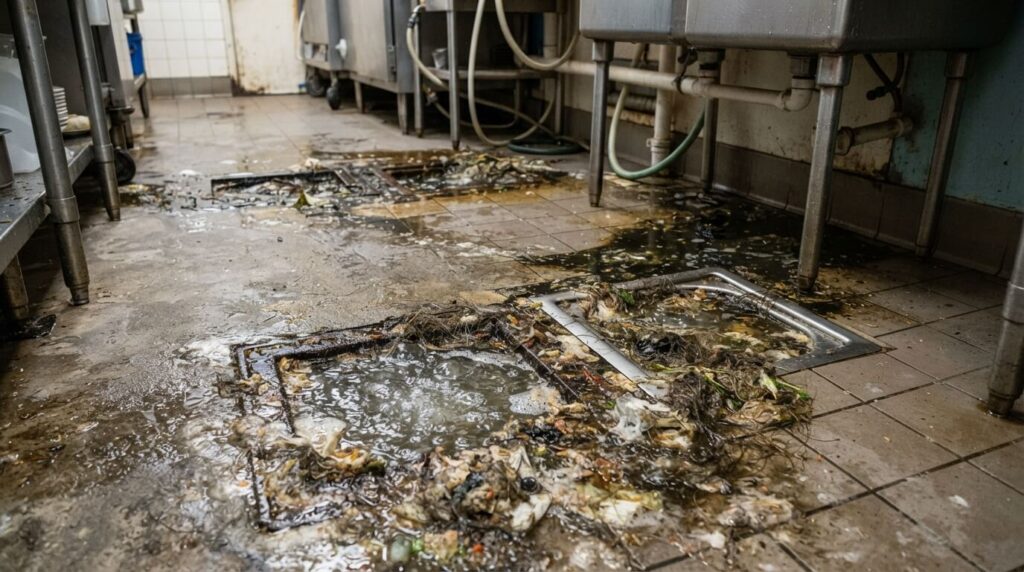
Multiple drains back up at the same time when a blockage or failure sits in the main sewer line, the plumbing vent system, or the septic system that every fixture shares. Each fixture in a home connects to a branch line, and the branch lines join the main drain. A restriction in the main drain stops wastewater from leaving the home, so the water rises through the lowest open fixtures.
The most common causes are a main sewer line clogged by grease, wipes, or debris, tree roots growing into the pipe, and a collapsed or sagging section of pipe. Blocked plumbing vents, problems in the city sewer main, and a full septic tank can produce the same result. The cause determines the repair, so identifying it comes before choosing a fix.
Whole-house backups follow recognizable patterns. Toilets gurgle when a shower drains, tubs fill when a washing machine empties, and floor drains in the basement bring up wastewater. These patterns separate a main-line problem from a clog in one fixture.
This article explains what simultaneous drain backups mean, which signs confirm a main-line problem, and what causes them. It also covers how to locate the blockage, what to do immediately, how plumbers clear the line, who pays for the repair, and how to prevent repeat backups.
What It Means When Multiple Drains Back Up at Once
Multiple drains backing up at once means the shared drainage system, not an individual fixture, has a restriction or failure. Wastewater from every fixture must pass through the same main line to reach the municipal sewer or septic tank. When that path is blocked or damaged, the water has no exit and returns to the lowest openings in the house.
This condition differs from an isolated clog because the obstruction sits downstream of several branch lines. Treating one fixture’s drain does not affect the restriction, which is why the problem returns or spreads to other fixtures.
Why several drains failing together points to the main line
Several drains failing together point to the main sewer line because all branch lines from sinks, showers, toilets, and appliances merge into that single pipe. A blockage past the merge point affects every fixture connected upstream of it.
The lowest fixtures in the house show the problem first, because wastewater rises to the lowest available outlet. Basement floor drains, basement toilets, and ground-floor tubs typically overflow before upstairs fixtures do. A plumber uses this pattern to estimate where along the line the obstruction lies.
How this differs from a single clogged sink or toilet
A single clogged sink or toilet has a blockage in that fixture’s trap or branch line, while a main-line problem affects several unrelated fixtures at once. If one fixture drains slowly and every other fixture runs normally, the blockage is local.
Local clogs usually clear with a plunger or a hand auger, and the problem stays in one place. A main-line blockage does not respond to plunging, and it produces symptoms in fixtures that share no branch line. A quick test is to run water in a second fixture: if it also drains slowly or the first fixture reacts, the obstruction is shared.
Signs of a Whole-House Drain Backup
The signs of a whole-house drain backup are fixtures reacting to each other, gurgling sounds, slow drainage in several fixtures, sewage odors, and wastewater rising in floor drains or basement fixtures. One of these signs alone can come from a local problem. Two or more together, appearing in different parts of the house, indicate a main-line or vent problem.
Toilets, tubs, and showers reacting to each other
Toilets, tubs, and showers react to each other when water discharged from one fixture appears in another, which shows that both connect to a blocked shared line. Common examples are a tub that fills with gray water when the toilet is flushed and a shower that gurgles when the washing machine drains.
The reaction happens because displaced water and air have nowhere to go past the blockage and move backward through the nearest open drain. Bathrooms on the lowest floor are usually the first to show this. A toilet bowl that rises or bubbles when another fixture runs is a strong indicator of a main-line restriction.
Gurgling, slow drains, and sewage odors
Gurgling, slow drains, and sewage odors together signal restricted flow and trapped air in the drainage system. Gurgling occurs when air is forced through water in a trap as wastewater struggles to pass a blockage. Slow drains appear across several fixtures because the main line is partly obstructed, and water leaves more slowly than it enters.
Sewage odors enter the home when water seals in traps are disturbed or when wastewater pushes gases back through fixtures. A persistent sulfur or rotten-egg smell near drains, combined with gurgling, points to a blockage or vent problem and not to dirty traps alone.
Backed up floor drains and basement fixtures
Backed-up floor drains and basement fixtures are the most reliable sign of a main-line blockage, because the basement floor drain is often the lowest opening in the drainage system. Standing water, sewage, or a rising water level in a floor drain, laundry standpipe, or basement shower shows that wastewater cannot exit the building.
This sign can also result from a blockage beyond the property line, in the city main. The presence of wastewater in basement fixtures means stopping all water use immediately, since every additional gallon sent down the drains raises the level in the affected fixtures.
Why Multiple Drains Back Up at Once
Multiple drains back up at once for six main reasons: main sewer line clogs, tree roots, damaged pipes, blocked plumbing vents, city sewer main problems, and a full septic tank or failing drain field. Five of the six involve the main line or the connection to the public sewer, and one involves the vent system that allows wastewater to flow.
Main sewer line clogs from grease, wipes, and debris
A main sewer line clogs from grease, wipes, and debris when these materials accumulate on the pipe walls or collect at a joint until they restrict the flow. Cooking grease cools and solidifies inside pipes. Wipes labeled flushable do not break down like toilet paper, and they bind together with grease and hair into dense masses.
Other common debris includes paper towels, feminine hygiene products, dental floss, and cat litter. A clog of this kind forms gradually, so early signs such as slow drains and occasional gurgling often appear weeks before a complete backup.
Tree roots in the sewer line
Tree roots in the sewer line cause backups when roots enter the pipe through joints or cracks and grow into a dense mass that catches waste. Roots seek moisture and nutrients, and the water vapor escaping from a small joint gap attracts them. Once inside, the roots thicken and trap paper and solids.
Older clay, cast iron, and concrete pipes are more vulnerable because they have more joints and more deterioration. Roots tend to regrow after clearing unless the pipe is repaired or lined, which makes root intrusion a common source of recurring backups.
Collapsed, bellied, or damaged pipes
Collapsed, bellied, or damaged pipes cause backups by reducing the pipe’s cross-section or by creating a low spot where waste collects. A collapsed pipe has broken or caved in, often from soil pressure, age, corrosion, or ground movement. A bellied pipe has sagged into a dip, usually because the soil beneath it settled, and water and solids pool in that dip instead of flowing through.
Orangeburg pipe, a bituminous fiber material used in some mid-century construction, deforms and collapses as it ages. These defects cannot be cleared by snaking alone and require repair or replacement.
Blocked plumbing vents
Blocked plumbing vents cause drain problems because vents supply the air that lets wastewater flow freely through the pipes. A vent stack runs through the roof, and birds’ nests, leaves, ice, or debris can block its opening. Without air entering the system, drains empty slowly, fixtures gurgle, and traps can be siphoned dry, which allows sewer gas to enter the home.
A vent problem produces slowness and gurgling but does not usually cause wastewater to overflow from floor drains on its own. This distinguishes a vent blockage from a main-line clog.
City sewer main problems
City sewer main problems cause backups when the public sewer line serving the street is blocked, overloaded, or damaged. Heavy rainfall can overload combined or aging systems, and blockages from grease or roots in the municipal line can force wastewater back into connected homes.
Signs that the problem is in the city main include backups in several neighboring homes and backups that begin during heavy rain. Basements are at highest risk because they sit lowest relative to the street sewer.
Full septic tank or failing drain field
A full septic tank or failing drain field causes backups when the system cannot accept more wastewater. A septic tank separates solids from liquid, and the liquid flows to the drain field for absorption. When the tank fills with solids, or when saturated or clogged soil prevents the drain field from absorbing liquid, wastewater returns to the house.
This condition applies only to homes not connected to a public sewer. Indicators include slow drains throughout the house, sewage odors near the tank, and wet or unusually green areas above the drain field. Regular pumping removes accumulated solids and delays these failures.
How to Tell Where the Blockage Is
The location of a blockage is determined by observing which fixtures are affected and in what order, checking the main cleanout, and confirming whether neighboring properties have the same problem. These three checks separate a branch-line clog, a main-line blockage, and a city sewer problem.
Which fixtures are affected, and in what order
Observing which fixtures are affected, and in what order, shows how far down the drainage system the blockage lies. If only one bathroom’s fixtures are slow, the blockage is probably in that bathroom’s branch line. If the lowest fixtures overflow first and fixtures on upper floors follow, the blockage is in the main line.
Testing fixtures one at a time gives clearer results. Flush an upper-floor toilet and watch the basement floor drain and lowest tub. Water appearing in those outlets indicates that the main line is obstructed downstream of the point where these branches join.
What the main cleanout tells you
The main cleanout shows whether the blockage is inside the property’s sewer line or beyond it. A cleanout is a capped pipe, usually near the foundation, in the basement, or in the yard, that gives direct access to the main sewer line.
If wastewater rises in the cleanout when it is carefully opened, the blockage lies downstream of the cleanout, in the lateral running to the street or in the city main. If the cleanout stays dry while indoor fixtures back up, the blockage lies upstream of it, in the house plumbing. Opening a cleanout under pressure can release sewage, so protective gloves, eye protection, and caution are necessary, and a plumber can perform this check safely.
Checking whether neighbors are affected
Checking whether neighbors are affected helps determine whether the problem belongs to the home or to the public sewer. Backups in several adjacent homes, especially at the same time or during heavy rain, indicate a problem in the city main.
If neighbors have normal drainage, the blockage is most likely in the home’s own sewer lateral. Contacting the local sewer utility reports the problem and confirms whether the municipality is already aware of a line issue.
What to Do Right Away When Drains Back Up
When drains back up, stop all water use, avoid flushing, keep chemical drain cleaners out of the pipes, protect the home from wastewater, and call a plumber. These steps prevent the backup from worsening and limit exposure to contaminated water.
Stop water use and avoid flushing
Stopping water use and avoiding flushing prevents more wastewater from entering a line that cannot drain. Every toilet flush, shower, dishwasher cycle, and washing machine load adds water to a blocked system and raises the level in the lowest fixtures.
Household members should pause laundry, dishwashing, and showers until the line is cleared. If the overflow is active, a plumber should be called before the situation worsens.
Why chemical drain cleaners can make it worse
Chemical drain cleaners can make a main-line backup worse because they do not reach or clear a blockage that is deep in the sewer line. Caustic products sit in standing water, can damage pipes and fittings, and create a hazard for the plumber who later opens the line.
Pouring a cleaner into several backed-up fixtures does not address a shared blockage and adds harsh chemicals to the wastewater. Contact with skin or eyes during an overflow is also dangerous. Mechanical clearing by a plumber is the appropriate method for main-line blockages.
Protecting your home and staying safe around sewage
Protecting the home during a sewage backup involves limiting contact with contaminated water and moving valuables away from affected areas. Sewage carries bacteria, viruses, and parasites, so anyone handling it should wear rubber gloves, waterproof boots, and eye protection, and wash thoroughly afterward.
Children, pets, and people with weakened immune systems should stay out of affected rooms. Move furniture and stored items off the floor, and ventilate the area. Turn off power to the affected area when water reaches outlets or appliances, and do so only when it can be done without standing in water. Photographing the damage before cleanup supports any later insurance claim.
How Plumbers Clear a Main Drain Blockage
Plumbers clear a main drain blockage using four main methods: snaking, hydro jetting, camera inspection, and pipe repair or replacement. The method depends on the type of blockage and the condition of the pipe. A camera inspection often comes first, and a repair follows when the pipe is damaged.
Snaking (augering)
Snaking, also called augering, clears a blockage by pushing a rotating cable with a cutting or hooking head through the pipe. The head breaks up or pulls out the obstruction so that water can flow again.
Snaking is effective for soft clogs and for opening a path through a root mass. It restores flow quickly and costs less than other methods. It does not remove residue from the pipe walls, so grease and root material can return and cause a repeat clog.
Hydro jetting
Hydro jetting clears a main drain by directing high-pressure water through a nozzle inside the pipe. The water scours the pipe walls and removes grease, scale, sludge, and roots.
Hydro jetting cleans the full pipe diameter and is often used for heavy grease buildup and recurring clogs. A camera inspection before jetting confirms that the pipe can withstand the pressure, because fragile or cracked pipes can be damaged by high-pressure water.
Camera inspection
A camera inspection identifies the cause and location of a blockage by sending a waterproof camera on a flexible cable through the sewer line. The video shows roots, grease, collapsed sections, bellies, offset joints, and foreign objects, and a locator can mark the exact position and depth of a defect.
The inspection produces a record of the pipe’s condition and lets the plumber choose between clearing and repairing. It is useful after clearing a blockage to confirm that the line is clean and to find the defect behind a recurring backup.
Pipe repair or replacement
Pipe repair or replacement is necessary when a blockage results from physical damage such as a collapse, a severe belly, or extensive root intrusion at failed joints. Clearing the line does not solve these problems, because the structural defect will cause new blockages.
Options include spot repair of a short damaged section, trenchless methods such as cured-in-place pipe lining and pipe bursting, and traditional excavation and replacement. Trenchless methods reduce digging of lawns and driveways, while excavation remains necessary for some collapses and severe misalignments.
Cost and Responsibility for Fixing a Backed-Up Main Drain
The cost of fixing a backed-up main drain ranges from a few hundred dollars for clearing a clog to several thousand dollars or more for pipe replacement. Responsibility for the repair depends on where the problem is located: homeowners are generally responsible for the sewer lateral on their property, and the city is responsible for the public main.
Cost by method and severity
Cost depends on the method and the severity of the problem. The following U.S. ranges are typical estimates that vary by region, access, pipe length, and contractor, so local quotes are necessary for an accurate figure.
Snaking usually costs a few hundred dollars. Hydro jetting is typically higher, commonly in the range of several hundred dollars up to about $1,000. A camera inspection commonly costs between about $100 and $500, and some plumbers include it with clearing services. Spot repairs, trenchless lining, and full line replacement cost the most, with replacement often ranging from several thousand dollars to more than $10,000 for long lines, deep pipes, or difficult excavation. Emergency and after-hours service commonly adds to the base price.
Homeowner vs. city responsibility
Homeowners are generally responsible for the sewer lateral, the pipe that runs from the house to the connection with the public sewer, while the municipality is responsible for the public sewer main. The exact boundary differs by city and utility. In some areas the homeowner owns the lateral all the way to the main, and in others the city owns the section under the street or up to the property line.
A camera inspection that shows the blockage or defect is in the public main supports a request for the municipality to respond. Checking the local sewer authority’s rules and calling the utility identifies who is responsible before repair work begins.
Insurance and sewer-line coverage
Standard homeowners insurance policies typically do not cover sewer backup or damage caused by tree roots and wear, unless the policy includes a water backup endorsement. This optional coverage, sometimes called sewer or water backup coverage, can pay for cleanup and damage to the home and contents, and it often has its own limit.
Separate service-line coverage, offered by some insurers and utilities, can cover repair of the underground sewer lateral. Reviewing the policy for backup and service-line provisions, and asking the insurer before work begins, clarifies what is covered.
Why Your Drains Keep Backing Up
Drains keep backing up when the underlying cause of the blockage remains after the first clearing. Clearing a clog restores flow but does not repair a damaged pipe, remove roots at their entry point, or stop the habits that create buildup. A recurring backup indicates that the cause, not just the blockage, needs attention.
Recurring causes (roots, grease buildup, pipe damage)
The most common recurring causes of drain backups are roots, grease buildup, and pipe damage. Roots regrow from the same entry points and block the line again, typically within months to a few years, depending on the tree and the pipe condition. Grease builds up again when cooking fat continues to enter the drains, because each layer narrows the pipe further.
Pipe damage, such as a bellied section, offset joint, or crack, catches solids every time waste flows through it. A camera inspection identifies which of these causes is active, and the repair or maintenance plan depends on that finding.
Signs the first fix did not solve the underlying problem
The first fix did not solve the underlying problem when symptoms return after clearing. Signs include slow drains reappearing within weeks or months, gurgling that resumes, backups occurring at the same fixtures each time, and the same plumber finding roots or grease on each visit.
Another sign is a clearing without a camera inspection, which leaves the cause unconfirmed. A follow-up inspection, along with repair of any defect found, separates a one-time blockage from a structural problem.
How to Prevent Repeat Drain Backups
Repeat drain backups are prevented by keeping harmful materials out of the drains, managing roots and maintaining pipes, and scheduling routine inspection and cleaning. These practices reduce the buildup and damage that produce most main-line blockages.
What not to flush or pour down drains
Only human waste and toilet paper should be flushed, and cooking grease and fats should stay out of all drains. Wipes, including those labeled flushable, paper towels, feminine hygiene products, dental floss, cotton swabs, diapers, and cat litter do not break down and should go in the trash.
Used cooking oil and fat should be cooled, collected in a container, and discarded with household waste. Wiping greasy pans with a paper towel before washing limits the grease that enters the line. Food scraps belong in the trash or compost, and sink strainers and hair catchers in showers reduce solids in the branch lines.
Root management and pipe upkeep
Root management and pipe upkeep reduce intrusion by limiting the roots’ access to the sewer line. Planting trees and large shrubs away from the sewer lateral lowers the risk, and a plumber can locate the line and advise on safe distances for specific species.
Existing root problems can be managed with periodic mechanical cutting or hydro jetting, and some plumbers apply root-inhibiting treatments. Permanent solutions include repairing failed joints or lining the pipe, which seals the entry points. Replacing deteriorated pipe materials such as clay, Orangeburg, or corroded cast iron removes the conditions that let roots enter.
Routine inspection and cleaning
Routine inspection and cleaning catch developing problems before they cause a backup. A camera inspection shows the pipe’s condition, and scheduled cleaning removes accumulated grease and roots. Older homes, homes with mature trees, and homes with a history of backups benefit from more frequent checks, and intervals should follow the plumber’s findings.
Homes on septic systems require regular tank pumping, and the drain field should be protected from vehicle traffic and heavy loads. Checking that the cleanout is accessible and the vent openings are clear keeps the system ready for service.
When to Call a Professional
Call a professional plumber when multiple drains back up, because a shared blockage cannot be cleared with a plunger or a household auger and requires equipment that reaches the main line. Other situations requiring a professional include sewage overflowing into living spaces, backups that return after clearing, sewage odors that persist, and water rising in the basement drain.
A professional is also necessary when a blockage seems to lie in the sewer lateral or city main, because locating the defect requires a camera and a line locator. Septic system backups need a licensed septic contractor, since the tank or drain field may need pumping or repair. Calling the sewer utility applies when neighbors report the same problem.
Can a Backed-Up Drain Cause Leaks or Property Damage?
A backed-up drain can cause leaks and property damage because wastewater that cannot leave the home escapes through the lowest fixtures and openings. Overflow can soak flooring, drywall, insulation, and stored belongings, and the water in a sewage backup is contaminated, which makes cleanup and material disposal necessary.
Water damage begins quickly, and mold can develop in damp materials within 24 to 48 hours, according to guidance from the U.S. Environmental Protection Agency. Porous materials such as carpet, padding, and drywall that contact sewage usually need removal, since they cannot be fully disinfected. A blocked or damaged pipe can also leak underground or inside walls, which saturates soil and framing and can weaken foundations over time.
Fast response limits the damage. Stopping water use, calling a plumber, and arranging professional water damage restoration reduce the affected area. Documenting the damage and notifying the insurer supports a claim when coverage applies.
What If Only One Sink or Toilet Won’t Drain?
If only one sink or toilet won’t drain, the blockage is almost certainly in that fixture’s trap or branch line and not in the main sewer line. Other fixtures draining normally confirms that the main line is open.
A plunger clears most toilet and sink clogs, and a hand auger reaches deeper obstructions such as hair, paper, or a foreign object. A sink trap can be removed and cleaned when the clog is at the trap. Chemical cleaners are a poor choice for a single clog because they can damage pipes and pose a safety hazard.
A plumber is needed when the local clog resists plunging and augering, when the same fixture clogs repeatedly, or when other fixtures begin to show slowness. Those changes suggest the blockage is moving into a shared line, and the situation should be treated as a main-line problem.