
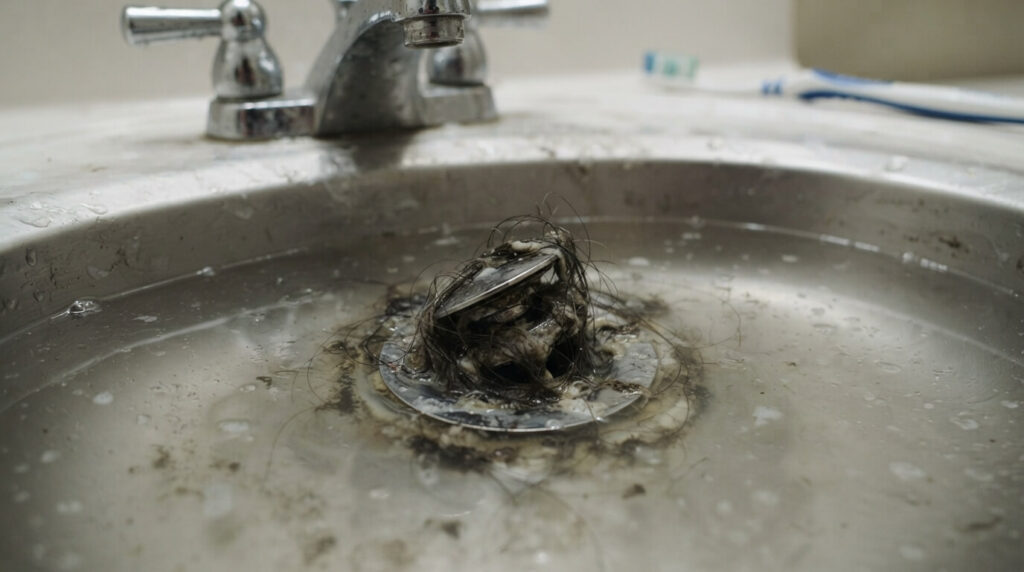
A clogged drain is a blockage inside a drain pipe that slows or stops wastewater from leaving a fixture or a building. Clogs form in kitchen sinks, bathroom sinks, bathtubs, showers, floor drains, toilets, and the main sewer line. The blockage may consist of hair, soap residue, grease, food particles, paper products, mineral scale, tree roots, or a damaged section of pipe.
Clogs differ by location, cause, and severity. A single fixture that drains slowly usually points to a local blockage in its trap or branch line. Several fixtures that drain slowly at once point to a blockage in the main drain or sewer line. Identifying the location first determines which tools and methods apply.
This article explains how blockages form, the types of clogged drains by location, their causes, and their warning signs. It then covers diagnosis, repair methods, the risks of ignoring or mishandling a clog, the signs that a plumber is needed, and prevention practices.
The sections that follow use the terminology of residential plumbing. Homeowners, renters, landlords, and property managers can use the information to judge whether a clog is a minor fixture problem or a sign of a deeper plumbing fault.
What a Clogged Drain Is and How Blockages Form
A clogged drain is a partial or complete obstruction inside a drain pipe that restricts the flow of wastewater. Drain pipes in a home slope downward so gravity carries water and waste toward the sewer or septic system. Any material that narrows the pipe interior or catches on its walls reduces the flow rate.
Blockages form through accumulation. Hair strands, soap residue, grease, food scraps, and paper fibres catch on rough pipe surfaces, bends, joints, and traps. Each deposit narrows the pipe and traps more material, so the restriction grows until water drains slowly or stops draining. Grease solidifies as it cools inside the pipe, which forms a sticky layer that binds other debris. Mineral scale from hard water can also build on pipe walls over time and reduce the internal diameter.
Structural faults produce a second category of blockage. Tree roots entering a joint, a collapsed pipe section, a sagging pipe that holds standing water, and a misaligned joint all obstruct flow without any household debris being the primary cause.
Partial Clogs vs. Complete Blockages
A partial clog allows water to pass at a reduced rate, while a complete blockage stops water from passing at all. A sink with a partial clog drains slowly and may gurgle. A sink with a complete blockage holds standing water that does not recede.
A partial clog is an early stage of the same process that produces a complete blockage. Debris that narrows a pipe by a small amount continues to collect material, so a slow drain tends to worsen until flow stops. The transition can take days, weeks, or months, depending on how much material enters the pipe and how much passes through.
The two conditions call for different responses. A partial clog often clears with a plunger, a drain snake, or an enzymatic cleaner. A complete blockage has no flow path, so liquid cleaners cannot reach the obstruction and mechanical removal is usually necessary.
What “Stoppage” Means in Plumbing
“Stoppage” is the plumbing trade term for a blockage that prevents wastewater from flowing through a drain, trap, or sewer pipe. The word is interchangeable with “clog” and “blockage” in most contexts, and it appears in plumbing codes, service records, and insurance documents.
In technical use, a stoppage usually refers to a complete obstruction rather than a slow drain. Plumbers classify a stoppage by where it occurs: in a fixture trap, a branch drain, the main drain, or the sewer lateral. The classification tells the technician which cleanout to use and which equipment to bring.
Types of Clogged Drains by Location in the Plumbing System
Clogged drains fall into four location-based types: single-fixture clogs, whole-house clogs in the main drain, main sewer line clogs, and the boundary between drain lines and sewer lines. Location matters because it determines how many fixtures are affected, how severe the problem is, and who can fix it.
A plumbing system is a branching network. Each fixture connects to a branch drain, branch drains join a main drain, and the main drain connects to the sewer line leading to the municipal sewer or septic tank. A blockage affects every fixture that drains through the blocked point. A blockage near the end of the network affects many fixtures. A blockage near a single fixture affects only that fixture.
Single-Fixture Clogs (Sink, Bathtub, Shower)
A single-fixture clog is a blockage in the trap or branch drain serving one sink, bathtub, or shower. Other fixtures in the house continue to drain normally, which distinguishes this type from main-line blockages.
Each fixture has a curved trap, usually a P-trap, that holds water to block sewer gases. The trap is also the most common collection point for debris. Kitchen sinks clog mainly from grease and food particles. Bathroom sinks, bathtubs, and showers clog mainly from hair, soap residue, and toothpaste. Removing the obstruction typically restores flow without affecting any other fixture.
Whole-House Clogs in the Main Drain
A whole-house clog is a blockage in the main drain that causes multiple fixtures to drain slowly or back up at once. The main drain is the large pipe, typically 3 to 4 inches in diameter, that collects flow from every branch drain in the home.
Fixtures at the lowest level of the house usually show symptoms first. A basement floor drain, a ground-floor shower, or a lower toilet may back up when upper-level fixtures discharge water. The blockage may sit inside the building or just outside it, near the point where the main drain meets the sewer line. Accessing it typically requires the main cleanout rather than a fixture trap.
Main Sewer Line Clogs
A main sewer line clog is a blockage in the pipe that carries all wastewater from the building to the municipal sewer main or septic tank. The residential sewer line, also called the sewer lateral, commonly measures 4 inches in diameter and runs underground beneath the yard.
Causes include tree root intrusion, grease accumulation, flushed non-degradable items, pipe sagging, corrosion, and collapse. Because the sewer line serves the whole building, a blockage there affects every fixture. Sewer line clogs are more serious than fixture clogs because the pipe is buried, the obstruction is harder to reach, and wastewater can back up into the lowest drains of the home.
Drain Line vs. Sewer Line: Where One Ends and the Other Begins
The drain line carries wastewater from fixtures to the main drain inside the building, while the sewer line carries it from the building to the public sewer or septic system. The transition point is generally where the pipe exits the building foundation, often near the main cleanout.
The boundary affects responsibility and repair access. Indoor drain lines, and usually the sewer lateral on private property, belong to the property owner. The municipal sewer main beyond the property line belongs to the local utility. Some jurisdictions assign the lateral section between the property line and the main to the utility, so ownership rules vary by location. A plumber or the local sewer authority can confirm where responsibility ends before repair work begins.
What Causes Drains to Clog
Drains clog for three main reasons: organic and household debris that accumulates on pipe walls, structural pipe damage or root intrusion, and recurring conditions that prevent a pipe from clearing itself. Most fixture clogs come from household materials entering the drain. Most sewer line clogs come from the pipe or from outside intrusion.
The cause determines the fix. Debris clogs respond to removal. Structural causes require repair or replacement of the pipe section, because clearing the obstruction without correcting the fault allows the blockage to return.
Hair, Soap Scum, Grease, and Household Debris
Hair, soap scum, grease, and household debris are the most common causes of fixture clogs. Hair collects in bathroom drains and binds with soap residue. Grease enters kitchen drains as liquid and solidifies against cooler pipe walls. Food particles, coffee grounds, and starchy foods such as rice and pasta add bulk to the deposit.
Soap scum forms when soap reacts with minerals in hard water, which produces a sticky residue that adheres to pipe walls. Flushed items also cause blockages. Wet wipes, even those labelled flushable, do not break down like toilet paper, and cotton swabs, dental floss, feminine hygiene products, and paper towels lodge in bends and joints. Each item narrows the pipe and catches further material.
Tree Roots, Pipe Damage, and Sewer Line Causes
Tree roots, pipe damage, and sewer line defects cause blockages that household habits do not produce. Roots seek moisture and nutrients, and they enter sewer lines through small cracks or loose joints. Once inside, roots expand, catch debris, and eventually restrict or block the full pipe diameter.
Other structural causes include corrosion in older metal pipes, cracked or collapsed clay and cast-iron sections, offset joints, and bellied pipe, which is a sagging section that holds standing water and solids. Ground movement, heavy loads above buried pipe, and age-related deterioration contribute to these faults. Older clay and cast-iron sewer lines are more susceptible to root intrusion and corrosion than modern PVC lines.
Why the Same Drain Keeps Clogging
A drain that clogs repeatedly has an unresolved cause, usually residual buildup, a pipe defect, or a habit that keeps adding debris. Clearing the center of a pipe with a plunger or snake restores flow but may leave a layer of grease, scale, or scum on the pipe walls. That layer narrows the pipe and catches new debris quickly.
Structural causes produce the same pattern. A root intrusion cut back without repairing the joint regrows. A sagging pipe continues to hold solids. A poorly vented drain line drains slowly because air cannot replace the departing water. A drain that clogs repeatedly within weeks or months warrants a camera inspection to identify the underlying cause.
Warning Signs Your Drain Is Clogged
The warning signs of a clogged drain are slow drainage, standing water, gurgling sounds, odours, and backups. Which signs appear, and how many fixtures show them, indicates whether the clog sits in a single fixture or in the main sewer line. Early signs usually appear before a full blockage forms.
Recognizing signs early allows simple correction before the blockage becomes complete. The two sets of signs below separate localized symptoms from whole-system symptoms.
Signs of a Clog in One Fixture
A clog in one fixture shows as slow drainage, standing water, gurgling, or odour at that fixture only. Water in a sink, tub, or shower takes longer to recede than it did before, and pooled water remains after use.
Gurgling occurs when air is forced through a partly blocked trap as water passes. A foul smell from the drain can come from decomposing debris caught in the trap. The fixture may also produce bubbles or a hollow sound when water runs. All other fixtures in the home drain normally, which confirms a localized blockage.
Signs of a Main Sewer Line Clog
A main sewer line clog shows as symptoms in multiple fixtures at once, including backups in the lowest drains of the house. Several fixtures drain slowly together, and gurgling may come from toilets, tubs, or floor drains when another fixture is used.
Distinctive signs include water backing up in a basement floor drain or shower when a washing machine drains, a toilet that bubbles when a sink is used, and sewage odour around the house or yard. Wet patches, unusually green or lush grass over the sewer line, or sunken ground in the yard may indicate a sewer line leak or a broken pipe. These signs justify contacting a plumber promptly.
How to Find and Diagnose the Clog
Diagnosing a clog involves three steps: determining how many fixtures are affected, ruling out non-clog causes of slow drainage, and locating the obstruction along the pipe. Correct diagnosis prevents wasted effort on the wrong fixture and identifies when professional equipment is needed.
The first check is scope. The second excludes venting and other faults. The third uses tools such as drain snakes and inspection cameras to locate a blockage that cannot be seen from the fixture.
Checking Whether It’s One Drain or the Whole House
To check whether the clog affects one drain or the whole house, run water in several fixtures and observe which drain slowly. If only one fixture is slow, the blockage is in that fixture’s trap or branch drain. If two or more fixtures on the same level or on different levels drain slowly, the blockage is in a shared line.
A practical test involves flushing a toilet while the tub or shower is being watched, then running a sink while observing a low floor drain. Water rising or bubbling in a separate fixture shows that the two fixtures share the obstructed line. A backup in the lowest fixture with all others slow usually indicates a main drain or sewer line blockage.
Why a Drain Won’t Drain When No Clog Is Visible
A drain can refuse to drain without a visible clog because of a blocked vent, a clog beyond the trap, a pipe with inadequate slope, or a partial collapse. The visible part of the drain is only the first few inches of the system, so the obstruction may sit farther down the pipe.
Plumbing vent stacks let air enter the drain system so water flows freely. A vent blocked by leaves, a bird’s nest, or ice creates negative pressure that slows drainage and causes gurgling, even with no blockage in the drain itself. A pipe that lost its downward slope, or one that was installed with too little slope, holds water and solids. Hard-water scale and grease on pipe walls can also narrow the passage without producing any visible obstruction at the drain opening.
Clogs Deep in the Pipe
A clog deep in the pipe is a blockage located beyond the reach of a plunger or a short household drain snake, often in a branch line, main drain, or sewer lateral. Symptoms persist after plunging and after snaking the first few feet of the line.
Plumbers locate deep clogs with a drain snake or auger that measures the distance to the obstruction, or with a sewer inspection camera that records the pipe interior. A camera inspection identifies the obstruction type, such as roots, grease, scale, a foreign object, or a pipe defect, and shows the pipe condition. The finding determines whether cable cleaning, hydro jetting, or a pipe repair is appropriate.
How to Fix a Clogged Drain
To fix a clogged drain, start with the least invasive method that suits the clog location: a plunger or household method for fixture clogs, a drain snake for deeper clogs, and professional equipment for severe or sewer-level blockages. Matching the method to the clog type prevents pipe damage and avoids unnecessary chemical use.
Method selection depends on the clog location, the drain material, and the obstruction type. Fixture clogs can often be cleared by the homeowner. Main-line and sewer clogs generally cannot.
What to Use First: Plunger, Snake, and Household Methods
Use a plunger first, then a drain snake, and try household methods such as hot water or a baking soda and vinegar mixture on light, grease-based buildup. A cup plunger creates pressure that dislodges a clog in a sink, tub, or shower. A flange plunger suits toilets.
For a plunger to work, cover the overflow opening with a wet cloth and seat the plunger fully over the drain. Push and pull in rhythmic strokes for 15 to 20 seconds. A drain snake, also called a drain auger, extends a flexible cable into the pipe to hook or break up an obstruction, and it reaches hair and debris a plunger cannot. A manual hand-crank snake handles most fixture clogs. Hot water can loosen soft grease, but it should not be used on a fully blocked porcelain fixture, and boiling water can soften PVC pipe joints. Baking soda and vinegar produce a mild fizzing reaction with limited cleaning effect on a complete clog.
Drain Cleaners: Chemical vs. Enzymatic
Chemical drain cleaners dissolve clogs through corrosive reactions, while enzymatic drain cleaners use bacteria or enzymes to break down organic matter gradually. The two categories differ in speed, pipe safety, and the types of clog they treat.
Chemical cleaners contain strong compounds such as sodium hydroxide (lye), sulfuric acid, or bleach. They act within minutes and can dissolve hair and grease, but they generate heat, can corrode pipes, and cause chemical burns on skin and in eyes. Different chemical cleaners must never be mixed, because the combination can release toxic gases. Enzymatic cleaners work over hours or overnight and are safe for most pipe materials, but they treat only organic matter such as grease, food, and soap scum and do not remove hair, mineral scale, or non-organic objects. Enzymatic cleaners suit maintenance and slow drains better than complete blockages.
Fixing Bathroom Sink, Tub, and Shower Clogs
To fix a bathroom sink, tub, or shower clog, remove the visible hair and debris from the drain opening, then use a plunger or a drain snake to clear the trap and branch line. Hair and soap residue cause most bathroom clogs, so removing the drain cover or stopper is the first step.
For a bathroom sink, remove the pop-up stopper and pull out accumulated hair, or place a bucket beneath the P-trap, unscrew the slip nuts, and clean the trap by hand. For a tub or shower, unscrew the drain cover, extract the hair mass with a hair-catching tool or bent wire, and snake the drain if the water remains slow. Reassemble the parts and run hot water to confirm that flow is restored. Sink stopper and trap cleaning also removes the residue that causes recurrence.
Handling Stubborn or Severely Clogged Drains
Stubborn or severely clogged drains require a longer drain auger, a hydro jetter, or a professional sewer machine. A standard household snake reaches about 25 feet, which is often insufficient for obstructions beyond the branch line.
A motorized drain auger, also called a sewer machine, uses a rotating cable with cutting heads to break through grease, roots, and compacted debris. Hydro jetting uses high-pressure water to scour pipe walls and remove grease, scale, and sludge, which makes it more thorough than cable cleaning for grease and scale buildup. Jetting is not suitable for every pipe, and pipes that are cracked or severely deteriorated can be damaged by high water pressure, so a camera inspection before jetting is standard practice. When several attempts fail, stop and call a plumber, because repeated forceful attempts can damage pipe.
Risks of Ignoring or Mishandling a Clogged Drain
Ignoring or mishandling a clogged drain carries three main risks: backups and leaks, pipe damage from repeated chemical use, and worsening blockages. A clog that remains in place tends to grow, and misapplied treatment can harm the pipe material.
The risks differ by clog location. A fixture clog may cause overflow and water damage. A sewer line clog may cause sewage to enter the building, which introduces health hazards and expensive cleanup.
Can a Clogged Drain Cause a Leak or Backup?
Yes, a clogged drain can cause a leak or backup, because blocked wastewater has no exit and rises through the lowest open fixture or seeps through weak pipe joints. A fixture clog can overflow a sink, tub, or shower. A sewer line clog can push wastewater into basement drains, tubs, and toilets.
Standing wastewater in a pipe raises the internal pressure on joints and old seals, which can cause them to leak inside walls or under floors. Sewage backups contain bacteria, viruses, and parasites, so they pose a health risk and require careful cleanup with protective equipment and disinfection. Water damage and mould growth can follow leaks that remain undetected. A backup in multiple fixtures warrants stopping water use and calling a plumber.
Damage from Overusing Chemical Cleaners
Overusing chemical cleaners damages pipes by corroding metal, softening plastic, degrading seals, and weakening joints. The corrosive compounds that dissolve a clog also attack pipe materials, and repeated applications compound the harm.
Older metal pipes are more vulnerable to corrosion, and a cleaner that sits in a fully blocked pipe stays in contact with the pipe wall for longer, which increases the damage. Chemical cleaners can also harm a septic system by killing the beneficial bacteria that break down waste. If a chemical cleaner fails to clear the clog, the standing liquid becomes a hazard for the plumber, who must work around it with protective gear. For recurring or complete clogs, mechanical methods are safer for the pipe than repeated chemical treatment.
When to Call a Plumber for a Clogged Drain
Call a plumber when a clog affects multiple fixtures, recurs after clearing, produces sewage backup, or resists plunging and snaking. Professional service is also appropriate when the cause is uncertain or a pipe defect is suspected.
Professional intervention prevents pipe damage, identifies the underlying cause, and reaches blockages that household tools cannot access. The following sections cover the signs that DIY methods have reached their limit, the professional process, and the cost factors involved.
Signs DIY Has Reached Its Limit
DIY has reached its limit when plunging and snaking fail, several fixtures clog together, sewage appears, or the same drain clogs repeatedly. Each of these signs indicates an obstruction or defect beyond the reach of household tools.
Specific indicators include:
- Multiple affected fixtures: The blockage sits in a shared drain or sewer line.
- Sewage backup: Wastewater returns through a floor drain, tub, or toilet.
- Repeated clogging: The drain clogs again within weeks of being cleared.
- Persistent gurgling or odour: The problem continues after the visible drain is cleaned.
- Failed chemical treatment: The cleaner did not open the drain and liquid remains in the pipe.
What Professional Drain and Sewer Clearing Involves
Professional drain and sewer clearing involves locating the blockage, removing it with mechanical or hydro-jetting equipment, and inspecting the pipe to confirm its condition. The plumber begins by identifying which drain or cleanout gives the best access.
A motorized auger cuts through roots and compacted debris, while hydro jetting scours grease and scale from the pipe walls. After clearing, a camera inspection shows the pipe interior and reveals cracks, root entry points, offset joints, sagging sections, or corrosion. The inspection guides the repair recommendation, which ranges from routine cleaning to spot repair, pipe lining, or pipe replacement. A record of the camera footage also helps when comparing repair options.
What Affects the Cost of Clearing a Clog
The cost of clearing a clog depends on the clog location, the clearing method, pipe access, and whether emergency service is required. A fixture clog in an accessible trap costs less to clear than a blockage deep in a sewer lateral.
Additional cost factors include:
- Clearing method: Hydro jetting and camera inspection add equipment and labour to a basic auger service.
- Pipe access: A missing or hard-to-reach cleanout increases time and effort.
- Pipe depth and length: Longer or deeper runs require more equipment.
- Pipe condition: Root intrusion, collapse, or corrosion may require repair in addition to clearing.
- Timing: Emergency, weekend, or after-hours service usually carries a higher rate.
- Regional rates: Labour and service fees vary by location.
Requesting a written estimate before work begins lets the property owner compare quotes.
How to Prevent Clogged Drains
To prevent clogged drains, control what enters the drain, keep pipes clean on a schedule, and protect the main sewer line from roots and debris. Prevention costs less than emergency clearing and reduces the risk of backups.
The three levels of prevention match the clog causes: daily habits reduce household debris, periodic maintenance removes buildup before it hardens, and sewer line care addresses root and structural risks.
Daily Habits That Keep Drains Clear
Daily habits that keep drains clear include using drain strainers, disposing of grease in the trash, flushing only toilet paper and human waste, and scraping plates before washing. These habits stop the main clog-forming materials before they enter the pipe.
- Install strainers: Fit mesh strainers in sinks, tubs, and showers to catch hair and food particles.
- Discard grease: Pour cooled cooking fat and oil into a container and place it in the trash.
- Flush selectively: Flush only toilet paper and human waste, and discard wipes, floss, and hygiene products in the trash.
- Scrape plates: Remove food scraps into the trash or compost before washing dishes.
- Flush with hot water: Run hot water through kitchen drains after use to move residue along.
Preventative Drain Maintenance Schedule
A preventative drain maintenance schedule combines weekly, monthly, and annual tasks that remove buildup before it forms a clog. The schedule applies to household fixtures and the main line.
- Weekly: Clean strainers and stoppers, and remove visible hair and debris.
- Monthly: Flush drains with hot water, and apply an enzymatic cleaner to slow drains and kitchen lines.
- Every six months: Clean P-traps under sinks and inspect exposed pipes for leaks or corrosion.
- Annually: Have a plumber inspect the main drain and cleanout, and clear the vents of debris.
- Every one to two years for older or root-prone lines: Schedule a camera inspection or professional cleaning.
Homes with older pipes, large trees near the sewer line, or a history of clogs benefit from a shorter interval.
Protecting the Main Sewer Line
To protect the main sewer line, keep tree roots away from the pipe, avoid flushing non-degradable items, and schedule periodic inspections. Root intrusion and grease accumulation are the two main threats to the sewer lateral.
Plant trees and large shrubs away from the sewer line path, and choose species with less aggressive root systems near buried pipe. A sewer line inspection locates cracks and root entry before a blockage forms. Root-cutting during cleaning removes roots temporarily, while pipe lining or replacement of damaged sections prevents regrowth at defective joints. Installing or maintaining an accessible main cleanout simplifies future inspection and clearing. Older clay or cast-iron sewer lines warrant closer monitoring than modern PVC.
Preventing Other Common Plumbing Problems at Home
Preventing other common plumbing problems at home follows the same principle as drain care: routine inspection, prompt repair of small faults, and correct use of fixtures. Leaking faucets, running toilets, low water pressure, frozen pipes, and failing water heaters are common problems that develop gradually and cost less to address early.
Practical measures include checking under sinks for moisture, replacing worn washers and seals, insulating exposed pipes in cold climates, and flushing the water heater tank annually to remove sediment. Knowing the location of the main water shutoff valve allows fast response to a burst pipe or major leak. Monitoring the water bill for unexplained increases can reveal a hidden leak.
Sewer Line Problems Beyond Clogs
Sewer line problems beyond clogs include cracked or collapsed pipe, offset joints, bellied sections, corrosion, and pipe deterioration from age. These faults can cause or worsen blockages, and they can also leak wastewater into surrounding soil without producing a full stoppage.
Cracks and broken joints allow roots to enter and soil to wash into the pipe. A bellied section holds standing water and solids, which leads to repeated clogs at the same point. Corrosion weakens cast-iron and galvanized steel pipe from the inside. A camera inspection identifies these faults and their locations. Repair options include spot repair, trenchless pipe lining, pipe bursting, and full excavation and replacement, and the choice depends on the pipe material, the extent of damage, and site access. A licensed plumber can assess which option fits the condition of the line.