
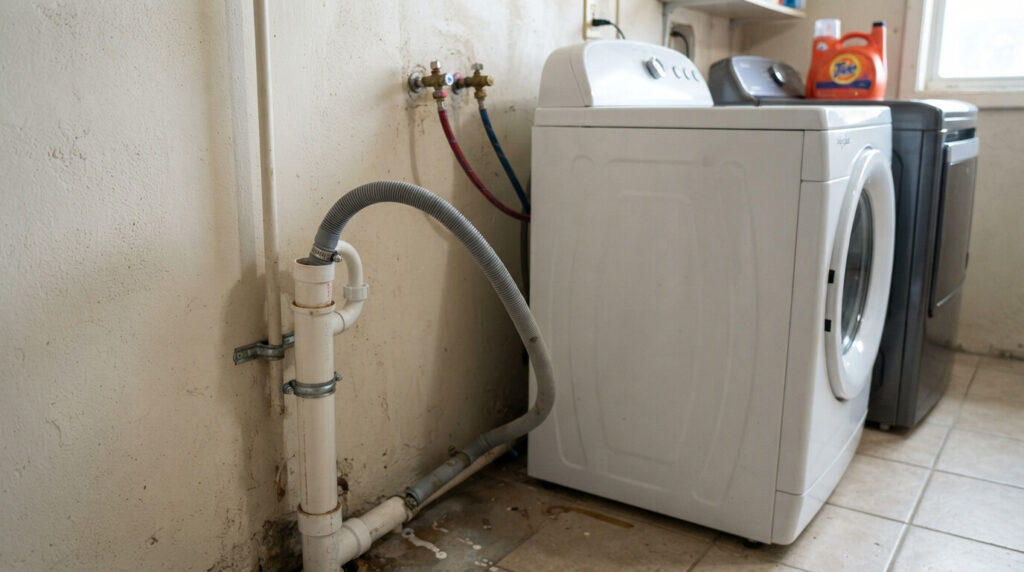
A clogged washing machine drain stops wastewater from leaving the drum, the drain hose, or the standpipe. The result is standing water in the drum, cycles that stall before the spin, or water rising out of the standpipe. Clogs form at four points along the drain path: the pump filter, the drain hose, the standpipe and trap, and the household drain line.
Each point needs a different fix. A pump filter is cleared by hand. A hose is disconnected and flushed. A standpipe and wall drain pipe are cleared with a drain snake or a wet/dry vacuum. A household line blockage sometimes needs a plumber. Choosing the correct fix starts with locating the clog, which the diagnostic tests in this guide do in a few minutes.
Most blockages consist of lint, hair, small objects, and hardened detergent residue. Kinked hoses and incorrect standpipe setups produce the same symptoms without any material clog. Some drain failures come from faulty components such as a lid switch or drain pump.
This guide covers how the drain system works, the warning signs, the causes, the diagnostic tests, each unclogging method, the safe use of drain cleaners, freeze-related problems, brand and machine-type differences, non-clog drain failures, prevention, and the conditions that call for a professional.
How a Washing Machine Drains and Where Clogs Form
A washing machine drains by pumping used water out of the drum through a drain hose into a household standpipe or laundry sink, from which gravity carries it into the wall drain and the main drain line. A clog forms wherever debris narrows this path, most often at the pump filter, the hose, or the trap.
The Drain Path from Pump to Hose to Standpipe to Wall Drain
The drain path runs from the drain pump to the drain hose, then to the standpipe, the P-trap, and the wall drain pipe. The pump pushes water out of the tub and up into the hose, and the hose discharges into the standpipe, which leads to the trap and the branch line that joins the main drain.
Clogs form at narrow or low points along this path. The pump housing and its filter catch coins, buttons, and lint before the water enters the hose. The drain hose has a small internal diameter, so lint and detergent residue accumulate along its walls. The trap holds a standing water seal and retains heavy debris in its curve. The branch line beyond the trap collects soap scum and lint that cool and harden on the pipe walls.
Machine-Side vs. Household-Side Drain Components
Machine-side components are the drain pump, pump filter, and drain hose, which belong to the appliance. Household-side components are the standpipe, trap, wall drain pipe, and main drain line, which belong to the building’s plumbing.
The distinction determines who repairs the problem and which tools apply. Machine-side parts are accessed from the washer itself and are serviced with a screwdriver, towels, and a shallow pan. Household-side parts need a drain snake, a wet/dry vacuum, or a plumber. The hose connection at the standpipe marks the boundary between the two sides, and the hose disconnect test described later uses that boundary to locate the clog.
Signs of a Clogged Washing Machine Drain
A clogged washing machine drain shows three main signs: water that remains in the drum after a cycle, slow or incomplete draining, and wastewater backing up from the standpipe, laundry sink, or floor drain. Each sign points to a different stage of the drain path.
Water Stays in the Drum or the Washer Won’t Spin
Water that stays in the drum after the cycle ends, or a washer that refuses to spin, indicates that wastewater is not leaving the tub. Most washers lock the spin stage until the tub drains, so a blocked pump, hose, or standpipe stops the cycle at the drain step.
Many models also display a drain error code, such as OE on LG washers or 5C and 5E on Samsung washers. A humming or buzzing pump with no water movement suggests a blockage in the pump or hose. A silent pump suggests an electrical or mechanical pump failure instead, covered later under non-clog failures. Unplug the washer before any inspection.
Slow or Incomplete Draining
Slow or incomplete draining means the drum empties over several minutes instead of draining steadily, or it leaves a few inches of water behind. A partial restriction in the hose, standpipe, or branch line causes this, because some water still passes through.
Partial clogs appear first as longer cycle times, damp clothes after the spin, or a gurgling sound from the standpipe during the discharge stage. Damp clothing after spinning results from the machine failing to remove water fast enough for the spin speed. Partial clogs grow worse over weeks, so early cleaning prevents a complete blockage.
Water Backing Up from the Standpipe, Laundry Sink, or Floor Drain
Water backing up from the standpipe, laundry sink, or floor drain means the household drain line cannot carry the washer’s discharge volume. A washer releases a large volume of water in a short time, so a partially blocked branch line overflows at the standpipe during the drain stage.
Backups in a laundry sink or floor drain indicate that the blockage sits downstream of the point where those fixtures connect. Water surfacing at several fixtures at once points to the main drain line. Stop using the washer immediately when water backs up, because each further cycle adds volume to an already full line.
What Causes Washing Machine Drains to Clog
Washing machine drains clog from four causes: lint, hair, and small objects; detergent and soap scum buildup; a kinked or crushed drain hose; and blockages further down the house drain line. Identifying the cause determines whether cleaning, repositioning, or professional service is needed.
Lint, Hair, and Small Objects
Lint, hair, and small objects cause clogs by collecting at the drain pump filter, in the hose, and in the trap. Synthetic fabrics, towels, and fleece release fibres during every wash, and those fibres bind to hair and to soap residue to form dense masses.
Small objects enter through pockets. Coins, hairpins, buttons, socks, and tissue paper lodge in the pump housing, where they block the impeller or the filter. Sock and small-garment losses occur most often on front-load washers, where items slip between the drum and the tub. Pet hair adds to the fibre load in households with pets.
Detergent, Softener, and Soap Scum Buildup
Detergent, softener, and soap scum build up on drain walls when undissolved product cools and hardens into a sticky layer that traps lint. Excess detergent, cold-water washing, and liquid fabric softener increase this residue.
Low-temperature cycles dissolve detergent less completely, so residue reaches the drain line still in a gel or paste form. Liquid softener contains fatty compounds that coat the inside of hoses and pipes. High-efficiency (HE) washers use little water, which gives residue less dilution and less flushing force. HE-rated detergent at the recommended dose reduces the residue that reaches the drain.
Kinked or Crushed Drain Hose
A kinked or crushed drain hose restricts water flow because the bend or compression shrinks the internal diameter at one point. The pump then pushes against a narrowed passage, which slows the drain or stops it.
Kinks occur when the washer sits too close to the wall, when the hose is bent sharply behind the machine, or when the machine moves during spin cycles and pinches the hose. A crushed hose can also result from heavy objects placed against it. A kink requires repositioning, not cleaning, and a hose with a permanent crease needs replacement.
Blockages Further Down the House Drain Line
Blockages further down the house drain line occur in the trap, the wall drain pipe, or the branch line that joins the main drain. Soap scum, lint, and grease accumulate on pipe walls until the pipe cannot carry a full washer discharge.
Older pipes made of cast iron or galvanized steel develop rough interior surfaces that catch debris faster than smooth PVC does. Tree roots enter underground lines through joints and narrow the pipe. A blockage at this level affects every fixture on the line, so symptoms often appear outside the laundry area.
How to Tell Whether the Clog Is in the Machine or the House Plumbing
The clog is in the machine if the washer still fails to drain with its hose disconnected from the standpipe and pointed into a bucket or sink. The clog is in the house plumbing if the washer drains normally into the bucket, or if other fixtures on the same line drain slowly.
Quick Tests: Hose Disconnect Test and Other-Fixtures Test
The hose disconnect test and the other-fixtures test separate machine-side from household-side clogs. The hose disconnect test removes the standpipe from the path, and the other-fixtures test checks whether the shared drain line is restricted.
For the hose disconnect test, unplug the washer, pull the hose from the standpipe, and place the free end in a large bucket or a utility sink. Plug the washer back in and run a drain and spin cycle. Water that flows into the bucket confirms a clear machine and hose, which places the clog in the standpipe, trap, or drain line. Water that does not flow indicates a blocked pump, filter, or hose. Keep the bucket lower than the washer’s drain outlet stays workable only if the bucket is emptied before it overflows, so use a bucket that holds at least a full load of wastewater or hold the hose over a floor drain or utility sink.
For the other-fixtures test, run water in the nearest laundry sink, bathroom sink, and shower, and flush a toilet. Slow draining or gurgling at several fixtures points to the branch line or the main drain. Normal draining at every fixture suggests the clog is limited to the standpipe and trap serving the washer.
Safety Steps and Tools You Need Before Unclogging
Before unclogging, unplug the washer, shut off the water supply valves, lay towels and a shallow pan around the work area, and gather the required tools. These steps prevent electric shock, flooding, and skin contact with contaminated wastewater.
The tools needed are a flashlight, a screwdriver, pliers for spring-type hose clamps, a shallow baking pan or baking tray, old towels, a bucket, rubber gloves, and eye protection. A wet/dry vacuum, a 1/4-inch drum auger (drain snake) of about 25 feet, and a flexible drain brush complete the set for hose and pipe work. Wear gloves and eye protection, because washer wastewater carries bacteria, detergent residue, and sometimes bleach. Pull the machine away from the wall only as far as the hoses allow, so connections do not strain or kink.
How to Drain Standing Water from a Washer That Won’t Drain
To drain standing water from a washer that won’t drain, unplug the machine, open the small drain tube or the pump filter access panel, and let the water flow into a shallow pan or bucket. Empty the pan repeatedly until the drum is dry.
Most front-load washers include a small rubber drain tube beside the pump filter cover. Place a towel and pan under the front lower panel, remove the tube cap, and lower the tube into the pan. Close the tube and empty the pan when it fills, then reopen it until the flow stops. On washers without an emergency drain tube, loosen the pump filter slowly, because a full drum can release several gallons quickly. Top-load washers without a front filter need the drain hose lowered to a bucket on the floor, which drains the tub by gravity. Bailing the drum with a cup and a bucket removes water when no other access exists.
How to Clean the Washer Drain Pump Filter
To clean the washer drain pump filter, unplug the washer, drain the residual water through the drain tube, unscrew the filter counterclockwise, remove the debris, rinse the filter, and screw it back in until it is tight. The filter sits behind a small access panel at the lower front of most front-load washers.
Open the panel with a coin or a flat screwdriver. Place a shallow pan and towels below the opening, because water remains in the pump housing even after the drum is empty. Turn the filter counterclockwise slowly and let the water drain before pulling it out fully. Remove coins, lint, hair, and fabric pieces from the filter and from the filter cavity. Shine a flashlight into the housing and spin the pump impeller with a finger. An impeller that turns freely and returns smoothly is clear. An impeller that binds or rattles may be blocked by a small object or may have a damaged blade. Rinse the filter under running water, reinstall it with the threads aligned, and close the panel. Pump filters need cleaning every one to three months on front-load machines under regular use.
How to Unclog a Washing Machine Drain Hose
To unclog a washing machine drain hose, disconnect it from the machine and the standpipe, flush it with a garden hose or sink sprayer, and push a flexible brush or snake through it to remove lint and residue. The hose is either cleaned after removal or cleaned in place, depending on access.
Inspect the hose for cracks, kinks, and soft spots before any cleaning. A hose with visible damage needs replacement, and a replacement hose of the correct length, diameter, and fitting type restores full flow. Hose cleaning applies to the machine-side drain path, so it follows a clean pump filter and precedes standpipe work.
Removing and Flushing the Hose
To remove and flush the drain hose, unplug the washer, loosen the hose clamps with pliers, pull the hose off the machine outlet and the standpipe, and run water through it from one end until the water flows clear. Hold the hose over a bucket or a tub while flushing.
Drain residual water from the hose into the bucket before inspecting it. Look through the hose toward a light to see obstructions. Flush with a garden hose in both directions, because a reverse flush pushes stuck debris back out the entry point. Stubborn residue loosens when the hose is filled with hot tap water and left for 15 minutes before flushing. Reattach the hose with the clamps tight and confirm that the hose has no kinks and that the standpipe end forms a high loop or sits at the recommended height.
Cleaning the Hose Without Removing It
To clean the hose without removing it, pull the washer out enough to access the standpipe end, detach only that end, and run a flexible drain brush or a small snake into the hose as far as it reaches. Flush with water from the standpipe end into a bucket.
This method suits machines wedged in tight spaces, where removing the machine-side fitting risks damaging connectors. Insert the brush gently and turn it while pulling out, which removes fibres from the inner wall. A wet/dry vacuum held against the open hose end pulls loose debris out by suction. Cleaning in place reaches only part of a long hose, so the hose needs full removal and flushing if flow does not improve.
How to Unclog the Standpipe and Wall Drain Pipe
To unclog the standpipe and wall drain pipe, remove the hose from the standpipe, then clear the obstruction with a drain snake, a wet/dry vacuum, or a manual flushing method, depending on how deep the clog sits. Standpipe clogs sit above or in the trap, and wall drain clogs sit beyond it.
A standpipe is typically 2 inches in diameter, which accepts a standard drum auger. Test the flow by pouring a gallon of water into the standpipe. Water that rises or drains slowly confirms a restriction. Wear gloves and lay towels around the standpipe base before any work.
How to Snake a Washer Drain Pipe
To snake a washer drain pipe, feed a 1/4-inch drum auger into the standpipe, rotate the handle clockwise as the cable advances, push through the obstruction, and pull the cable out slowly with the debris attached. Rinse the cable as it exits the pipe.
Advance the cable until it meets resistance, which marks the clog or the trap bend. Rotate the handle while applying light forward pressure, so the auger tip breaks through or hooks the blockage. Do not force the cable past the trap, because forcing can scratch plastic pipe or kink the cable. After the snake passes through, flush the pipe with hot water for several minutes. A second pass is necessary if water still drains slowly. A cable length of 25 feet reaches most branch lines, while clogs farther than that need a longer auger or a professional.
Unclogging Without a Snake
Unclogging without a snake relies on a wet/dry vacuum, a plunger, hot water, or an enzyme cleaner. These methods clear partial clogs in the standpipe and trap, where debris and soap scum sit within reach.
A wet/dry vacuum set to liquid mode, with its hose sealed against the standpipe opening using a rag, pulls out standing water and soft debris. A cup plunger or a small sink plunger sealed over the standpipe opening dislodges shallow obstructions through pressure changes. Hot tap water, not boiling water, softens soap scum. Boiling water can soften PVC joints and damage older pipes. An enzymatic cleaner, left overnight, breaks down organic residue slowly and suits maintenance more than complete blockages.
Clogs Inside the Wall
A clog inside the wall sits in the drain branch line or the vent connected to it, beyond the reach of a standpipe-level snake. Symptoms include repeated backups after a successful standpipe cleaning, gurgling at multiple fixtures, and sewage smells near the laundry area.
A blocked plumbing vent produces similar symptoms, because the drain cannot pull air behind the water. A cleanout fitting on the main line lets a plumber insert a longer or motorized auger. Attempting to open walls or to force a long cable through a hidden run risks pipe damage and leaks. A licensed plumber uses a camera inspection to find the blockage location and type.
Do Drain Cleaners Work in a Washing Machine Drain?
Drain cleaners work on some washing machine drain clogs, mainly soap and grease buildup in the standpipe and branch line, but they cannot dissolve solid objects and carry risks for the machine and the plumbing. Mechanical removal remains the more reliable method.
Chemical cleaners react with organic residue and soap scum but do not remove coins, buttons, or compacted lint. Cleaner needs time in standing water or in a pipe to work, and a washer drain line moves water quickly, which limits contact time. Many washer manufacturers advise against pouring chemical cleaners into the drum or the machine, because the chemicals can damage seals, hoses, and the pump.
Using Drano and Other Chemical Cleaners Safely
Using Drano and other chemical cleaners safely means applying the product only to the standpipe or household drain, following the label’s dose and wait time, and never mixing products. Never add a chemical cleaner through the washer drum or the drain hose.
Wear chemical-resistant gloves and eye protection, ventilate the area, and keep the washer unplugged while the cleaner works. Mixing a chlorine-based product with an acid or an ammonia-based product releases toxic gas, so one product is used at a time. After the wait time, flush with hot tap water for the period stated on the label. Standing chemical cleaner in the standpipe endangers the next person who works on the pipe, so a failed attempt is reported to the plumber before snaking begins. Chemical cleaners can corrode old metal pipes and soften plastic fittings, so repeated use is not a maintenance method.
Enzymatic and Non-Chemical Alternatives
Enzymatic and non-chemical alternatives are enzyme-based drain cleaners, a wet/dry vacuum, hot water flushing, and baking soda followed by vinegar. They clear organic residue and light buildup without corrosive chemistry.
Enzyme cleaners contain bacteria or enzymes that digest fats, proteins, and starches. They need several hours, often overnight, and work best as preventive maintenance in lines with a partial restriction. Baking soda and vinegar produce foam that loosens light surface residue, but the reaction is short and has limited effect on dense clogs. Hot water, a wet/dry vacuum, and a snake remove material physically and apply to most clogs. Enzyme products do not dissolve hair or solid objects.
What to Look for in a Washer Drain Cleaner
A washer drain cleaner should be labelled safe for the pipe material, suited to the clog type, and compatible with septic systems if the home uses one. The label needs to state clearly that the product is approved for washer drain lines or standpipes.
Enzymatic formulas suit septic systems and plastic pipes. Sodium hydroxide and sulfuric-acid products clear tougher clogs but damage some pipe and fitting materials. Check the listed pipe compatibility for PVC, ABS, cast iron, and copper. Look for clear instructions on contact time, dosage, and flushing. A product that lists hair and soap scum as targets fits washer lines better than one marketed for grease alone.
How to Fix a Frozen Washing Machine Drain
To fix a frozen washing machine drain, move the washer into a room above freezing temperature, thaw the hose and standpipe with warm towels, warm water, or a hair dryer on low heat, and confirm that water flows before running a cycle. Never use an open flame or a heat gun on the hose or pipe.
Freezing occurs in unheated garages, basements, and sheds when ice forms in the hose, the pump, or the standpipe trap. Symptoms include no drainage, the drum holding water, or a drain error after a cold night. Unplug the washer before thawing. Wrap the hose in warm, damp towels and replace them as they cool, and pour warm, not boiling, water into the standpipe. Give the pump and housing several hours at room temperature to thaw. Inspect the hose and pump housing for cracks after thawing, because expanding ice splits hoses and cracks plastic. Insulating exposed pipes and keeping the laundry area above 32°F (0°C) prevents recurrence.
Front-Load vs. Top-Load and Brand-Specific Drain Clogs
Front-load and top-load washers clog at different points, because their pump access, tub design, and filter placement differ. Brand-specific designs also change where the filter sits and which error codes indicate a drain problem.
Front-load machines collect debris at a user-accessible pump filter, while top-load machines usually have no user-serviceable filter and send debris to the hose and standpipe. The sections below describe each design and the brands most often searched.
Front-Load Washers
Front-load washers clog mainly at the drain pump filter, located behind a small panel at the lower front of the cabinet. Coins, socks, lint, and hair collect there, so the filter is the first component to check.
The door gasket also traps hair, lint, and small items that slip into the drain path. Front-load washers use less water than top-load models, so they flush residue less thoroughly. A monthly filter check and periodic gasket wipe-downs reduce drain complaints. The emergency drain tube beside the filter lets a user remove water before opening the filter.
Top-Load Washers
Top-load washers clog mainly in the drain hose, the standpipe, or the pump, which sits under the tub and is not directly accessible from the front. Most top-load models have no user filter, except a lint filter on some older agitator models.
Lint and small items that pass through the tub reach the pump housing, so pump access needs removal of a cabinet panel or tilting of the machine. Top-load washers also develop hose kinks behind the cabinet, because the machine sits close to the wall. Models with a removable lint filter inside the agitator or the tub wall need periodic cleaning of that screen.
LG, Samsung, GE, and Whirlpool Notes
LG, Samsung, GE, and Whirlpool washers differ in filter location and drain error codes, so the owner’s manual for the exact model gives the authoritative location and code meaning. The notes below describe the common patterns.
LG front-load washers place the drain pump filter behind a lower-right or lower-left access panel and display the OE code when draining fails. Samsung front-load washers place a debris filter at the lower-front corner and display 5C, 5E, or SC for drain faults. Whirlpool front-load models show F21 for a long drain time, and Whirlpool top-load models show F9E1 for a drain fault. GE washers vary by model, with front-load units carrying a pump filter at the front and top-load units carrying a pump under the tub, and the code meanings are listed in each model’s manual. Code meanings can change between model years, so confirm the code against the manual or the manufacturer’s support page.
When the Washer Won’t Drain but Nothing Is Clogged
A washer that won’t drain with no clog has a faulty component, such as a lid switch, drain pump, or control board, or a setup problem, such as incorrect drain hose height. These failures show the same symptoms as a clog but remain after cleaning.
A clear pump filter, a clean hose, and a free-flowing standpipe rule out a blockage. The next steps check electrical and mechanical parts and the hose position.
Lid Switch, Drain Pump, and Control Failures
Lid switch, drain pump, and control failures stop draining because the machine does not send power to the pump or the pump cannot move water. Each part has a distinct failure pattern.
A faulty lid switch on a top-load washer prevents the spin and drain stage, because the machine reads the lid as open. A click when the lid closes and a washer that still will not advance suggests switch failure. A failed drain pump is either silent, which suggests a dead motor, or loud and grinding, which suggests a damaged impeller or a foreign object. A control board fault produces no pump activation and no error, or a drain error that returns immediately after a reset. Testing the pump or the board with a multimeter requires technical skill, so a technician diagnoses these parts when basic checks fail. Replacement pumps are a common, moderate-cost repair.
Drain Hose Height and Siphoning Problems
Drain hose height and siphoning problems stop proper draining when the hose sits too low or is pushed too far into the standpipe, which lets water siphon out of the drum or prevents it from draining. The hose needs a high loop and an air gap at the standpipe.
Manufacturers commonly specify a hose discharge height between roughly 30 and 96 inches above the floor, and the exact range is in the owner’s manual. A hose sealed tightly into the standpipe creates a closed connection that blocks air and causes siphoning, which leads to water leaving the drum during the fill stage. A hose set too high increases pump load and can leave water in the hose. Inserting the hose a few inches into the standpipe, without sealing the opening, leaves an air gap and allows correct drainage.
How to Prevent Washing Machine Drain Clogs
To prevent washing machine drain clogs, clean the pump filter and lint screen regularly, use the recommended dose of HE detergent, check pockets before washing, run a hot cleaning cycle monthly, and keep the drain hose free of kinks. These habits address each cause identified earlier.
Filter cleaning every one to three months removes debris before it reaches the hose. Measure detergent by the machine’s fill line and load size, because excess detergent produces residue. A monthly hot-water cleaning cycle with a washer cleaner dissolves detergent and softener residue in the tub and drain path. Fit a lint trap or a mesh filter on the discharge hose, if the machine drains to a laundry sink, to catch fibres before they reach the trap. Reduce liquid fabric softener use, because its residue coats drain walls. Inspect the hose annually for cracks and kinks, and replace hoses on a schedule recommended by the manufacturer, since rubber hoses weaken with age.
When to Call a Plumber or Appliance Technician
Call a plumber when the clog is in the household drain line, the standpipe or branch line does not clear after snaking, or several fixtures back up. Call an appliance technician when the pump, lid switch, control board, or motor fails or when the machine shows a drain error after the filter and hose are clear.
Signs that need a plumber include repeated backups after clearing the standpipe, sewage odours, gurgling at multiple fixtures, water in a floor drain, and suspected vent or main line blockage. Signs that need an appliance technician include a silent or noisy pump with clear drain paths, persistent drain error codes, and leaks from the pump housing. Professional service is also the safer choice when a repair requires opening the cabinet on a machine still under warranty, since unauthorized repairs can affect coverage. Check the warranty terms before disassembly.
Washing Machine Drain Setup Problems
Washing machine drain setup problems arise from incorrect standpipe height, missing or improperly installed traps, and absent drain connections. A setup fault causes recurring clogs, siphoning, backups, and slow draining even when the lines are clean.
Setup errors are common after a machine relocation, a laundry remodel, or an installation in a home without an existing laundry hookup. Plumbing codes define standpipe and trap requirements, and local codes can differ, so a licensed plumber confirms compliance for a given location.
Standpipe Height, Trap, and Rough-In Basics
Standpipe height, trap, and rough-in basics are the plumbing dimensions and components that let a washer discharge without backing up or siphoning. A standpipe is typically 2 inches in diameter, extends at least 18 inches above the trap weir, and connects to a trap that holds a water seal against sewer gases.
The International Plumbing Code and the Uniform Plumbing Code both set the standpipe top between 18 and 42 inches above the trap weir, and many washer manufacturers recommend a top height near 30 to 39 inches from the floor. The trap sits below the standpipe and must connect to a vented drain. The rough-in, which is the drain opening and supply valves inside the wall, needs a standpipe opening sized for the drain hose and a vent that prevents siphoning of the trap. A standpipe too short allows overflow during the drain stage. A standpipe too tall strains the pump. A trap without a vent drains slowly and gurgles.
What to Do When There Is No Drain Pipe in the Wall
When there is no drain pipe in the wall, drain the washer into a laundry sink, a floor drain, or a dedicated drain installed by a plumber. A hose draped into a bathtub or out a window is not a code-compliant, permanent solution.
A laundry sink, often called a utility sink, accepts the drain hose when the hose is secured at the sink edge with a hose guide and sized to the sink’s capacity. A floor drain in a basement or a garage works when the hose is held in a fixed position above the drain opening. A new standpipe and trap require a plumber to tie into the drain line and the vent, and in some homes a laundry pump or an up-flush system lifts water to a higher drain. Local building codes and permit rules apply to a new drain line, so confirm requirements before starting.
Laundry Sink and Floor Drain Clogs
Laundry sink and floor drain clogs occur when lint, soap scum, and debris collect in the sink trap or the floor drain trap, which slows the washer’s discharge and causes backups during the drain stage. These fixtures receive the full washer discharge volume when the hose drains to them.
A laundry sink clog appears as water rising in the basin when the washer drains. Remove the sink strainer, clear visible lint and hair, and run a small drain snake through the trap. Take the sink trap apart with a bucket beneath it when the snake does not clear the blockage, and clean the trap by hand. A floor drain collects dirt, lint, and sediment in its trap, so remove the grate, scoop out the debris, and flush with hot water. Standing water in a floor drain after the washer drains, or repeated overflow, points to a blocked branch line, which needs a longer auger or a plumber. A mesh lint filter at the end of the drain hose reduces the debris that reaches these fixtures.
I can also put this in a Word document or Markdown file if you’d like.