
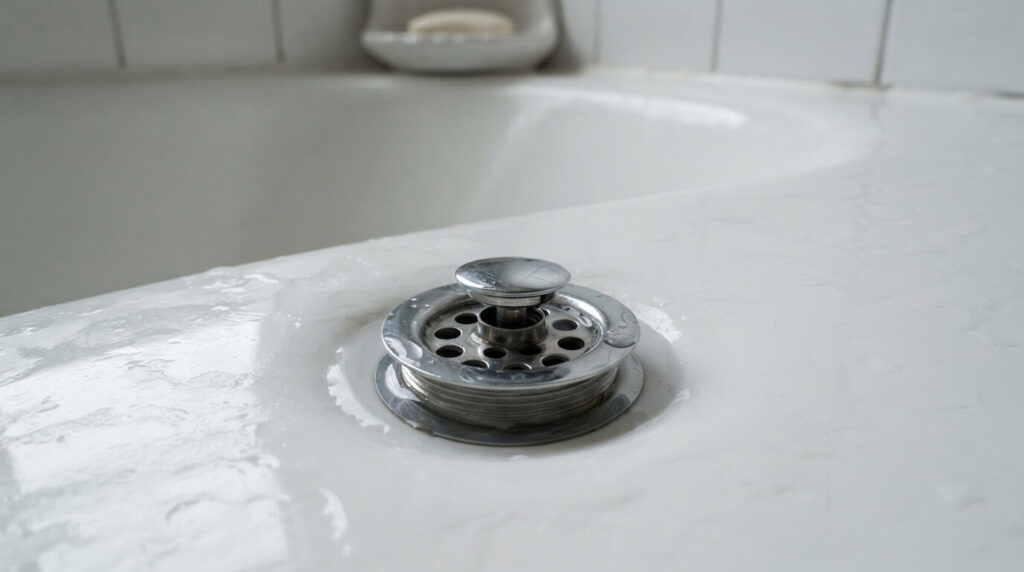
A clogged bathtub drain results from hair, soap residue, mineral deposits, or foreign objects that narrow the drain pipe until water can no longer pass freely. Most tub clogs sit within the first few inches of the drain opening or in the stopper assembly, which makes them removable with hand tools and no plumber.
The correct method depends on the clog’s location, its material, and whether the tub drains slowly or not at all. Hair clogs respond to manual removal or a drain snake. Soap scum responds to hot water and dish soap. Deeper blockages in the P-trap or the branch line may need an auger or professional equipment.
This guide covers how to identify the clog type, what causes it, how to remove the stopper, and how to clear the drain with hand tools, home remedies, and drain cleaners. It also explains how to choose a method, why a tub may keep draining slowly after clearing, when to call a plumber, and how to prevent repeat clogs.
The final section explains how shower drains differ from bathtub drains, so the same methods can be adapted to a walk-in shower.
How to Tell What Kind of Clog Your Bathtub Drain Has
A bathtub drain clog is identified by how fast the water drains, what sounds and odors the drain produces, and whether other fixtures in the home are also affected. These three signals separate a partial hair clog from a full blockage and a tub-only clog from a plumbing-system problem.
Checking these signs first prevents wasted effort. A hair clog at the drain opening needs a different tool than a blockage in the main drain line.
Slow Drain vs. Fully Blocked Drain
A slow drain lets water pass at a reduced rate, while a fully blocked drain holds standing water that does not lower at all. A slow drain usually indicates a partial obstruction, most often hair and soap scum coating the pipe walls.
A partial clog gets worse over time because each shower adds more debris to the narrowed passage. Clearing it early with a hair removal tool or hot water and dish soap is easier than clearing a complete blockage. A fully blocked drain points to a dense mass of hair, a stopper failure, or a foreign object. It usually requires a plunger or drain snake.
Standing Water, Gurgling, and Odor as Clues
Standing water after a shower indicates restricted flow, gurgling indicates trapped air moving through a partial blockage or a vent problem, and a sewage or rotten odor indicates decomposing organic material in the drain or trap.
Each clue points to a different location. Standing water alone suggests a nearby obstruction. Gurgling from the tub when another fixture drains suggests the fixtures share a line and air is being displaced. A persistent sewer smell suggests buildup in the P-trap or a dry trap that no longer holds its water seal.
Bathtub-Only Clog vs. Whole-House Drain Problem
A bathtub-only clog affects just the tub, while a whole-house drain problem affects several fixtures at once, such as the toilet, bathroom sink, and washing machine. The test is simple: run water in other fixtures and watch the tub.
If water from a flushed toilet or running sink appears in the tub, the blockage sits in a shared branch line or the main drain. A tub-only clog sits between the tub drain opening and the point where the tub’s drain line joins the shared line. Tub-only clogs are suitable for do-it-yourself methods. Whole-house symptoms need a plumber or a main-line cleaning.
What Causes a Bathtub Drain to Clog
Bathtub drains clog mainly from hair combined with soap scum, but stopper mechanisms that trap debris, mineral deposits, and foreign objects also cause blockages. Hair is the most common cause because it does not dissolve in water and binds with soap residue to form a dense mat.
Identifying the cause determines which removal method works. Organic buildup responds to manual removal, while mineral deposits and foreign objects need different treatment.
Hair and Soap Scum Buildup
Hair and soap scum are the leading causes of bathtub drain clogs. Hair catches on rough pipe surfaces and on the drain crossbars, and soap scum acts as a binder that turns loose strands into a solid mass.
Soap scum forms when fatty acids in bar soap react with minerals in hard water. The residue is sticky and adheres to pipe walls, which narrows the passage progressively. Body oils, shampoo residue, and skin cells add to the mass. Long hair mats faster than short hair, and households with several long-haired users experience faster buildup.
Stopper Mechanisms and Trapped Debris
Stopper mechanisms cause clogs when hair and soap scum wrap around the stopper body, linkage, or rocker arm beneath the drain opening. Even when the pipe itself is clear, this trapped debris restricts water flow and prevents the stopper from sealing or opening fully.
Pop-up, trip-lever, and toe-touch stoppers all have moving parts below the drain opening where debris collects. A trip-lever assembly extends into the overflow pipe, and its plunger or spring linkage catches hair. A worn stopper that does not open fully also reduces drain flow and mimics a pipe clog.
Mineral Buildup and Foreign Objects
Mineral buildup and foreign objects cause clogs that hair removal does not fix. Hard water deposits calcium and magnesium scale on pipe walls, and small objects such as bottle caps, toy pieces, and razor caps lodge in the drain or trap.
Scale reduces the pipe’s internal diameter over months or years, so the drain slows gradually even after hair is removed. Foreign objects produce a sudden clog rather than a gradual one. A snake or a retrieval tool can remove a lodged object, but scale requires a descaling treatment or professional cleaning if the pipe is heavily coated.
How to Open and Access the Bathtub Drain Before You Start
To access a bathtub drain, remove the stopper or drain cover, then the strainer if one is present, so the drain opening is exposed for cleaning. The removal method depends on the stopper type, which is identified by how the stopper operates.
Access is the first physical step in every hand-tool method. Skipping it leaves the most common clog location, the stopper and the upper drain, untouched.
Removing Common Stopper Types (Lift-and-Turn, Push-Pull, Toe-Touch, Trip-Lever)
Each stopper type has its own removal method. Lift-and-turn and push-pull stoppers unscrew from the drain, toe-touch stoppers unscrew after the cap is removed, and trip-lever stoppers are removed by taking off the overflow plate and pulling out the linkage.
- Lift-and-turn: Turn the knob or stopper counterclockwise to unscrew it. If a small set screw is visible on the side, loosen it with a screwdriver first.
- Push-pull: Unscrew the top cap by turning it counterclockwise, loosen the setscrew beneath it, and unscrew the stopper from the drain.
- Toe-touch: Turn the cap counterclockwise to remove it, then unscrew the stopper’s threaded post from the drain crossbar.
- Trip-lever: Remove the two screws that hold the overflow plate, then pull the plate with the attached linkage and plunger straight out of the overflow opening.
Clean hair and residue off each removed component before reinstalling it. The trip-lever linkage in particular carries trapped debris that is not visible from the tub.
What to Do When the Drain Plug Is Stuck
A stuck drain plug is loosened by applying penetrating lubricant to the threads, waiting several minutes, and turning the stopper with pliers or a drain key while protecting the finish with a cloth. Corrosion, soap scum, and mineral scale are the most common reasons a plug will not turn.
If the plug still does not turn, tapping the stopper lightly with a rubber mallet can break the bond of the scale. For a tight crossbar drain, a tub drain wrench or a pair of needle-nose pliers gripped against the crossbars provides leverage. Avoid forcing the plug with a metal tool directly against the tub, since chips in porcelain or acrylic finishes are difficult to repair.
Tools and Safety Prep
The basic tool set for a bathtub drain clog includes rubber gloves, a flashlight, a screwdriver, needle-nose pliers, a bucket, a flat-bottom plunger, and a plastic drain hair-removal tool or a drain snake. Gloves and eye protection are required when any cleaner is used.
Place a towel or old cloth on the tub floor before starting to prevent scratches from dropped tools. Remove standing water with a cup or small container if the tub is full, particularly before any chemical product is used. Ventilate the bathroom by opening a window or running the exhaust fan whenever a cleaning product is involved.
How to Unclog a Bathtub Drain by Hand and With Simple Tools
To unclog a bathtub drain by hand, remove the stopper, pull out visible hair, then use a plunger or drain snake if the blockage remains. These methods physically remove or dislodge the obstruction, so they work on the most common causes without chemicals.
The order of methods matters. Start with the least invasive one and move to tools only if the drain stays blocked.
Removing Hair From the Drain
Hair is removed from a bathtub drain by extracting it with a barbed plastic drain tool, needle-nose pliers, or a bent wire hook inserted through the drain opening. Pull the hair mass out slowly rather than jerking it, which can break the strands and leave part of the clog behind.
Shine a flashlight into the drain to see how far the hair extends. Clear the upper drain and the stopper seat first, then run hot tap water to check flow. Dispose of the hair in the trash, not down a toilet or sink. A plastic barbed strip costs little and reaches farther into the drain than fingers or pliers, which makes it the preferred tool for a hair clog.
Using a Plunger on a Bathtub (and Sealing the Overflow)
To plunge a bathtub, block the overflow opening with a wet rag or a wet cloth held firmly against it, place a flat-bottom plunger over the drain with enough water to cover the plunger cup, and pump vigorously for 15 to 20 seconds. Sealing the overflow is necessary because otherwise the pressure escapes through the overflow opening instead of pushing the clog.
The plunger creates alternating pressure and suction that loosens the obstruction. A flat-bottom cup seals against the tub floor better than a toilet flange plunger. Petroleum jelly around the plunger rim improves the seal. Do not plunge after a chemical cleaner has been poured in, because the splash-back contains caustic liquid.
Using a Drain Snake or Auger
A drain snake, also called a drain auger, clears a bathtub clog by extending a flexible coiled cable into the drain, rotating the handle to hook or break up the blockage, and pulling the debris out. It reaches clogs that sit beyond the stopper, in the horizontal drain arm or the P-trap.
Feed the cable slowly into the drain opening until resistance is felt, then turn the handle clockwise to engage the clog. Push and rotate to break up softer material, or retract the cable to pull hair out. Wipe the cable as it comes out to avoid spreading debris. A hand-crank snake suits most household clogs, and a powered auger suits longer or denser blockages. Avoid forcing the cable against a hard resistance, since the resistance may be a pipe bend rather than the clog.
Unclogging a Bathtub Without a Snake
A bathtub can be unclogged without a snake by using a straightened wire coat hanger with a small hook bent at one end, a plastic drain hair-removal strip, a wet-dry vacuum, or a plunger. Each substitute reaches the same upper-drain location where most tub clogs form.
For a coat hanger, straighten the wire, bend a small hook at one end, feed it into the drain, and pull the hair out. Wrap the other end in tape or a cloth to avoid scratching the finish. A wet-dry vacuum set to liquid mode and sealed tightly over the drain can pull a loose clog upward. Neither substitute reaches as far as a full-length auger, so a deeper blockage may still need a proper snake.
Home Remedies for a Clogged Bathtub Drain
Home remedies for a clogged bathtub drain include baking soda and vinegar and hot water with dish soap. These treatments soften or dissolve light soap and grease buildup, but they do not remove dense hair masses or solid objects.
Home remedies are best applied to slow drains, where the blockage is partial and consists mainly of soap scum and body oils.
Baking Soda and Vinegar
To use baking soda and vinegar on a bathtub drain, pour half a cup of baking soda into the drain, follow with half a cup of white vinegar, cover the drain for 15 to 30 minutes, then flush with hot water. The reaction between sodium bicarbonate and acetic acid produces carbon dioxide gas, water, and sodium acetate.
The fizzing action loosens light residue on pipe walls, but the reaction is mild and does not dissolve hair. Remove standing water from the tub first so the mixture reaches the clog directly. Do not combine this method with a commercial chemical drain cleaner, since mixing products can release harmful fumes or splash hazardous liquids.
Hot Water and Dish Soap
To clear a partial clog with hot water and dish soap, pour a quarter cup of liquid dish soap into the drain, wait 5 to 10 minutes, then flush with a large pot of hot water. Dish soap breaks down grease and oils that hold hair and soap scum together in the pipe.
Use hot tap water or water heated on the stove to a hot but not boiling temperature. Boiling water can soften PVC pipe joints and crack porcelain tubs or fixtures. This method works best on early-stage slow drains, and it is a low-risk first step before a tool is needed.
What Home Remedies Cannot Fix
Home remedies cannot fix dense hair clogs, foreign objects, heavy mineral scale, tree-root intrusion, or blockages deep in the drain line. These obstructions are solid or firmly attached, so a mild reaction or a soap solution does not break them down.
If a home remedy is tried twice and water still drains slowly or stands in the tub, the clog is likely more than soap scum. Continuing with the same treatment delays the correct fix. Switch to hair removal, a plunger, or a snake, or evaluate whether the problem is in a deeper section of the plumbing.
Drain Cleaners for Bathtubs: Types, Safety, and Non-Drano Options
Bathtub drain cleaners fall into three main types: chemical, enzymatic, and natural. Each dissolves clogs through a different mechanism and carries different speed, safety, and pipe-compatibility trade-offs.
Drano is one commercial chemical brand, but many other chemical, enzymatic, and plant-based products are available. The right product depends on the clog material, the pipe type, and whether the tub holds standing water.
Chemical vs. Enzymatic vs. Natural Drain Cleaners
Chemical drain cleaners use caustic or acidic compounds such as sodium hydroxide or sulfuric acid to dissolve clogs quickly, enzymatic cleaners use bacteria or enzymes to digest organic matter slowly, and natural cleaners use mild ingredients such as baking soda, vinegar, or citric acid.
- Chemical: Acts within minutes to hours and dissolves hair and grease, but carries the highest risk to skin, eyes, and some pipes.
- Enzymatic: Works over several hours or overnight, digests organic residue without corroding pipes, and suits maintenance and slow drains.
- Natural: Works mildly on soap scum and light buildup, is the safest for pipes and users, and does not clear dense clogs.
Non-Drano options include other chemical brands, enzymatic products designed for hair and organic waste, and plant-based cleaners. Check the product label for the pipe types it supports, such as PVC, metal, or older cast iron.
How to Use a Drain Cleaner in a Tub With Standing Water
To use a drain cleaner in a tub with standing water, read the product label, confirm the cleaner is rated for standing water, pour the labeled amount directly into the drain, wait the stated time, and flush with the specified water temperature. Many cleaners are heavier than water and sink toward the clog, but some are not designed for full standing water.
If the label does not allow standing water, remove as much water as possible with a cup or wet-dry vacuum first. Wear gloves and eye protection, keep the bathroom ventilated, and keep children and pets out of the room. If the water does not begin draining within the labeled time, do not add a second product. Contact a plumber, since the chemical remains in the tub and needs careful handling.
Pipe Safety, Fumes, and When Not to Use Chemicals
Chemical drain cleaners are unsafe when combined with other cleaners, used on fully blocked drains with unknown materials, or applied to certain pipes. Mixing products such as bleach and ammonia-based cleaners can produce toxic gases.
Avoid chemical cleaners in these situations:
- Multiple fixtures blocked: The clog is in the main line, and the chemical will not reach it.
- Old or damaged pipes: Caustic chemicals can worsen corrosion in aging metal pipes.
- Septic systems: Strong chemicals can harm the bacteria that break down waste, unless the label states septic compatibility.
- After a previous chemical attempt: Residual chemicals can splash and cause burns if the drain is plunged or snaked.
If chemical residue remains in a tub, wear gloves and eye protection before any further work, and rinse with plenty of water when the drain opens.
How to Choose the Right Method for Your Clog
Choose the method by matching it to the clog’s location and severity: hair removal for a visible clog at the drain opening, hot water and dish soap for a slow drain, a plunger or snake for a fully blocked drain, and a plumber for multi-fixture problems.
Selecting the mildest effective method reduces the risk of pipe damage and avoids unnecessary product use. The following table compares the main methods by clog type, difficulty, and risk to pipes.
| Method | Best for | Difficulty | Pipe risk |
| Hair removal tool | Visible hair at the drain opening | Low | None |
| Hot water and dish soap | Slow drain from soap and grease | Low | Low if water is not boiling |
| Baking soda and vinegar | Light soap scum buildup | Low | Low |
| Plunger | Full block in the upper drain | Medium | Low |
| Drain snake | Deeper hair clog or lodged object | Medium | Low if used gently |
| Enzymatic cleaner | Slow drain, maintenance | Low | Low |
| Chemical cleaner | Stubborn organic clog | Medium | Higher, depends on pipe type |
| Plumber | Multi-fixture backup, repeat clogs | None for the homeowner | Lowest, done by a professional |
Start at the top of the table and move down if the drain stays blocked. If the tub drains after a method but slows again within days, the clog was partly cleared, and a deeper tool or professional inspection is the next step.
Why Your Bathtub Still Won’t Drain After You Unclog It
A bathtub that still will not drain after unclogging has a blockage deeper than the tool reached, a venting problem, or a main-line backup. The upper drain may be clear while the obstruction sits farther along the pipe.
Persistent slow drainage after a successful cleaning points to a second problem. The next three sections identify which one.
Clog Deeper in the Pipe or P-Trap
A clog deeper in the pipe or P-trap remains when the tool did not reach the blockage. The P-trap is the curved section of pipe that holds water to block sewer gas, and it collects hair and debris in its bend.
A standard hand snake may pass through the trap without catching all of the buildup. A longer auger or a professional drain camera can reach and clear it. If the tub drain has an access panel behind the wall, the trap may be reached directly. Otherwise, professional service is the practical route.
Venting Problems and Slow Drainage
A venting problem slows bathtub drainage when the plumbing vent pipe is blocked, which prevents air from entering the drain line and creates a vacuum that holds water back. Signs include gurgling sounds, slow draining across several fixtures, and bubbles rising in the tub or trap.
Vent blockages form from leaves, nests, or debris at the roof opening. Clearing a vent usually requires roof access, so a plumber is the safer choice. A clear drain line with slow flow and gurgling is the typical sign that the vent, not the drain, is the problem.
Main Line Backup
A main line backup occurs when the primary sewer line that carries all household wastewater is blocked, so water cannot leave the home from any fixture. The tub is often the lowest fixture to show the problem, so wastewater may appear in the tub when a toilet flushes or a washing machine drains.
Signs include multiple slow drains, sewage odor, and water in floor drains or the lowest tub or shower. Tree roots, pipe collapse, grease accumulation, and foreign objects cause main line blockages. Stop using water in the home and call a plumber, since continued use adds wastewater that has nowhere to go.
When to Call a Plumber for a Clogged Bathtub
Call a plumber when the clog remains after plunging and snaking, when several fixtures are affected, when sewage odor or backup appears, or when the tub clogs repeatedly. These situations indicate a blockage or plumbing fault beyond household tools.
Calling early prevents water damage and pipe damage from repeated forceful attempts.
Warning Signs You Need Professional Help
The main warning signs are multiple fixtures draining slowly, sewage backing up into the tub, recurring clogs within weeks of clearing, gurgling from several drains, and a persistent sewer smell.
- Multi-fixture symptoms: These indicate a shared line or main line problem.
- Sewage backup: This is a health hazard that requires professional cleaning.
- Recurring clogs: These suggest a deeper obstruction, pipe damage, or root intrusion.
- Failed attempts: Two failed methods, such as plunging and snaking, indicate a blockage beyond the reach of home tools.
- Chemical residue in the tub: Standing water with caustic chemicals needs safe handling.
What Plumbers Do and What It Typically Costs
Plumbers clear bathtub clogs by using a motorized auger, a hydro-jetting machine, or a drain camera to locate and remove the blockage. They also inspect the P-trap, vent, and main line to find the underlying cause.
A drain camera shows the pipe interior and identifies scale, roots, or damage, and hydro-jetting uses high-pressure water to scour the pipe walls. Cost depends on the region, the service call fee, the method used, the accessibility of the pipe, and whether the job is billed hourly or at a flat rate. Request a written estimate before work begins, and confirm whether camera inspection or jetting is charged separately.
How to Prevent Bathtub Drain Clogs
Prevent bathtub drain clogs by capturing hair before it enters the drain, cleaning the stopper mechanism regularly, and flushing the drain on a routine schedule. Preventing hair and soap buildup at the source is more effective than clearing a clog after it forms.
Prevention takes little time and reduces the need for tools, chemicals, or plumber visits.
Hair Catchers and Stopper Maintenance
A hair catcher is a mesh or silicone drain cover that traps hair on the surface of the drain so it can be removed and discarded before it enters the pipe. Placing one over every tub drain is the single most effective preventive step.
Empty the hair catcher after each shower or when visible hair accumulates. Remove and clean the stopper and its linkage regularly to prevent debris from wrapping around the moving parts. Replace a worn stopper that does not seal or open fully, since a faulty stopper restricts flow and encourages buildup. Using liquid soap or shower gel instead of bar soap reduces soap scum formation.
Routine Drain Cleaning Schedule
A routine drain cleaning schedule for a bathtub includes removing visible hair weekly, flushing the drain with hot water monthly, and using an enzymatic cleaner every one to three months according to the product label. These intervals keep buildup from accumulating.
Households with long hair, hard water, or several regular users benefit from more frequent cleaning. Hot tap water flushes loosen light soap residue, and enzymatic cleaners digest organic matter that a simple flush leaves behind. Track cleaning dates so the schedule is followed rather than replaced by reactive fixes after a clog forms.
Shower Drain vs. Bathtub Drain: What Changes
Shower drains and bathtub drains clog for the same reasons, mainly hair and soap scum, but they differ in drain design, access, and tool use. A shower drain has no stopper or overflow, so the cover is removed and the clog is reached directly.
A bathtub drain includes a stopper mechanism and an overflow opening, which add hidden parts where debris collects and require overflow sealing before plunging. In a shower, a plunger seals directly over the drain once the cover is removed, and no overflow needs blocking. Shower drains often have a strainer or grate held by screws, and a drain snake or hair-removal tool passes through the opening once the cover is off.
Both drain types connect to a P-trap, so deeper clogs in either follow the same diagnosis and the same tool choices. Chemical and enzymatic cleaner safety rules also apply equally. The main change is the access step: bathtubs require stopper or overflow assembly removal, and showers require only cover removal.